


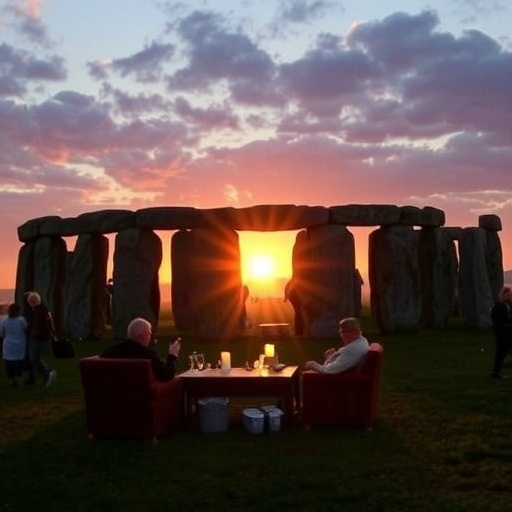
A groundbreaking digital venture has been launched, promising to revolutionize the way the world experiences prehistoric heritage. The Virtual World of Stonehenge, an innovative online platform, allows users globally to immerse themselves in the fascinating history and archaeology surrounding the iconic Stonehenge site. Developed through a collaboration between the University of Reading and the British Museum, this free-to-access digital experience offers unparalleled access to one of the most significant prehistoric collections ever assembled, transcending the limitations of physical museum visits and bringing the past vividly into the present.
Launching precisely on June 21st to coincide with the summer solstice—a date of profound importance to Stonehenge and its cultural legacy—the Virtual World of Stonehenge goes far beyond a traditional replication of the physical exhibition. While the original 2022 British Museum showcase brought together over 400 objects from 36 European institutions and attracted nearly 200,000 visitors, this online experience transcends geographical and physical boundaries. It invites users to explore prehistoric Britain interactively, offering a dynamic temporal dimension where Stonehenge is seen morphing through various epochs, shedding light on its multifaceted evolution and significance.
The project’s technological core lies in its sophisticated use of 3D laser scanning, digital animation, and immersive soundscapes, created by a multidisciplinary team of archaeologists, digital heritage experts, and computer scientists. During the exhibition’s final weeks in 2022, a highly detailed laser scan of the British Museum gallery was captured, serving as the digital blueprint for the virtual environment. These precise measurements ensured every artifact and spatial detail was faithfully rendered, enabling users to navigate authentically within the gallery or step inside reconstructed prehistoric landscapes like the Neolithic flint mines at Grimes Graves.
One of the most compelling features of the Virtual World of Stonehenge is its ability to shed light on nuanced archaeological narratives often missed by conventional displays. The platform highlights lesser-known prehistoric relics such as a 6,000-year-old elm leaf, a delicately woven cow-hair bracelet, and remnants of ancient feasts, employing animation and interactive storytelling to contextualize these objects within the daily lives and rituals of Stonehenge’s ancient communities. This approach not only enhances engagement but fosters a deeper appreciation of the complex social and cultural fabric that shaped prehistoric Britain.
Professor Duncan Garrow of the University of Reading emphasizes the transformative educational potential of the project. By uniting an extraordinary assemblage of artifacts rarely seen together, the Virtual World of Stonehenge offers an immersive learning environment where users can interrogate the intersection between archaeological evidence and lived experience. This digital format allows for multi-sensory exploration—users can observe how the monument aligned with celestial phenomena, hear recreated ambient sounds, and engage with layered historical interpretations, bringing prehistoric Britain to life in a manner previously unachievable in museum contexts.
At the same time, Dr. Neil Wilkin, curator at the British Museum, highlights the project’s forward-thinking implications for museum engagement in the twenty-first century. The initiative serves as a prototype for virtual exhibitions that can extend the reach of cultural institutions globally, fostering inclusivity by making world-class collections accessible regardless of physical or economic barriers. Moreover, the integration of cutting-edge technologies heralds a new era of digital heritage preservation and public archaeology, where virtual experiences can complement and enhance traditional curatorial practices.
Technically, the Virtual World of Stonehenge exemplifies an advanced convergence of archaeological survey methods and digital tools. The laser scanning process produced millions of data points, constructing an ultra-high-resolution 3D model of the gallery space and its constituent objects. This geospatial accuracy underpins the digital environment’s interactivity, allowing users to manipulate views, zoom in on minute details, and gain spatial insights that static images or text-based descriptions cannot offer. Additionally, the underpinning narrative content draws on extensive archaeological research funded by UK Research and Innovation and the Arts and Humanities Research Council, ensuring both scholarly rigor and public accessibility.
The virtual platform’s sound design is equally innovative, using ambient recordings and reconstructed acoustic profiles to immerse visitors in the sensory atmosphere of the prehistoric world. For example, users can experience the atmospheric sounds of the summer solstice sunrise illuminating Stonehenge, or hear the ambient clatter from the flint mines at Grimes Graves, thereby deepening emotional connection and contextual understanding. This multisensory integration reinforces the project’s ambition to be more than a virtual museum tour, positioning it as a holistic archaeological experience harmonizing visual, auditory, and intellectual engagement.
Besides its public and educational impact, the Virtual World of Stonehenge also advances archaeological methodology by providing a scalable model for digital conservation. The high-fidelity digital capture serves as a preservation tool that mitigates risks associated with physical artifact degradation, travel restrictions, or exhibition deinstallations. Institutions across the globe can look to this project as a template for safeguarding and sharing their collections, leveraging virtual reality and interactive media to future-proof cultural heritage—an urgent priority amid climate change, urban development, and other preservation challenges.
Moreover, the project opens exciting avenues for interdisciplinary research by integrating digital humanities, archaeology, and computer science domains. The collaboration between British Museum curators, university archaeologists, and heritage technology firms like ArtasMedia demonstrates an effective alliance between academia and industry. Such partnerships facilitate the application of emerging technologies to solve complex questions about human history, potentially inspiring new methodologies in archaeological visualization, data interpretation, and public outreach that can be adapted to other cultural contexts and time periods.
Crucially, the Virtual World of Stonehenge also taps into the emotive and symbolic power of the site itself. Stonehenge’s exact astronomical alignments during the solstice are reconstructed with scientific precision, allowing users to witness how the monument interacts with the rising sun on this pivotal day. This temporal accuracy does not merely serve aesthetic purposes but conveys the profound cosmological knowledge possessed by its Neolithic and Bronze Age builders, adding layers of meaning to the experience and underscoring the monument’s enduring significance across millennia.
The accessibility of this virtual exhibition across multiple devices—including desktop computers, tablets, and smartphones—ensures that a diverse global audience can engage with Stonehenge’s prehistoric narratives regardless of location or technological proficiency. Such democratization of cultural heritage promotes wider public interest in archaeology while also inspiring future generations of researchers, educators, and enthusiasts. The response to the initial trial phases and media previews has been overwhelmingly positive, pointing to an appetite for more immersive, interactive digital humanities projects that redefine museum experiences.
In conclusion, the Virtual World of Stonehenge stands at the vanguard of a digital revolution in cultural heritage. By bridging meticulous archaeological scholarship with transformative technological innovation, it offers an unprecedented opportunity to explore prehistoric Britain in an expansive, nuanced, and engaging manner. This free, globally accessible experience not only honors Stonehenge’s profound historical legacy but also envisions a future where heritage and technology converge, bringing the deep past into the digital age and captivating audiences worldwide.
News Publication Date:
Sunday, 21 June
Web References:
https://research.reading.ac.uk/british-museum-partnership/world-of-stonehenge/
https://www.cloudtour.tv/the-world-of-stonehenge/
Cite Scienmag News
Courtney Benton. (June 20, 2026). Experience the Magic of Stonehenge from Your Sofa This Solstice. Scienmag. https://scienmag.com/experience-the-magic-of-stonehenge-from-your-sofa-this-solstice/
Courtney Benton. "Experience the Magic of Stonehenge from Your Sofa This Solstice." Scienmag, 20 June 2026, https://scienmag.com/experience-the-magic-of-stonehenge-from-your-sofa-this-solstice/. Accessed 3 September 2026.
Courtney Benton. "Experience the Magic of Stonehenge from Your Sofa This Solstice." Scienmag. June 20, 2026. https://scienmag.com/experience-the-magic-of-stonehenge-from-your-sofa-this-solstice/


