


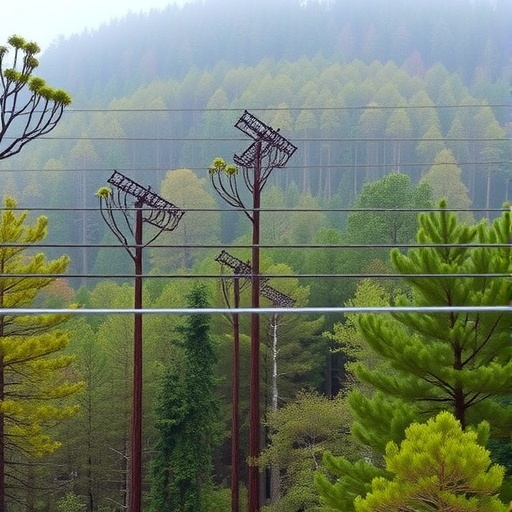
As Earth’s climate system evolves with unprecedented rapidity, forests — vital guardians of global ecological balance — are undergoing complex transformations that extend far beyond the mere sequestration of carbon. Emerging research has begun to unravel the subtle yet profound ways in which climate change reshapes the biophysical interactions between forested landscapes and their surrounding environments, particularly regarding land surface temperature dynamics. A recent groundbreaking study delves deep into these dynamics, revealing starkly contrasting trends that underscore the dualistic nature of forests as climate regulators amidst rising atmospheric dryness. This nuanced revelation challenges long-held assumptions about the uniform benefits of forest cooling and opens new frontiers for understanding ecosystem-climate feedbacks in the Anthropocene.
Forests have long been recognized as crucial climate buffers, primarily through their capacity for carbon storage and evapotranspiration-driven cooling effects. The new research pivots attention to a complementary biophysical mechanism: the difference in growing-season land surface temperature (LST) between forested areas and adjacent open lands, designated as ∆LSTgs. By systematically quantifying ∆LSTgs globally across a span of more than two decades (2001–2023), the researchers uncovered contrasting temporal patterns that vary profoundly with geography and changing atmospheric conditions. Notably, these patterns defy a simplistic narrative of consistent forest cooling, instead revealing a dynamic response heavily modulated by atmospheric humidity levels.
Central to these divergent forest temperature dynamics is the rising vapor pressure deficit (VPD), a measure of atmospheric dryness that quantifies the difference between the amount of moisture in the air and its saturation point. The study identifies VPD as the predominant driver behind the observed variations in ∆LSTgs, exerting a stronger influence than other conventional climatic factors such as temperature, precipitation, or solar radiation. This finding shines light on the critical role that atmospheric moisture stress plays in forest surface energy exchanges, fundamentally altering the cooling potential traditionally attributed to forests under wetter conditions.
However, the forest response to this intensifying atmospheric dryness is far from uniform across global biomes. The research highlights a pivotal interaction between VPD fluctuations and plant hydraulic traits, particularly stomatal regulation strategies embodied by anisohydricity, a measure of plants’ ability to regulate water loss through stomata under drought stress. Forests exhibiting high anisohydricity maintain more open stomata even under dry conditions, enabling continued transpiration and evaporative cooling but at increased risk of hydraulic failure. In contrast, isohydric forests tightly conserve water by closing stomata earlier, reducing cooling at the leaf surface.
Intriguingly, this stomatal regulatory behavior correlates with latitude, delineating distinct forest cooling trajectories. Tropical forests near the equator tend to display more isohydric characteristics. Here, rising VPD often surpasses the hydraulic safety threshold of these ecosystems, leading to stomatal closure and a consequent weakening of forest cooling effects. This trend portends a diminished capacity of tropical forests to mitigate local heating as atmospheric dryness intensifies, potentially accelerating heat stress on these already vulnerable ecosystems.
Conversely, high-latitude forests manifest a more anisohydric strategy, maintaining open stomata under increasing VPD levels that nonetheless remain within their hydraulic safety margins. As a result, these boreal and temperate forests continue to sustain transpiration-driven cooling, which paradoxically intensifies with rising VPD. This phenomenon enhances the biophysical benefits of northern forests, amplifying their role as regional climate coolants and underscoring the heterogeneous nature of forest climate feedbacks across latitudes.
This nuanced physiological interplay yields profound implications regarding future forest-climate interactions under global warming. It underscores that elevated atmospheric dryness will not only influence ecosystem carbon dynamics but also significantly alter the biophysical feedback mechanisms by which forests regulate surface temperatures. As VPD continues to climb worldwide, the traditional ecological services of forests, particularly their cooling benefits, may become compromised in many parts of the globe, particularly within tropical zones critical for biodiversity and global climate regulation.
Moreover, the study’s integrative approach—which combines satellite observations of surface temperature with detailed climatological measurements and physiological trait data—provides a comprehensive framework to understand how climatic stressors mediate forest cooling effects. By leveraging large-scale data spanning two decades, the researchers offer robust evidence that forest cooling is not static but dynamically contingent on complex interactions among atmospheric moisture, plant hydraulics, and geographic distribution, emphasizing the need for ecosystem-specific climate mitigation strategies.
The findings challenge the prevailing optimism about forests’ capacity to offset warming through biophysical means alone. In vulnerable tropical regions, the erosion of cooling benefits linked to stomatal closure under heightened VPD may exacerbate heat stress, increase fire risk, and undermine forest resilience. This could trigger feedback loops accelerating tropical forest degradation and amplifying global warming, raising alarm over the future of these essential carbon sinks.
Conversely, the sustained or even enhanced cooling in high-latitude forests might partially offset regional warming trends, but the balance of such compensatory effects at the global scale remains uncertain. These complexities highlight an urgent need to integrate physiological and biophysical forest attributes into predictive climate models, allowing for more accurate assessments of forest contributions to local and global temperature regulation.
Crucially, the research points to the hydraulic safety margin as a vital threshold parameter dictating the tipping points at which forests transition from cooling to warming agents. This insight offers potential pathways for management interventions aimed at bolstering forest hydraulic resilience, such as selective species planting or conservation strategies tailored to optimize ecosystem-level responses to rising VPD.
In a broader context, the study underscores that atmospheric dryness—often overshadowed by temperature-centric perspectives on climate change—constitutes a formidable and multifaceted challenge for forest ecosystems worldwide. Rising VPD alters not only physiological processes at the leaf level but also cascades through landscape-scale energy budgets, with cascading impacts on regional climate patterns, hydrology, and ecosystem services.
As the global community contemplates reforestation and afforestation policies as climate mitigation tools, these findings call for a recalibrated understanding that accounts for the limits imposed by plant hydraulic behavior and atmospheric moisture constraints. The simplistic paradigm of “more trees equal cooler climate” must evolve into a sophisticated appreciation of when, where, and how forest ecosystems can be expected to maintain their biophysical cooling contributions in a drying and warming world.
Ultimately, this pioneering research adds a critical dimension to our grasp of climate-vegetation feedbacks, illuminating the complex, sometimes counterintuitive outcomes of drying atmospheres on forested landscapes. By highlighting the paramount role of VPD and stomatal regulation across global latitudinal gradients, it informs the scientific community, policymakers, and conservationists alike about the nuanced realities shaping the future of Earth’s green lungs and their vital climate services.
Understanding these relationships better will be indispensable to crafting adaptable and resilient conservation strategies capable of sustaining the biophysical cooling functions of forests. The study’s revelations lay groundwork for future research probing genetic, species-specific, and ecosystem-level hydraulic traits, as well as remote sensing advancements to monitor forest physiological stress and energy exchanges in real time under changing climates.
As atmospheric dryness intensifies in the coming decades, the fate of forests as biophysical climate modulators will hinge on the delicate balance between environmental stressors and intrinsic plant water regulation mechanisms. This research presents an urgent clarion call to incorporate these intricate biophysical and physiological insights into forest management and climate policy frameworks, lest the cooling benefits of the planet’s forests risk becoming relics of a less-dry past.
Cite Scienmag News
Sloane Callahan. (June 17, 2026). Forests’ Cooling Power Limited by Rising Dryness. Scienmag. https://scienmag.com/forests-cooling-power-limited-by-rising-dryness/
Sloane Callahan. "Forests’ Cooling Power Limited by Rising Dryness." Scienmag, 17 June 2026, https://scienmag.com/forests-cooling-power-limited-by-rising-dryness/. Accessed 4 September 2026.
Sloane Callahan. "Forests’ Cooling Power Limited by Rising Dryness." Scienmag. June 17, 2026. https://scienmag.com/forests-cooling-power-limited-by-rising-dryness/


