


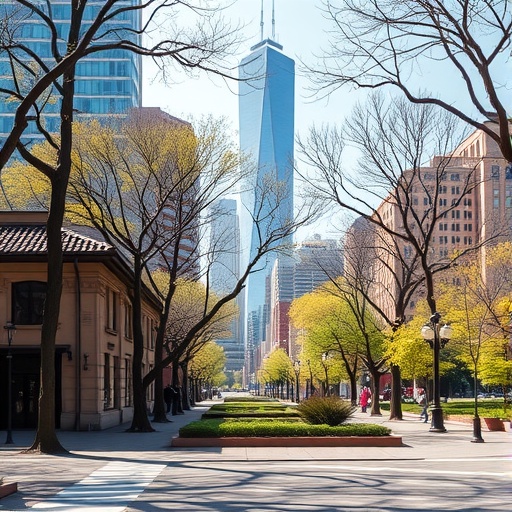
Urban parks are emerging as critical assets in the global fight against the escalating challenges posed by urban heat, pollution, and noise. Groundbreaking research led by the University of Surrey’s Global Centre for Clean Air Research (GCARE) reveals the multifaceted benefits these green spaces offer within city environments, highlighting their indispensable role in fostering climate resilience and enhancing urban livability. This study harnessed high-frequency environmental monitoring to deliver unprecedented insights into how urban parks mitigate the deleterious effects of a rapidly changing climate on city dwellers and their surroundings.
The research, published in the esteemed journal City and Environment Interactions, was conducted in Stoke Park—the largest green sanctuary in Guildford, Surrey, encompassing an expansive 52 hectares of grasslands, abundant tree cover, and immaculately maintained gardens. This location provided an ideal natural laboratory to analyze spatial variations in temperature, particulate matter pollution, and ambient noise levels, comparing the park’s interior with adjacent urban settings in real time over the course of a summer season.
One of the most striking findings pertains to PM10 concentrations, which denote particulate matter measuring less than 10 micrometers in diameter. These particles are notorious for penetrating deep into the respiratory system, triggering and exacerbating a host of cardiovascular and pulmonary diseases. The study’s measurements identified that within the shaded confines of Stoke Park, PM10 levels were over 11 percent lower during morning hours relative to nearby built-up streets. This significant reduction underscores the critical air purification function parks serve, particularly in urban environments inundated with vehicular and industrial emissions.
Thermal regulation emerged as another compelling advantage of urban parks. Morning temperatures inside Stoke Park dropped by an average of 6.5 percent compared with surrounding urban areas, a statistically robust difference with important implications for mitigating urban heat island effects. Throughout daylight hours, the park consistently maintained cooler ambient temperatures, often several degrees lower than the neighboring urban fabric. Remarkably, this cooling influence extended beyond the park’s borders; for every 100 meters moving into the built environment, temperatures rose by more than half a degree Celsius up to 300 meters away, indicating a tangible microclimatic buffering effect that parks impart on adjacent neighborhoods.
Noise pollution, an often-overlooked environmental stressor linked to increased psychological distress and cardiovascular risk, also diminished within the park environment. Measurements revealed a steady downward trend in decibel levels with increasing distance from major roadways. Specifically, there was a 5.41 dB reduction in noise inside Stoke Park areas, a difference perceptible to the human ear and likely to translate into improved well-being for park visitors and local residents alike. These findings contribute valuable empirical evidence to urban acoustic ecology and its intersection with public health.
Professor Prashant Kumar, the founding director of GCARE and the study’s lead author, emphasized the broader urban planning and policy relevance of these results. He noted that the empirical data unequivocally confirms parks’ capacity to effectuate meaningful reductions in heat, air contaminants, and noise exposure, which are crucial determinants of urban health and sustainability. This evidence base empowers city planners and decision-makers to integrate green infrastructure as a cornerstone of climate-adaptive urban design strategies.
Further delving into the nuances of park microclimates, the study also quantified thermal comfort through the Physiologically Equivalent Temperature (PET) metric—a sophisticated composite index that accounts not only for air temperature but also humidity, wind speed, and radiant heat, thus approximating human thermal sensation. Within tree-shaded zones and grasslands of Stoke Park, PET values were reduced by as much as 8.5 degrees Celsius compared to adjacent paved, built-up streets. This stark difference elucidates how strategic vegetation and landscape management can mitigate heat stress, especially during peak temperature episodes, offering reprieve to vulnerable groups such as the elderly and those with chronic health conditions.
Postgraduate researcher Soheila Khalili, co-author of the study, underscored the criticality of understanding these park effects in the context of accelerating climate change. As urban centers grapple with increasingly frequent and intense heatwaves, coupled with deteriorating air quality, the explicit characterization of how urban green spaces function as environmental buffers provides a scientific foundation for enhancing urban resilience. Khalili highlighted that the benefits observed extend well beyond park boundaries, effectively shaping microclimates and environmental quality in adjoining urban habitats, a finding that could inform the distribution and design of green spaces to maximize ecological and human health outcomes.
The methodology underpinning this study involved continuous, high-resolution environmental monitoring equipment, enabling the researchers to capture the dynamic interactions between natural elements and urban infrastructure throughout diurnal and seasonal cycles. This granular approach represents a significant advancement over traditional point-in-time sampling, lending robustness and practical relevance to the findings. The integrated assessment—encompassing thermal, particulate, and acoustic parameters—epitomizes a holistic paradigm essential for tackling the multiplex nature of urban environmental challenges.
From a policy perspective, this research offers actionable intelligence that can inform zoning laws, urban redevelopment projects, and climate adaptation frameworks. The evidence supports prioritizing the preservation and creation of urban parks as multipurpose green lungs that not only improve air quality and reduce noise but also stave off thermal extremes, helping cities to meet obligations under international climate and health accords. Moreover, the study encourages multidisciplinary collaboration, combining urban ecology, environmental engineering, public health, and social sciences to cultivate resilient and equitable urban futures.
The investigation was conducted as part of the GreenCities project, a collaborative international initiative supported by NERC-FAPESP. It builds upon a lineage of studies led by Professor Kumar’s GCARE team under the auspices of the UK’s Research and Innovation funding councils, including the RECLAIM Network Plus and GP4Streets projects. This body of work collectively advances the frontier of knowledge surrounding urban environmental health, offering a compelling scientific foundation to leverage the protective capacities of urban nature.
In conclusion, this landmark study decisively quantifies the benefits of urban parks, validating their vital role in mitigating urban heat, curbing particle pollution, and dampening noise pollution. It expands our understanding of green infrastructure as a multidimensional solution to some of the most pressing environmental health issues faced by cities today. As global urban populations continue to swell amid climate uncertainties, such evidence-based research provides the impetus and justification for embedding parks within the fabric of sustainable, healthy, and climate-resilient urban development.
News Publication Date: 10 June 2026
Web References:
https://doi.org/10.1016/j.cacint.2026.100407
References:
Khalili, S., Jones, L., Sebastian Pfautsch, S., Kumar, P., 2026. Quantifying the benefits of parks for mitigating heat, air and noise pollution to inform climate-resilient planning. City and Environment Interactions, 31, 100407.
Cite Scienmag News
Russell Cooper. (June 15, 2026). Study Reveals Parks Cool Neighborhoods and Reduce Pollution Hundreds of Meters Beyond Their Borders. Scienmag. https://scienmag.com/study-reveals-parks-cool-neighborhoods-and-reduce-pollution-hundreds-of-meters-beyond-their-borders/
Russell Cooper. "Study Reveals Parks Cool Neighborhoods and Reduce Pollution Hundreds of Meters Beyond Their Borders." Scienmag, 15 June 2026, https://scienmag.com/study-reveals-parks-cool-neighborhoods-and-reduce-pollution-hundreds-of-meters-beyond-their-borders/. Accessed 4 September 2026.
Russell Cooper. "Study Reveals Parks Cool Neighborhoods and Reduce Pollution Hundreds of Meters Beyond Their Borders." Scienmag. June 15, 2026. https://scienmag.com/study-reveals-parks-cool-neighborhoods-and-reduce-pollution-hundreds-of-meters-beyond-their-borders/


