


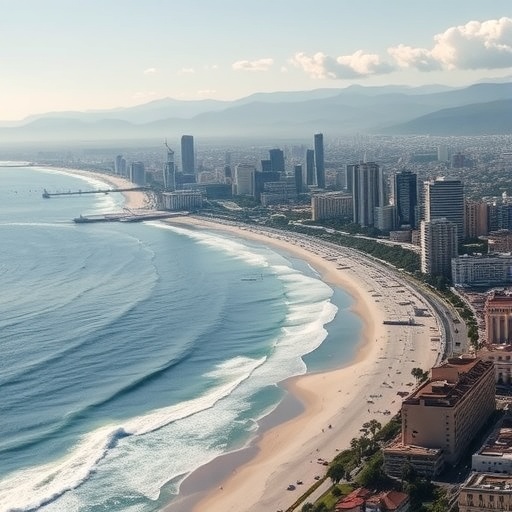
In a groundbreaking study that bridges atmospheric science and urban environmental health, researchers at the Institute of Environmental Science and Technology of the Universitat Autònoma de Barcelona (ICTA-UAB) have unveiled alarming projections about the future interplay of climate change, coastal meteorology, and air pollution in the Barcelona metropolitan area. Using sophisticated high-resolution climate modeling, the study forecasts significant alterations in the behaviour of sea and land breezes by the years 2050 and 2100, with cascading consequences for air quality and public health across this densely populated coastal region.
The complex dynamics that govern sea and land breezes in coastal cities like Barcelona hinge upon the differential heating between the land and the adjacent sea surface. Under stable current climatic conditions, these breezes serve as crucial natural ventilation mechanisms, dispersing accumulated air pollutants and thus acting as a protective buffer against urban smog and associated health hazards. However, the findings from this study suggest that anthropogenic climate change will disrupt these natural patterns, leading to intensified stagnation zones where air pollutants may become trapped over the coastal urban sprawl.
By leveraging cutting-edge atmospheric simulation tools and climate scenario data consistent with the latest IPCC pathways, the researchers accomplished a granular temporal and spatial analysis of meteorological shifts under progressive warming trends. Their models predict a pronounced weakening of the coastal ventilation effect typically induced by robust sea breezes during the warmer months, primarily due to the elevated temperatures over both land and sea surfaces altering pressure gradients that drive these local winds.
This attenuation of sea breeze intensity is particularly troubling as it compromises the natural flushing mechanism that historically maintained acceptable levels of air pollutants such as nitrogen oxides (NOx), particulate matter (PM2.5 and PM10), ozone, and other hazardous compounds emitted by traffic, industrial activity, and residential sources. The study’s projections reveal that the diminished air flow will exacerbate the accumulation of these toxic substances, effectively “trapping” them in the urban canopy, particularly in low-lying coastal districts where large portions of Barcelona’s population reside.
Moreover, the researchers detail a parallel intensification of nocturnal land breezes, which in synergy with a reduction in daytime sea breeze activity, could foster diurnal cycles of pollutant concentration fluctuations that are more extreme than previously observed. This cyclical entrapment of pollutants leads to prolonged exposure periods with heightened health implications, including respiratory and cardiovascular diseases, increased asthma incidence, and overall elevated morbidity rates.
From a meteorological perspective, the study also elucidates the mechanistic reasons behind these future shifts. The warming of the sea surface temperature (SST) under climate change scenarios decreases the land-sea temperature contrast—a critical driver for generating sea breeze circulation. Additionally, elevated atmospheric stability conditions limit vertical mixing, further preventing the dispersion of pollutants away from the human breathing zone. These factors coalesce to generate a less ventilated coastal atmosphere vulnerable to pollution build-up.
The use of ultra-fine spatial resolution in the models—down to the scale of individual city neighbourhoods—affords unprecedented insights into localized variations in future air quality patterns. This granularity enables public health planners and urban policymakers to anticipate not only broad regional impacts but also neighborhood-specific vulnerabilities, empowering targeted mitigation interventions. For example, areas with lower natural ventilation combined with higher emissions could become pollution “hotspots,” necessitating stricter emission controls and urban design modifications.
Importantly, the study’s temporal scope extends far beyond mid-century, encompassing projections for the turn of the century (2100), thereby providing a long-term vision of climate-induced challenges that will test the resilience of coastal megacities globally. Barcelona, emblematic of many Mediterranean and global cities bordering seas, serves as a critical case study illustrating the complex feedback loops between climate change, urban meteorology, and environmental health.
The implications of these findings resonate across multiple domains of urban sustainability. Besides direct health consequences, elevated pollutant concentrations influence economic productivity through increased medical costs and lost workdays. They also stress the urgency of integrating adaptive urban planning with climate mitigation efforts. Enhancing green infrastructure, optimizing traffic flows, and deploying air quality monitoring networks become non-negotiable strategies in confronting the forecasted air quality challenges.
Beyond Barcelona, the scientific framework and modeling techniques developed by the ICTA-UAB team offer a replicable template for other coastal cities worldwide facing similar climate-induced meteorological transitions. Coastal megacities from Los Angeles to Mumbai, Sydney to Durban, could benefit immensely from predictive diagnostics of local breeze behaviours under varied warming scenarios, fortifying their preparedness for an uncertain climatic future.
Simultaneously, this research underscores the pressing need for global climate mitigation to avoid surpassing warming thresholds that exacerbate these localized but significant health risks. The study acts as a clarion call to policymakers emphasizing that greenhouse gas emissions reduction is integral not only to preserving natural ecosystems but also to protecting millions of urban inhabitants from escalating air pollution burdens linked to altered wind patterns.
In conclusion, the ICTA-UAB study compellingly illustrates that climate change’s influence on the dynamics between sea and land breezes will profoundly affect air quality in Barcelona, trapping pollutants and escalating health risks for millions. This nexus of atmospheric science, urban health, and climate change adaptation highlights both the urgency and complexity of developing resilient strategies for future coastal cities around the globe.
News Publication Date:
Not specified.
Web References:
Not specified.
References:
Not specified.
Cite Scienmag News
Russell Cooper. (June 11, 2026). Climate Change to Disrupt Sea-Land Breeze Patterns and Accelerate Ozone Pollution in Barcelona. Scienmag. https://scienmag.com/climate-change-to-disrupt-sea-land-breeze-patterns-and-accelerate-ozone-pollution-in-barcelona/
Russell Cooper. "Climate Change to Disrupt Sea-Land Breeze Patterns and Accelerate Ozone Pollution in Barcelona." Scienmag, 11 June 2026, https://scienmag.com/climate-change-to-disrupt-sea-land-breeze-patterns-and-accelerate-ozone-pollution-in-barcelona/. Accessed 5 September 2026.
Russell Cooper. "Climate Change to Disrupt Sea-Land Breeze Patterns and Accelerate Ozone Pollution in Barcelona." Scienmag. June 11, 2026. https://scienmag.com/climate-change-to-disrupt-sea-land-breeze-patterns-and-accelerate-ozone-pollution-in-barcelona/


