


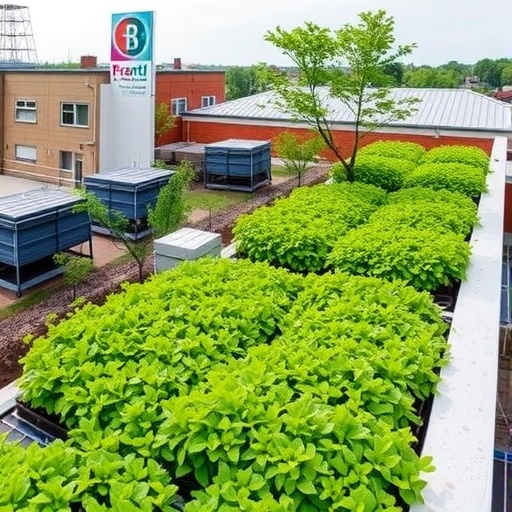
Biochar is emerging as a surprising lever for tackling one of climate science’s trickiest problems: methane (CH₄). Unlike carbon dioxide, methane acts as a powerful short-term greenhouse gas, and its exchange in urban systems such as green roofs has been poorly quantified. New field results suggest that engineered green roof substrates can be tuned to act as stronger methane sinks through the addition of biochar.
Researchers at the University of Toronto’s Green Roof Innovation Testing Laboratory (GRIT Lab II) ran a five-year study spanning 2020–2024 to evaluate how biochar amendments alter CH₄, CO₂, and water vapor fluxes. The experiment compared modules amended with roughly 5% (v/v) biochar against unamended controls, measuring gas exchange across multiple seasons and years.
The headline finding is clear: biochar-amended modules consistently absorbed substantially more methane than controls throughout every season. During spring 2023, methane uptake approached −1.91 ± 0.25 nmol·m⁻²·s⁻¹ in biochar treatments, versus −0.40 ± 0.10 nmol·m⁻²·s⁻¹ in the control plots. That scale of improvement indicates a robust enhancement rather than a short-lived anomaly.
Crucially, the added methane drawdown did not coincide with elevated carbon dioxide emissions. This decoupling points to a net positive shift in gaseous carbon balance, strengthening the case that biochar can improve climate outcomes without simply transferring emissions to CO₂.
The mechanism appears to center on hydrology and microclimate. Analyses using structural equation modeling linked higher CH₄ uptake to biochar’s ability to retain moisture within the substrate. By stabilizing moisture conditions, biochar likely promotes aerobic “microsites” where methane-oxidizing microbes can function efficiently.
Those moisture effects, combined with biochar’s porous structure and surface chemistry, may enhance gas diffusivity and provide durable habitats for methanotrophs. In turn, CH₄ is more effectively converted to CO₂ at the microbial interface.
The practical implication is significant for cities. Reported methane uptake rates surpass values commonly reported for many soils and urban substrates, suggesting that biochar-enhanced green roofs could become meaningful methane mitigation infrastructure alongside their established stormwater and energy benefits.
While the study focused on a single biochar type and dose, it opens a roadmap for future work: testing dose–response relationships across feedstocks and pyrolysis conditions, mapping microbial community dynamics, and evaluating performance in native-plant green roof designs.
News Publication Date:
20-Jul-2026
Web References:
http://dx.doi.org/10.1007/s44246-026-00296-y
References:
10.1007/s44246-026-00296-y
Cite Scienmag News
Russell Cooper. (July 27, 2026). Biochar Makes Green Roofs Potent Methane Sinks. Scienmag. https://scienmag.com/biochar-makes-green-roofs-potent-methane-sinks/
Russell Cooper. "Biochar Makes Green Roofs Potent Methane Sinks." Scienmag, 27 July 2026, https://scienmag.com/biochar-makes-green-roofs-potent-methane-sinks/. Accessed 4 September 2026.
Russell Cooper. "Biochar Makes Green Roofs Potent Methane Sinks." Scienmag. July 27, 2026. https://scienmag.com/biochar-makes-green-roofs-potent-methane-sinks/


