


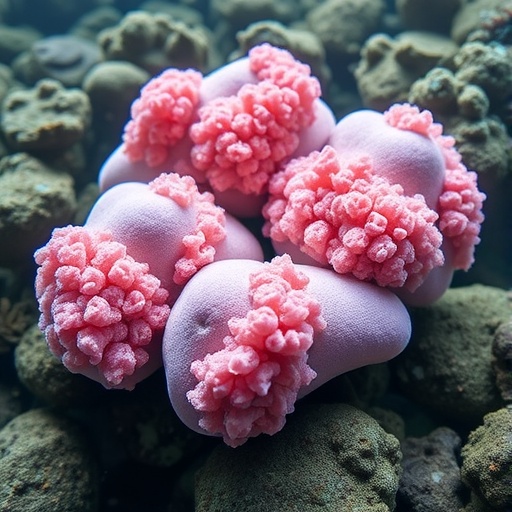
Beneath the serene waters off Japan’s Tanegashima Island lies a remarkable and largely unexplored marine ecosystem that challenges our understanding of underwater biodiversity. This ecosystem is formed by rhodoliths—pebble-like nodules that may superficially resemble small rocks scattered on the ocean floor, yet are in fact living aggregates of calcifying red algae. These coralline algae play a crucial ecological role by creating habitats that support diverse marine life and significantly contribute to long-term carbon sequestration in marine sediments, a process of growing importance in the context of climate change research.
Recent groundbreaking research conducted by a team from Hiroshima University has revealed an astonishingly diverse community of rhodolith-forming coralline algae in the mesophotic zone of Tanegashima Island waters, at depths between 35 and 38 meters. Their study identified at least twelve distinct species in a relatively small seafloor area, including four species entirely new to science. This finding not only underscores the remarkable biodiversity hidden beneath the ocean’s surface but also emphasizes how coral-algal communities vary dramatically with depth, revealing distinct biological assemblages that are not mere extensions of shallower ecosystems.
The islands off Kagoshima Prefecture—including Tanegashima—are uniquely positioned at the junction of dynamic oceanographic and geological influences. The warm and nutrient-rich Kuroshio Current flows past Tanegashima, while the complex seabed topography creates a range of habitats across depth gradients. These factors create an exceptional environment for algal diversity, particularly within the mesophotic zone, which spans depths from roughly 30 to 150 meters and receives limited, low-intensity light. This zone has historically been understudied due to the challenges of sampling at such depths, leaving a significant gap in knowledge about its biological inhabitants.
Employing meticulous scientific methods, the research team collected rhodolith samples through seafloor dredging across two separate sites approximately 10 kilometers off the island’s western shore. Samples were preserved at subzero temperatures and later subjected to rigorous genetic and morphological analyses. By sequencing key chloroplast genes—psbA and rbcL—and the mitochondrial COI-5P gene, they were able to construct detailed phylogenetic trees that elucidated the evolutionary relationships among species. Morphological examinations, including light and scanning electron microscopy, further supplemented genetic data, confirming the discovery of four previously undescribed coralline algal species.
These new species were formally named Orientalilithon compactum, Roseolithon aggregatum, Roseolithon sparsituberculatum, and Sporolithon variotuberculatum. The detailed description of Orientalilithon compactum is particularly noteworthy; it constitutes the first-ever account elucidating both male and female reproductive structures within the Orientalilithon genus. This contributes fundamental taxonomic knowledge that is essential for understanding reproductive biology and species differentiation in these calcifying algae.
The discovery of these novel species signifies more than just an expansion of taxonomic records. It illustrates the critical importance of combining molecular genetics with traditional morphological taxonomy to accurately classify and understand marine biodiversity. Associate Professor Aki Kato from Hiroshima University highlights how taxonomy is vital not only for naming species but also for revealing evolutionary and ecological relationships that refine our broader comprehension of marine ecosystems.
One of the most striking revelations of this study is the distinct species composition variation between shallow and deeper rhodolith beds. While the study identified 12 species in the mesophotic rhodolith beds, only three were shared with rhodoliths found in the adjacent 1-meter shallow waters. This contrasts sharply with observations in fleshly red algae (non-calcifying species) in the same region, where approximately 80% of mesophotic species are found in shallower waters as well. Such stark differences imply that environmental variables—such as light availability, water temperature, and ecological interactions—create unique and isolated niches that shape the distribution patterns of coralline algae differently from other algal forms.
The researchers hypothesize that the exceptional diversity and abundance of coralline algae in the mesophotic environment off Tanegashima may be linked to the warmer seawater temperatures near the seafloor and the clear waters allowing sunlight to penetrate deeper. These conditions could facilitate photosynthesis and calcification even in low-light environments, supporting vibrant communities that have evolved unique adaptations to thrive in these depths.
Looking forward, the team aims to investigate whether the four new species are endemic—exclusively native—to Tanegashima Island or possess broader distributions in neighboring submerged locales. Such molecular assessments will be crucial to understanding species dispersal, biogeography, and potential vulnerability to environmental change. Simultaneously, the extent and density of rhodolith beds in the area remain poorly quantified, an important gap given rhodoliths’ ecological significance and carbon storage potential.
Associate Professor Kato stresses the ongoing need for integrated molecular and morpho-anatomical analyses to reassess Japanese coralline algal biodiversity comprehensively. Worldwide, over 700 species of coralline algae have been documented, but many classifications rely solely on morphological traits without genetic confirmations. This can obscure true species diversity and evolutionary relationships, underscoring the importance of comprehensive approaches that encompass both genetic and anatomical data.
Beyond taxonomy, the study raises significant ecological implications. Rhodolith beds form some of the largest seaweed habitats in marine ecosystems and serve as biodiversity hotspots. Their calcium carbonate structures not only provide nursery grounds and refuges for various marine organisms but also act as carbon sinks, modulating ocean chemistry and mitigating climate impacts. Understanding how these communities respond to changing conditions — including ocean warming, acidification, and human-induced disturbances — is vital for developing effective marine conservation strategies.
This pioneering investigation by Hiroshima University scientists opens a new chapter in marine phycology by unveiling the rich yet cryptic biodiversity of mesophotic rhodolith beds in subtropical Japan. It calls for intensified exploration of mesophotic zones globally, which may harbor untapped biological treasures with profound ecological and climate relevance. Ultimately, such discoveries remind us that beneath the waves, much remains hidden, awaiting scientific illumination to deepen our understanding of life’s diversity and resilience on Earth.
News Publication Date: 13-May-2026
Web References: https://doi.org/10.1111/jpy.70176
Cite Scienmag News
Violet Maxwell. (June 9, 2026). Scientists Discover 4 New Species of Underwater ‘Living Pink Rocks’ That Help Store Carbon. Scienmag. https://scienmag.com/scientists-discover-4-new-species-of-underwater-living-pink-rocks-that-help-store-carbon/
Violet Maxwell. "Scientists Discover 4 New Species of Underwater ‘Living Pink Rocks’ That Help Store Carbon." Scienmag, 9 June 2026, https://scienmag.com/scientists-discover-4-new-species-of-underwater-living-pink-rocks-that-help-store-carbon/. Accessed 4 September 2026.
Violet Maxwell. "Scientists Discover 4 New Species of Underwater ‘Living Pink Rocks’ That Help Store Carbon." Scienmag. June 9, 2026. https://scienmag.com/scientists-discover-4-new-species-of-underwater-living-pink-rocks-that-help-store-carbon/


