

Monday, July 27, 2026
Science
No Result
View All Result
  • Login
  • HOME
  • SCIENCE NEWS
  • CONTACT US
  • HOME
  • SCIENCE NEWS
  • CONTACT US
No Result
View All Result
Scienmag
No Result
View All Result
Home Science News Marine

Experienced Captains Face Conventional AI as Autonomous Navigation Charts a New Course

July 27, 2026
in Marine
Reading Time: 2 mins read
0
Experienced Captains Face Conventional AI as Autonomous Navigation Charts a New Course

Experienced Captains Face Conventional AI as Autonomous Navigation Charts a New Course

65
SHARES
587
VIEWS
Share on FacebookShare on Twitter
ADVERTISEMENT

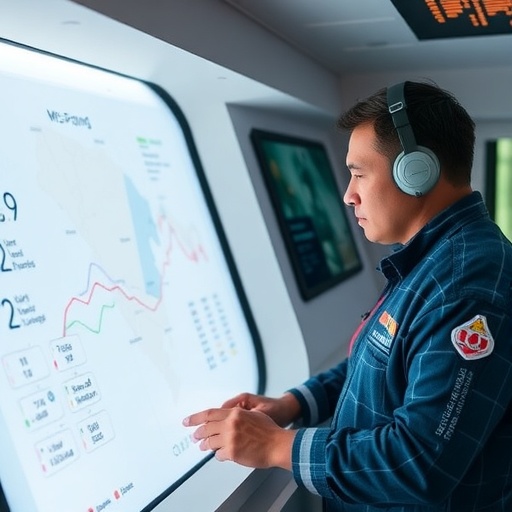
Teaching an AI to navigate a ship is turning out to be a far tougher problem than teaching it to drive a car. In places like Japan’s Seto Inland Sea, vessels must thread narrow channels crowded with ships, negotiate hundreds of islands, react to shifting conditions, and follow international navigation rules—even when the “right” move involves human judgment.

To tackle this, researchers led by Assistant Professor Takefumi Higaki at Osaka Metropolitan University built an autonomous ship-navigation system using a new training strategy. Rather than programming explicit objectives or balancing safety, efficiency, and rule compliance by hand, they learned behavior from real vessel operations.

Their approach centers on a “diffusion AI” route planner trained on maneuvers performed by the training ship Fukae-Maru from Kobe University. Instead of predicting a single optimal action in each moment, diffusion-based decision-making generates a distribution of plausible human-like trajectories, then synthesizes a whole route that respects the complex constraints of maritime navigation.

The team evaluated the model against two state-of-the-art navigation AIs that rely on conventional machine-learning with imitation learning. In confusing encounter scenarios, the diffusion AI handled uncertainties more effectively, while still managing arbitrary numbers of nearby ships, coastlines, narrow waterways, and speed control in realistic simulations.

When the researchers ran ship encounter tests, the AI consistently complied with international collision-avoidance regulations, maintaining safe separation distances rather than taking risky shortcuts. This behavior emerged without explicitly encoding a multi-objective trade-off in the model design.

Even more striking, as training progressed the AI developed unexpected “local custom” behaviors that were not explicitly programmed. For example, when passing through the Akashi Kaikyo Traffic Route, where vessels keep right inside designated lanes, the system repeatedly aligned itself with the correct lane.

According to Dr. Higaki, the standout feature is that the model was not forced to explicitly optimize a list of competing goals. Instead, it implicitly learned sophisticated ship-handling skills directly from operational data. The result is a framework that can reduce the manual burden of defining what “correct” behavior looks like.

With more real-world navigation data becoming available, such autonomous systems could spread in the same way AI-driven cars did—improving maritime safety and helping address growing labor shortages in the shipping industry, especially in Japan.

The study was published in Ocean Engineering on 21-Apr-2026.

Image Credits: Osaka Metropolitan University

Keywords: autonomous ship navigation, diffusion AI, collision-avoidance, maritime safety, imitation learning, trajectory planning

Tags: AI decision-making in complex waterwaysAI handling maritime navigation uncertaintiesAI route planning for shipsAutonomous maritime navigationautonomous ship navigation challengesdiffusion AI in ship navigationmachine learning in maritime industrymaritime safety and efficiencynavigation rule compliance AIobstacle avoidance in autonomous shipsreal-world vessel operation dataship navigation system developmentsimulation-based evaluation of autonomous ships
Share26Tweet16
Previous Post

Drosophila Study Reveals Global Molecular Code Linking Birth Order to Neurons

Next Post

New Snail Species Strengthens Montenegro Biodiversity Protection Case

Related Posts

Engineered Triangular Pockets Efficiently Extract Uranyl Complexes from Water
Marine

Engineered Triangular Pockets Efficiently Extract Uranyl Complexes from Water

July 27, 2026
Coral’s Swiss Army Knife: How Cilia Enable Multiple Functions
Marine

Coral’s Swiss Army Knife: How Cilia Enable Multiple Functions

July 27, 2026
Empty seashells evolved into new habitats 470 million years ago
Marine

Empty seashells evolved into new habitats 470 million years ago

July 27, 2026
Great Barrier Reef Hosts Its Own Diverse Microbiome
Marine

Great Barrier Reef Hosts Its Own Diverse Microbiome

July 27, 2026
Marine Heatwaves Extend and Intensify, New Study Finds More Extreme Reality
Marine

Marine Heatwaves Extend and Intensify, New Study Finds More Extreme Reality

July 27, 2026
Orcas filmed exploding a giant fish after ramming it with force, possibly playing
Marine

Orcas filmed exploding a giant fish after ramming it with force, possibly playing

July 27, 2026
Next Post
New Snail Species Strengthens Montenegro Biodiversity Protection Case

New Snail Species Strengthens Montenegro Biodiversity Protection Case

  • Mothers who receive childcare support from maternal grandparents show more

    Mothers who receive childcare support from maternal grandparents show more parental warmth, finds NTU Singapore study

    27656 shares
    Share 11059 Tweet 6912
  • University of Seville Breaks 120-Year-Old Mystery, Revises a Key Einstein Concept

    1061 shares
    Share 424 Tweet 265
  • Bee body mass, pathogens and local climate influence heat tolerance

    682 shares
    Share 273 Tweet 171
  • Researchers record first-ever images and data of a shark experiencing a boat strike

    546 shares
    Share 218 Tweet 137
  • Groundbreaking Clinical Trial Reveals Lubiprostone Enhances Kidney Function

    531 shares
    Share 212 Tweet 133
Science

Embark on a thrilling journey of discovery with Scienmag.com—your ultimate source for cutting-edge breakthroughs. Immerse yourself in a world where curiosity knows no limits and tomorrow’s possibilities become today’s reality!

RECENT NEWS

  • Boosting antitumor immunity by triggering cancer cell pyroptosis
  • Pusan National University Scientists Create Smart Adaptive Vibration Isolator System
  • Self-Sampling Boosts HPV Detection and Increases Cervical Cancer Screening Rates
  • Real-Time Laser Ablation Monitoring Detects Wafer Penetration via Recoil Force

Categories

  • Agriculture
  • Anthropology
  • Archaeology
  • Athmospheric
  • Biology
  • Biotechnology
  • Blog
  • Bussines
  • Cancer
  • Chemistry
  • Climate
  • Earth Science
  • Editorial Policy
  • Marine
  • Mathematics
  • Medicine
  • Pediatry
  • Policy
  • Psychology & Psychiatry
  • Science Education
  • Social Science
  • Space
  • Technology and Engineering

Subscribe to Blog via Email

Enter your email address to subscribe to this blog and receive notifications of new posts by email.

Join 5,146 other subscribers

© 2025 Scienmag - Science Magazine

Welcome Back!

Login to your account below

Forgotten Password?

Retrieve your password

Please enter your username or email address to reset your password.

Log In
No Result
View All Result
  • HOME
  • SCIENCE NEWS
  • CONTACT US

© 2025 Scienmag - Science Magazine

Discover more from Science

Subscribe now to keep reading and get access to the full archive.

Continue reading
