

Monday, August 17, 2026
Science
No Result
View All Result
  • Login
  • HOME
  • SCIENCE NEWS
  • CONTACT US
  • HOME
  • SCIENCE NEWS
  • CONTACT US
No Result
View All Result
Scienmag
No Result
View All Result
Home Science News Medicine

Cytokine-Expanded Memory NK Cells Show Metabolic and Epigenetic Reprogramming and Persistence

July 27, 2026
in Medicine
Reading Time: 2 mins read
0
Cytokine-Expanded Memory NK Cells Show Metabolic and Epigenetic Reprogramming and Persistence

Cytokine-Expanded Memory NK Cells Show Metabolic and Epigenetic Reprogramming and Persistence

65
SHARES
587
VIEWS
Share on FacebookShare on Twitter
ADVERTISEMENT

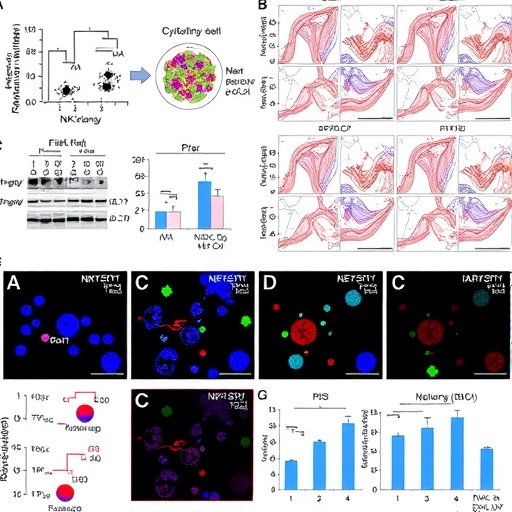
Cytokines can do more than merely cue immune cells to respond—they may also help them acquire durable, memory-like capabilities. In a newly reported study in Cell Death Discoveries, researchers describe how cytokine stimulation can generate “expandable memory” natural killer (NK) cells that persist and adapt through profound metabolic and epigenetic remodeling. The work frames NK-cell memory as a programmable state rather than a fixed lineage property, offering a potential roadmap for next-generation cellular immunotherapies.

The investigators found that specific cytokine cues drive NK cells into a phenotype marked by sustained functional competence after activation. Unlike transient effector states that fade as stimulation wanes, these cytokine-induced cells are reported to maintain responsiveness over time, consistent with a memory-like program. Importantly, the term “expandable” reflects the ability of these cells to proliferate and retain their characteristics, which is a practical requirement for adoptive transfer approaches.

A central theme is metabolic reprogramming. The study indicates that cytokine exposure reshapes how NK cells use energy, affecting pathways that govern growth, survival, and effector function. By tuning metabolic flux, the cells appear better able to endure post-transfer conditions where nutrients, oxygen, and inflammatory cues fluctuate. This metabolic advantage may help explain why the memory-like state is not quickly extinguished.

Equally notable is epigenetic remodeling. The researchers report that cytokine conditioning alters regulatory landscapes—mechanisms that control which genes can be turned on or off. Such epigenetic changes provide molecular “stickiness,” stabilizing the memory-like transcriptional program so that the cells can react appropriately upon re-encounter with targets.

The study also emphasizes persistence properties. For immunotherapies, long-lived immune cells can translate into more durable tumor surveillance and reduced dependence on repeated dosing. By linking cytokine instruction to persistence, the authors suggest that therapeutic protocols could be engineered to induce not only activation, but also a lasting cellular identity.

From a translational viewpoint, cytokine-induced expandable memory NK cells could be positioned as safer or more scalable alternatives to approaches that rely on extensive genetic modification. Cytokine-based conditioning is often more straightforward to implement, though optimizing timing, combinations, and dosing remains critical.

Overall, the report advances viral science news by showing that immune memory in NK cells can be actively manufactured through cytokine-driven metabolic and epigenetic rewiring. If validated and refined in preclinical and clinical settings, this strategy could reshape how we design durable innate immune responses against cancer and other persistent threats.

Subject of Research: Cytokine-induced expandable memory NK cells; metabolic and epigenetic remodeling; persistence.

Article Title: Cytokine-induced expandable memory NK cells with significant metabolic, epigenetic remodeling, and persistence properties.

Article References: Wang, H., Tu, J., Luo, Y. et al. Cytokine-induced expandable memory NK cells with significant metabolic, epigenetic remodeling, and persistence properties. Cell Death Discov. (2026). https://doi.org/10.1038/s41420-026-03260-2

Image Credits: AI Generated

DOI: https://doi.org/10.1038/s41420-026-03260-2

Tags: adoptive NK cell therapycytokine stimulation effects on NK cellsCytokine-induced memory natural killer cellsdurable NK cell responsesepigenetic remodeling of immune cellsimmune cell energy utilizationimmune cell metabolic pathwaysmetabolic reprogramming in NK cellsnext-generation cellular immunotherapiesNK cell functional competenceNK cell proliferation and persistenceprogrammable NK cell memory
Share26Tweet16
Previous Post

Dopamine-Linked Brain Network Reconfiguration Dynamics Altered in Parkinson’s Disease

Next Post

Multidisciplinary Neurohemodynamics Team Improves Echocardiography-Guided Care for Neonatal AVMs

Related Posts

Pilot Study Examines Personal Care Use, Social Media Engagement Among NJ Students
Medicine

Pilot Study Examines Personal Care Use, Social Media Engagement Among NJ Students

August 17, 2026
PARP1 Drives Neuropathic Pain Through GPX4-Dependent Ferroptosis in Injured Mice’s Sensory Neurons
Medicine

PARP1 Drives Neuropathic Pain Through GPX4-Dependent Ferroptosis in Injured Mice’s Sensory Neurons

August 15, 2026
Genome-wide skin pQTL map reveals genetic regulators and mechanisms underlying skin disorders
Medicine

Genome-wide skin pQTL map reveals genetic regulators and mechanisms underlying skin disorders

August 15, 2026
Levistilide A Drives Ferroptosis via RNF40-HSP90α Axis, Suppressing Colorectal Cancer Lung Metastasis
Medicine

Levistilide A Drives Ferroptosis via RNF40-HSP90α Axis, Suppressing Colorectal Cancer Lung Metastasis

August 15, 2026
Sintilimab, IBI305, and Chemotherapy Show Promise in First-Line Advanced Gastric and GEJ Adenocarcinoma
Medicine

Sintilimab, IBI305, and Chemotherapy Show Promise in First-Line Advanced Gastric and GEJ Adenocarcinoma

August 15, 2026
Mercury Detected in New York City Skin-Lightening and Skincare Products, 2009–2022
Medicine

Mercury Detected in New York City Skin-Lightening and Skincare Products, 2009–2022

August 15, 2026
Next Post
Multidisciplinary Neurohemodynamics Team Improves Echocardiography-Guided Care for Neonatal AVMs

Multidisciplinary Neurohemodynamics Team Improves Echocardiography-Guided Care for Neonatal AVMs

  • Mothers who receive childcare support from maternal grandparents show more

    Mothers who receive childcare support from maternal grandparents show more parental warmth, finds NTU Singapore study

    27656 shares
    Share 11059 Tweet 6912
  • University of Seville Breaks 120-Year-Old Mystery, Revises a Key Einstein Concept

    1061 shares
    Share 424 Tweet 265
  • Bee body mass, pathogens and local climate influence heat tolerance

    682 shares
    Share 273 Tweet 171
  • Researchers record first-ever images and data of a shark experiencing a boat strike

    546 shares
    Share 218 Tweet 137
  • Groundbreaking Clinical Trial Reveals Lubiprostone Enhances Kidney Function

    531 shares
    Share 212 Tweet 133
Science

Embark on a thrilling journey of discovery with Scienmag.com—your ultimate source for cutting-edge breakthroughs. Immerse yourself in a world where curiosity knows no limits and tomorrow’s possibilities become today’s reality!

RECENT NEWS

  • Students with heavier social media use choose more products containing hormone-disrupting chemicals
  • Pilot Study Examines Personal Care Use, Social Media Engagement Among NJ Students
  • Tropical Forest Biomass Responds to Diverse Climate Controls
  • Survey-Based Model Reveals How Preparedness Constraints Shape Cholera Transmission in Sudan

Categories

  • Agriculture
  • Anthropology
  • Archaeology
  • Athmospheric
  • Biology
  • Biotechnology
  • Blog
  • Bussines
  • Cancer
  • Chemistry
  • Climate
  • Earth Science
  • Editorial Policy
  • Marine
  • Mathematics
  • Medicine
  • Pediatry
  • Policy
  • Psychology & Psychiatry
  • Science Education
  • Social Science
  • Space
  • Technology and Engineering

Subscribe to Blog via Email

Success! An email was just sent to confirm your subscription. Please find the email now and click 'Confirm Follow' to start subscribing.

Join 5,149 other subscribers

© 2025 Scienmag - Science Magazine

Welcome Back!

Login to your account below

Forgotten Password?

Retrieve your password

Please enter your username or email address to reset your password.

Log In
No Result
View All Result
  • HOME
  • SCIENCE NEWS
  • CONTACT US

© 2025 Scienmag - Science Magazine
