


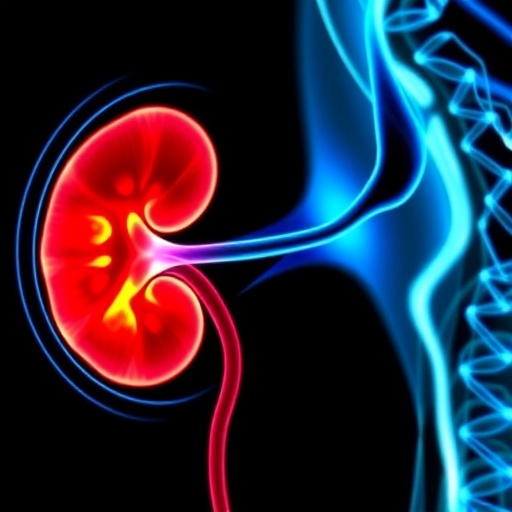
In a groundbreaking advancement poised to transform preoperative care for kidney tumor patients, researchers at the Icahn School of Medicine at Mount Sinai have unveiled an innovative application of multiparametric magnetic resonance imaging (MRI). This pioneering investigation offers a beacon of hope for personalized medicine, enabling clinicians to predict the trajectory of kidney function deterioration and the subsequent development of chronic kidney disease (CKD) before nephrectomy is performed.
Dr. Mira Liu, the visionary postdoctoral fellow leading this cutting-edge study, earned the prestigious W.S. Moore Award at the 2026 International Society for Magnetic Resonance in Medicine (ISMRM) & International Society for MR Radiographers & Technologists (ISMRT) Annual Meeting, recognizing the originality and clinical relevance of her research. The accolade spotlights her seminal article published in the Journal of Magnetic Resonance Imaging, which details the capability of advanced MRI techniques to anticipate renal outcomes, fundamentally challenging existing paradigms in kidney surgery risk assessment.
The clinical conundrum addressed by Dr. Liu’s team stems from the unpredictable aftermath of nephrectomy—a surgical procedure indispensable for excising kidney tumors but not without its risks. While nephrectomy can be curative, a significant subset of patients experience a decline in kidney function, often progressing to CKD, a condition associated with considerable morbidity and mortality. Presently, physicians lack robust predictive tools to discern which patients bear heightened susceptibility to such adverse outcomes, relying largely on standard clinical parameters and rudimentary function tests.
This pioneering pilot study encompassed 43 patients scheduled for nephrectomy due to renal masses, each undergoing an array of sophisticated preoperative MRI protocols that transcended anatomical imaging. Employing multiparametric MRI allowed the researchers to probe physiological and microstructural facets of kidney health, measuring parameters such as renal blood flow, oxygen consumption, tissue inflammation, filtration efficiency, and cellular environment characteristics. Utilizing these comprehensive imaging biomarkers, the team formulated predictive models of kidney function one year post-surgery, revealing compelling correlations.
Central to the study’s revelations was the insight that MRI-derived metrics significantly enhanced the prediction of long-term renal decline compared to traditional assessments alone. Notably, kidneys exhibiting either compromised baseline function or paradoxically elevated functional stress prior to surgery were more prone to future deterioration. This phenomenon suggests an underlying depletion of renal reserve capacity—an intrinsic stress threshold beyond which renal compensation fails, precipitating progressive damage.
The implications of this research extend well beyond static snapshots of kidney anatomy; the quantitative insights gleaned from MRI articulate a dynamic portrait of organ physiology. Such granularity in preoperative evaluation heralds a new era of precision nephrology, where imaging elucidates hidden physiological burdens, guiding surgical planning, perioperative management, and vigilant postoperative surveillance.
Dr. Liu emphasizes the transformative potential of integrating multiparametric MRI into routine clinical workflows, positing that these insights can inform tailored therapeutic strategies. By identifying high-risk individuals preemptively, clinicians may deploy nephroprotective interventions—modifying surgical approaches, optimizing perioperative care, or instituting meticulous follow-up protocols aimed at preserving renal function and enhancing patient outcomes.
Complementing Dr. Liu’s work, co-mentors and collaborators at Mount Sinai underscore the synergy between advanced imaging and molecular insights. Recent complementary research published in the Journal for ImmunoTherapy of Cancer aligns with these findings, indicating that presurgical MRI biomarkers also mirror tumor immunobiology, suggesting a dual role for this imaging modality in characterizing both cancer aggressiveness and renal resilience.
Moreover, this research catalyzes a broader conversation about organ reserve and functional adaptation, themes increasingly recognized across various organ systems. The concept that organs under latent strain may harbor predispositions to failure invites a paradigm shift in clinical evaluation, where imaging transcends morphology to reveal pathophysiological states invisible to conventional diagnostics.
Prospective validation studies are poised to amplify these promising results, with plans underway to extend investigations across diverse patient populations in multiple healthcare institutions. Such multicenter endeavors will ascertain the robustness, applicability, and clinical utility of MRI-derived risk scores, potentially revolutionizing presurgical assessment protocols on a global scale.
This intersection of imaging science and clinical nephrology epitomizes the burgeoning field of quantitative imaging biomarkers, which strive to deliver actionable intelligence beyond the realm of structural visualization. As MRI technology evolves, harnessing its full potential promises to enhance risk stratification, personalize therapeutic decisions, and ultimately safeguard kidney health in vulnerable patients.
In the context of mounting chronic kidney disease prevalence worldwide, innovation in early detection and intervention is paramount. Dr. Liu’s study heralds a crucial step forward, marrying technological sophistication with clinical necessity. This union beckons a future where informed, nuanced clinical decisions mitigate postoperative kidney injury and transform patient trajectories following kidney tumor surgery.
To disseminate these transformative findings and foster multidisciplinary collaborations, the Icahn School of Medicine at Mount Sinai continues to champion research excellence. With its rich infrastructure combining translational science, clinical expertise, and state-of-the-art imaging facilities, Mount Sinai stands at the forefront of redefining nephrology and surgical care paradigms.
As the field advances, embracing multiparametric MRI as a presurgical sentinel may evolve into standard practice, embedding precision medicine principles at the heart of nephrectomy care. This research not only illuminates kidney disease risk but also embodies a broader vision of harnessing innovative imaging to unlock organ health secrets, ultimately elevating patient care standards worldwide.
News Publication Date: June 9, 2026
Web References:
- Study DOI: 10.1002/jmri.70213
- Dr. Liu’s Award: ISMRM 2026 Meeting YIA
- Related tumor biology research: Journal for ImmunoTherapy of Cancer
References:
Liu, M., et al. (2026). Multiparametric MRI Predicting Renal Function Deterioration & Chronic Kidney Disease Development in Patients Undergoing Nephrectomy for Renal Masses: A Pilot Study. Journal of Magnetic Resonance Imaging. DOI: 10.1002/jmri.70213.
Cite Scienmag News
Jerry Hayes. (June 9, 2026). Could MRI Detect Kidney Disease Before It Develops? Award-Winning Study Opens New Possibilities. Scienmag. https://scienmag.com/could-mri-detect-kidney-disease-before-it-develops-award-winning-study-opens-new-possibilities/
Jerry Hayes. "Could MRI Detect Kidney Disease Before It Develops? Award-Winning Study Opens New Possibilities." Scienmag, 9 June 2026, https://scienmag.com/could-mri-detect-kidney-disease-before-it-develops-award-winning-study-opens-new-possibilities/. Accessed 5 September 2026.
Jerry Hayes. "Could MRI Detect Kidney Disease Before It Develops? Award-Winning Study Opens New Possibilities." Scienmag. June 9, 2026. https://scienmag.com/could-mri-detect-kidney-disease-before-it-develops-award-winning-study-opens-new-possibilities/


