


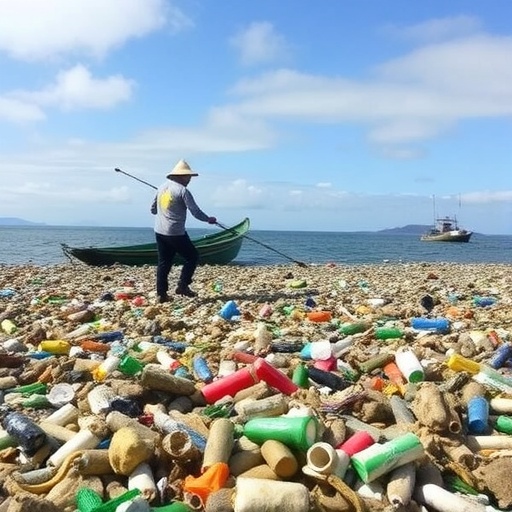
Marine plastic pollution is rapidly emerging as one of the most pressing environmental and socioeconomic challenges for coastal communities around the world. In a groundbreaking new study, Nguyen et al. (2026) present compelling evidence on how plastic debris in the marine environment is directly corroding the income and livelihood security of fishing communities in Viet Nam. This extensive research delves into complex interactions between pollution, fishery resources, and community well-being, revealing alarming trends and urgent calls for comprehensive mitigation strategies.
The study’s methodology is robust, integrating long-term field sampling of marine environments with socioeconomic surveys among fisherfolk. By assessing plastic concentrations in key fishing areas alongside detailed interviews regarding income fluctuations and livelihood disruptions, the researchers quantify the multifaceted impact of marine plastic waste. Their findings demonstrate not only the environmental degradation wrought by widespread plastics but also the substantial economic toll it inflicts on individuals whose lives depend on the marine ecosystem.
One of the key technical highlights of this investigation is the measurement of microplastic and macroplastic levels in artisanal fishing zones, revealing concentrations that significantly exceed global averages. These plastics interfere with commercial fish stocks by altering habitat quality and impairing fish health. The research team harnessed spectroscopic analysis and polymer identification techniques to map the sources and types of plastic pollutants, facilitating a clearer comprehension of contamination pathways and accumulation hotspots impacting fisheries.
The ecological consequences of marine plastic pollution extend far beyond obvious waste accumulation. Nguyen and colleagues reveal that plastics exacerbate stress on already vulnerable fish populations by introducing toxic substances and microfibers into the food chain. This biochemical contamination results in physiological and reproductive impairments in fish species vital for community sustenance. The cascading effects compromise fish abundance, which directly correlates with the declining catch volumes reported in local fishing records.
Sociologically, the research documents a disturbing decline in household earnings among fishing families correlated with plastic pollution severity. Several respondents reported increased costs of gear replacement and clean-up operations, alongside reduced market value of fish due to contamination fears. This economic squeeze has led to heightened food insecurity and reduced resilience against seasonal and environmental shocks, underscoring the insidious spread of poverty linked to environmental degradation.
Another critical dimension explored is the erosion of traditional knowledge systems and fishing practices caused by the altered marine landscape. Local fishermen cited the increasing difficulty of navigating plastic-laden waters and the growing unpredictability of fish behavior as disruptive to generations-old practices. This loss threatens cultural heritage and communal identity bound intricately to the social fabric of these maritime communities.
The study further investigates policy gaps and inadequate waste management infrastructure that compound marine plastic pollution challenges in Viet Nam. Despite governmental initiatives, enforcement remains sporadic, and community engagements are limited, hindering effective plastic containment. The researchers argue that an integrative approach combining education, infrastructural investment, and participatory governance is essential to reverse the trend and protect both ecological and human systems.
Technological interventions discussed include enhanced waste sorting and recycling mechanisms, alongside innovative biodegradable alternatives to traditional fishing gear plagued by plastic waste entanglements. Such advancements could mitigate plastic introduction and improve ecosystem recovery rates, yet require coordinated support from multiple stakeholders, including policymakers, industry, and civil society.
The paper meticulously contextualizes these findings within global trends, emphasizing that the plight of Viet Nam’s fishing communities is emblematic of broader issues faced by millions across Asia and beyond. The interconnectedness of marine pollution, climate change, and socioeconomic vulnerabilities calls for globally scaled, yet locally tailored, solutions to ensure the sustainability of marine resources and livelihoods.
In sum, Nguyen et al.’s research represents a pivotal contribution to marine pollution science, combining rigorous environmental data analysis with an empathetic sociological lens. Their synthesis underscores the urgency of bi-directional interventions addressing both pollution control and community adaptation measures to safeguard the future of fisheries-dependent populations.
Their work also highlights the critical necessity for cross-disciplinary collaboration in tackling marine plastic pollution effects. Oceanographers, economists, social scientists, policymakers, and community leaders must unite efforts to craft holistic, evidence-based interventions that balance ecological health with sustainable socioeconomic development.
Importantly, the study serves as a wake-up call regarding the ethical dimensions of marine pollution, urging global responsibility in reducing plastic production and disposal. It advocates for a shift in consumer behavior and corporate accountability as foundational to long-term solutions beyond mere remediation.
This research contributes significantly to the growing body of literature emphasizing marine plastic pollution not just as an environmental hazard, but as a profound disruptor of human livelihoods. It firmly positions environmental integrity and human welfare as inseparable components of sustainable marine resource management.
Moving forward, the study recommends longitudinal monitoring frameworks integrating environmental, economic, and cultural indicators to track progress and inform adaptive strategies. Such integrated monitoring is vital to evaluate the effectiveness of interventions and ensure that fishing communities can thrive sustainably in the face of emerging environmental pressures.
In conclusion, the insights provided by Nguyen et al. illuminate a critical nexus between marine pollution and human resilience, casting new light on how globally pervasive plastic waste crises manifest concretely in vulnerable coastal livelihoods. This exemplary research delivers a clarion call for immediate, multi-pronged actions to alleviate marine plastic pollution and fortify the future of fishing communities in Viet Nam and similar settings worldwide.
Cite Scienmag News
Reese Ellison. (June 8, 2026). Marine Plastic Pollution Threatens Vietnam Fishing Livelihoods. Scienmag. https://scienmag.com/marine-plastic-pollution-threatens-vietnam-fishing-livelihoods/
Reese Ellison. "Marine Plastic Pollution Threatens Vietnam Fishing Livelihoods." Scienmag, 8 June 2026, https://scienmag.com/marine-plastic-pollution-threatens-vietnam-fishing-livelihoods/. Accessed 4 September 2026.
Reese Ellison. "Marine Plastic Pollution Threatens Vietnam Fishing Livelihoods." Scienmag. June 8, 2026. https://scienmag.com/marine-plastic-pollution-threatens-vietnam-fishing-livelihoods/


