


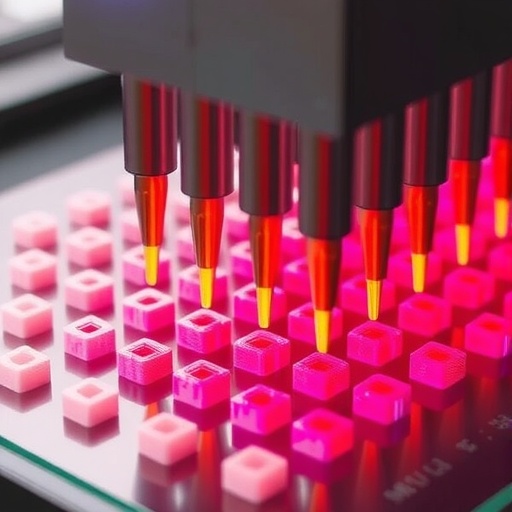
In a groundbreaking advancement poised to revolutionize the field of additive manufacturing, researchers Ma, Wang, and their colleagues have introduced a novel approach that overcomes persistent limitations in micro-scale multimaterial direct ink writing. Their work centers on the development of thermally elongated thermoplastic nozzles, a breakthrough technology that unlocks unprecedented precision and versatility in multimaterial printing at the microscale. This innovation, recently published in npj Advanced Manufacturing, marks a significant leap forward in engineering, materials science, and manufacturing technology.
Direct ink writing (DIW) has long been touted for its potential to fabricate intricate structures with multiple materials, enabling complex functionalities in microscale devices. However, the realization of truly multimaterial architectures at such fine resolutions has been hindered by nozzle design constraints. Traditional nozzles lacked the ability to maintain structural integrity and precise flow control when scaled down to microscale dimensions, especially when handling diverse thermoplastic inks with distinct rheological properties. The research team addressed this bottleneck by reimagining nozzle fabrication and material selection, employing thermally elongated thermoplastic components that bolster both durability and flow fidelity.
The core innovation lies in the thermal elongation process applied to thermoplastic nozzle elements. By subjecting thermoplastic components to controlled thermal gradients and stresses, the researchers were able to induce elongation that refined the microstructure and surface properties of the nozzle interior. This process reduces nozzle clogging and irregular flow patterns that commonly plague multimaterial DIW systems. Furthermore, the elongated nozzles demonstrate enhanced chemical compatibility with a range of thermoplastic inks, while permitting finely tuned extrusion rates that facilitate layering of disparate materials with minimal cross-contamination.
To validate their design, the team performed extensive characterization of nozzle geometry, flow dynamics, and print fidelity. High-resolution imaging confirmed that the nozzles maintained consistent internal diameters with remarkable uniformity over millimeter-scale lengths, a crucial parameter for stable ink flow. Rheological testing under extrusion conditions revealed that thermally elongated nozzles significantly decreased the critical shear stress required for ink extrusion. This reduction enables printing at lower pressures, extending the functional lifespan of the nozzle and minimizing mechanical stresses on sensitive materials within the ink formulations.
Beyond the mechanical and material studies, the researchers demonstrated the practical benefits of their nozzles through complex microfabrication experiments. Utilizing multimaterial ink formulations, they printed structures integrating conductive, insulating, and structural elements within microscale geometries. The resulting architectures exhibited unprecedented resolution and material integration, showcasing the potential for applications in flexible electronics, biomedical devices, and microscale sensors. Each layer of these constructs adhered cohesively without delamination or phase mixing, a testament to the precise control afforded by the novel nozzle technology.
One of the most salient outcomes of this research is the capacity to customize nozzle dimensions and elongation profiles to suit specific ink compositions and intended device architectures. This adaptability significantly expands the scope of direct ink writing, empowering engineers and material scientists to transcend previous limitations imposed by nozzle inefficiencies. The elongation technique can be modified to tailor flow channel surface roughness and wettability, optimizing extrusion behavior for a broad spectrum of thermoplastic inks including those loaded with nanoparticles or bioactive agents.
The thermal elongation method also offers compelling manufacturing advantages. Nozzle production involves standard thermoplastic extrusion followed by a controlled thermal treatment, enabling scalable and cost-effective fabrication of high-performance nozzles. This contrasts favorably with more complex microfabrication techniques such as lithography or laser ablation, which are comparatively expensive and less adaptable. Consequently, this innovation holds promise not only for research laboratories but also for industrial settings requiring rapid prototyping and small-batch manufacturing of multifunctional microscale devices.
Moreover, the newfound ability to print multiple materials at micro resolutions opens exciting avenues in the design of next-generation microsystems. These systems span from miniaturized biomedical implants capable of localized drug delivery to microelectromechanical systems (MEMS) with embedded sensors and actuators. The thermally elongated nozzles effectively eliminate the compromise between resolution, material diversity, and printing throughput that has constrained the field until now, setting new standards for what can be achieved with direct ink writing.
From a technical perspective, control algorithms and system integration were adapted to leverage the improved nozzle capabilities. The team implemented refined pressure modulation and temperature stabilization protocols, ensuring that inks with varying viscosities and thermal properties extruded smoothly. These software and hardware enhancements synergize with the nozzle design, culminating in a highly reproducible multimaterial printing platform that can be readily adapted for diverse research and manufacturing needs.
The environmental and economic implications of this technology are noteworthy as well. By optimizing extrusion efficiency and reducing material waste from nozzle clogging and print failures, thermally elongated nozzles contribute to greener manufacturing processes. Additionally, the approach enables the use of environmentally benign thermoplastic inks, including biodegradable and bioresorbable polymers, expanding the sustainability profile of DIW applications.
Looking ahead, the research team envisions extending this thermal elongation concept beyond thermoplastic nozzles to other extrusion-based microfabrication components. Potential developments might encompass dynamic nozzles with programmable elongation states or composite nozzles integrating functional coatings for enhanced chemical resistance or bioactivity. Such innovations could further enhance the versatility and adaptability of multimaterial microscale printing technologies.
The societal impact of this breakthrough could be transformative. With improved multimaterial direct ink writing accessible via thermally elongated nozzles, industries from healthcare to electronics can expect accelerated innovation cycles and deployment of devices that are smaller, more functional, and customizable. Patient-specific implants, wearable electronics with integrated sensors, and microscale energy harvesters represent just a few of the domains poised to benefit from this technology.
In conclusion, the thermally elongated thermoplastic nozzle innovation by Ma, Wang, and colleagues represents a paradigm shift in multimaterial microscale printing. Combining sophisticated materials engineering with pragmatic fabrication techniques, this advancement unlocks a new dimension of precision and material integration in direct ink writing. As researchers and industries adopt this technology, we anticipate a surge in microscale additive manufacturing capabilities that could reshape multiple sectors and spur a wave of technological breakthroughs.
Cite Scienmag News
Denise Maddox. (June 8, 2026). Thermally Elongated Nozzles Enable Micro-Scale Multimaterial Printing. Scienmag. https://scienmag.com/thermally-elongated-nozzles-enable-micro-scale-multimaterial-printing/
Denise Maddox. "Thermally Elongated Nozzles Enable Micro-Scale Multimaterial Printing." Scienmag, 8 June 2026, https://scienmag.com/thermally-elongated-nozzles-enable-micro-scale-multimaterial-printing/. Accessed 4 September 2026.
Denise Maddox. "Thermally Elongated Nozzles Enable Micro-Scale Multimaterial Printing." Scienmag. June 8, 2026. https://scienmag.com/thermally-elongated-nozzles-enable-micro-scale-multimaterial-printing/


