

Sunday, August 16, 2026
Science
No Result
View All Result
  • Login
  • HOME
  • SCIENCE NEWS
  • CONTACT US
  • HOME
  • SCIENCE NEWS
  • CONTACT US
No Result
View All Result
Scienmag
No Result
View All Result
Home Science News Earth Science

Continental fern savannah wildfires driven by end-Triassic greenhouse warming

July 26, 2026
in Earth Science
Reading Time: 2 mins read
0
Continental fern savannah wildfires driven by end-Triassic greenhouse warming

Continental fern savannah wildfires driven by end-Triassic greenhouse warming

65
SHARES
587
VIEWS
Share on FacebookShare on Twitter
ADVERTISEMENT

Two hundred million years ago, vast CO₂ emissions from the Central Atlantic Magmatic Province helped trigger the end-Triassic mass extinction, a biological collapse that reshaped Earth’s ecosystems. Across drill cores from Germany, Luxembourg, Denmark and the UK, palynological records reveal a puzzling “dark zone”: pollen and spore assemblages become markedly darker at this critical interval. The effect is difficult to explain with straightforward thermal maturation, suggesting that an additional process altered the microscopic record.

To test what caused this sudden palynomorph darkening, researchers applied the Palynomorph Darkness Index, focusing on trilete spores produced by ferns and Classopollis pollen from conifer lineages. Because different groups preserve differently through time, pairing fern spores with conifer pollen provides a comparative view of how terrestrial vegetation responded during greenhouse-driven environmental stress.

Strikingly, the maximum darkness aligns with phases of forest collapse and the spread of fern-dominated pioneer vegetation. Peak values occur in the Triletes Beds in Germany and in correlatable strata elsewhere across Europe. The synchrony indicates that the darkening was not a local artifact of sedimentation or basin chemistry, but instead reflects a continent-scale disturbance.

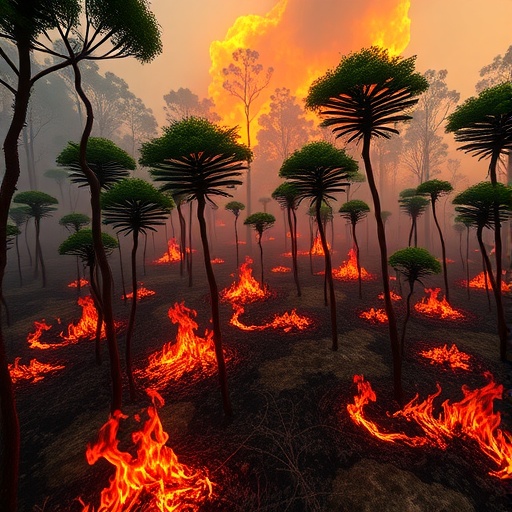
The study then connects these observations to physical fire effects. Controlled heating experiments on spores from the modern clubmoss Lycopodium show that the magnitude and pattern of darkness observed in the Triassic best match scenarios where surface fires burn through fern savannas. In this model, repeated burning can darken palynomorphs in ways that mimic—or exceed—thermal maturation signals expected from burial heating alone.

Independent proxies strengthen the wildfire interpretation. Microcharcoal measurements indicate abundant charcoal production during the same extinction interval, consistent with frequent burning. In parallel, pyrolytic polycyclic aromatic hydrocarbons—molecules formed during combustion—further corroborate widespread, high-temperature events rather than purely geological heating.

Together, the evidence points to continental-scale fern-savana wildfires during end-Triassic greenhouse warming. Such fires would have amplified environmental volatility, degrading habitat, suppressing forest recovery, and stressing plant communities already under rapid climatic change.

By linking palynological “darkening” to combustion-derived changes, the work reframes how the terrestrial biosphere responded to extreme warming. It also implies that heat stress and prolonged drought—interrupted by episodes of intense precipitation—created conditions ideal for widespread ignition and fire spread.

Finally, the record suggests that ecosystem collapse was not driven only by atmospheric chemistry and oceanic disruption, but also by repeated terrestrial burning events that reshaped vegetation at a continental scale.

Subject of Research: End-Triassic extinction; palynology; wildfire and greenhouse warming
Article Title: Continental-scale fern savannah wildfires during end-Triassic greenhouse warming.
Article References: Hollaar, T.P., Kent, M.S., Lomax, B.H. et al. Continental-scale fern savannah wildfires during end-Triassic greenhouse warming. Nat. Geosci. (2026). https://doi.org/10.1038/s41561-026-02048-4
DOI: https://doi.org/10.1038/s41561-026-02048-4
Keywords: wildfire; palynomorph darkness; end-Triassic; fern savannas; microcharcoal; pyrolytic PAHs; palynology; greenhouse warming

Tags: Central Atlantic Magmatic Provinceclimate-driven vegetation changecontinent-scale environmental disturbanceend-Triassic greenhouse warmingfern spores and conifer pollenforest collapse during end-Triassicfossilized plant spores and pollenpalynological recordspalynomorph darkness indexterrestrial vegetation responseTriassic mass extinctionwildfire effects on ancient ecosystems
Share26Tweet16
Previous Post

Scientists uncover molecular mechanisms of Pirsonia diadema infection in diatoms

Next Post

Planetary-Mass Exosatellite Detected Orbiting Substellar Companion

Related Posts

Tropical Forest Biomass Responds to Diverse Climate Controls
Earth Science

Tropical Forest Biomass Responds to Diverse Climate Controls

August 16, 2026
Survey-Based Model Reveals How Preparedness Constraints Shape Cholera Transmission in Sudan
Earth Science

Survey-Based Model Reveals How Preparedness Constraints Shape Cholera Transmission in Sudan

August 16, 2026
Waste-Based Retrofits Improve Thermal Performance in North Sinai Social Housing
Earth Science

Waste-Based Retrofits Improve Thermal Performance in North Sinai Social Housing

August 16, 2026
AI Optimizes Visible-Light Degradation of Acid Orange 25 with Ag/N-TiO2 Persulfate
Earth Science

AI Optimizes Visible-Light Degradation of Acid Orange 25 with Ag/N-TiO2 Persulfate

August 16, 2026
Rhizosphere Effects on Oklahoma Winter Wheat Yield Drive Probes for Beneficial Microbes
Earth Science

Rhizosphere Effects on Oklahoma Winter Wheat Yield Drive Probes for Beneficial Microbes

August 16, 2026
Tropical Forcing Drove Widespread Millennial Monsoon Variability Over 3.5 Million Years
Earth Science

Tropical Forcing Drove Widespread Millennial Monsoon Variability Over 3.5 Million Years

August 15, 2026
Next Post
Planetary-Mass Exosatellite Detected Orbiting Substellar Companion

Planetary-Mass Exosatellite Detected Orbiting Substellar Companion

  • Mothers who receive childcare support from maternal grandparents show more

    Mothers who receive childcare support from maternal grandparents show more parental warmth, finds NTU Singapore study

    27656 shares
    Share 11059 Tweet 6912
  • University of Seville Breaks 120-Year-Old Mystery, Revises a Key Einstein Concept

    1061 shares
    Share 424 Tweet 265
  • Bee body mass, pathogens and local climate influence heat tolerance

    682 shares
    Share 273 Tweet 171
  • Researchers record first-ever images and data of a shark experiencing a boat strike

    546 shares
    Share 218 Tweet 137
  • Groundbreaking Clinical Trial Reveals Lubiprostone Enhances Kidney Function

    531 shares
    Share 212 Tweet 133
Science

Embark on a thrilling journey of discovery with Scienmag.com—your ultimate source for cutting-edge breakthroughs. Immerse yourself in a world where curiosity knows no limits and tomorrow’s possibilities become today’s reality!

RECENT NEWS

  • Tropical Forest Biomass Responds to Diverse Climate Controls
  • Survey-Based Model Reveals How Preparedness Constraints Shape Cholera Transmission in Sudan
  • Waste-Based Retrofits Improve Thermal Performance in North Sinai Social Housing
  • KAIST develops semiconductor neuron that harnesses noise to selectively process signals

Categories

  • Agriculture
  • Anthropology
  • Archaeology
  • Athmospheric
  • Biology
  • Biotechnology
  • Blog
  • Bussines
  • Cancer
  • Chemistry
  • Climate
  • Earth Science
  • Editorial Policy
  • Marine
  • Mathematics
  • Medicine
  • Pediatry
  • Policy
  • Psychology & Psychiatry
  • Science Education
  • Social Science
  • Space
  • Technology and Engineering

Subscribe to Blog via Email

Enter your email address to subscribe to this blog and receive notifications of new posts by email.

Join 5,149 other subscribers

© 2025 Scienmag - Science Magazine

Welcome Back!

Login to your account below

Forgotten Password?

Retrieve your password

Please enter your username or email address to reset your password.

Log In
No Result
View All Result
  • HOME
  • SCIENCE NEWS
  • CONTACT US

© 2025 Scienmag - Science Magazine

Discover more from Science

Subscribe now to keep reading and get access to the full archive.

Continue reading
