

Saturday, September 5, 2026
Science
No Result
View All Result
  • Login
  • HOME
  • SCIENCE NEWS
  • CONTACT US
  • HOME
  • SCIENCE NEWS
  • CONTACT US
No Result
View All Result
Scienmag
No Result
View All Result
Home Science News Medicine

Planetary-Mass Exosatellite Detected Orbiting Substellar Companion

July 26, 2026
in Medicine, Technology and Engineering
Denise Maddox
By Denise Maddox Scienmag Editorial Profile - Mechanical Engineering
Reading Time: 2 mins read
0
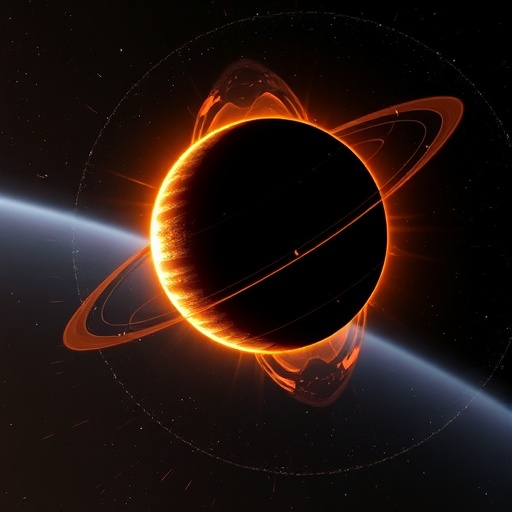
Planetary-Mass Exosatellite Detected Orbiting Substellar Companion

Planetary-Mass Exosatellite Detected Orbiting Substellar Companion

65
SHARES
587
VIEWS
Share on FacebookShare on Twitter
ADVERTISEMENT

Brown dwarfs bridge the gap between planets and stars, occupying a mass range that challenges both definitions and expectations. In star–substellar systems, a third body orbiting the companion has been dubbed an “exosatellite,” but the term’s boundaries—especially whether it truly qualifies as an exomoon—remain unsettled. With more than 6,000 exoplanets discovered, the absence of any confidently detected exomoon has stood out as a major observational puzzle. Some candidates have been proposed, yet they remain controversial and unconfirmed.

The new study reports evidence for an exosatellite around CD-35 2722 B, a brown dwarf companion directly imaged around its host star. Researchers turned to a method familiar from exoplanet discovery: radial velocity analysis. Instead of monitoring a bright star’s wobble, they analyzed high-resolution VLT/CRIRES+ spectra of the brown dwarf itself, searching for periodic Doppler shifts that could betray the gravitational tug of an orbiting companion.

In exoplanet science, radial velocity works by detecting oscillations in spectral lines caused by an object’s orbital motion. Here, the same logic is applied to a much more difficult target: a substellar body whose spectral behavior can be complex. The team nevertheless finds what appears to be a periodic signal consistent with at least one satellite orbit.

The best-fitting orbital model suggests a satellite with a minimum mass near 0.9 Jupiter masses and an orbital period of roughly 170 days. A key point is that this inference depends on statistical modeling of the radial-velocity variations and the quality of the spectroscopic data. Consequently, while the signal is compelling, the existence of the companion remains to be tested more decisively.

What makes the result especially notable is that it represents, to the authors’ knowledge, the first time this radial-velocity technique has produced evidence for satellites around a companion brown dwarf. If confirmed, such a detection would provide a new pathway to study “moon-like” systems in the substellar regime.

Whether the object will meet any formal, community-agreed criteria for an exomoon is still uncertain. Still, the work is portrayed as a meaningful step toward an eventual first uncontroversial exomoon detection, aided by advancing instruments and improved spectroscopic sensitivity.

Subject of Research: Exosatellite formation and detection around a brown dwarf companion
Article Title: Planetary-mass exosatellite detected around the substellar companion of a star.
Article References: Hoy, K., Zurlo, A., Peña R, P.A. et al. Nature 655, 865–869 (2026). https://doi.org/10.1038/s41586-026-10751-w
Image Credits: AI Generated
DOI: 10.1038/s41586-026-10751-w
Keywords: Brown dwarfs; exosatellites; radial velocity; direct imaging; substellar companions

Article Title: Planetary-Mass Exosatellite Detected Orbiting Substellar Companion

Article References: Hoy, K., Zurlo, A., Peña R, P. A., Köhler, J., Desidera, S., Gratton, R., Lazzoni, C., Petrus, S., Rodler, F., Smoker, J., D’Orazi, V., Carleo, I., & Giovannini, I. (2026). Planetary-mass exosatellite detected around the substellar companion of a star. Nature, 655(8124), 865-869. https://doi.org/10.1038/s41586-026-10751-w

Image Credits: AI Generated

DOI: 10.1038/s41586-026-10751-w

Keywords: brown dwarf companions, direct imaging of brown dwarf exosatellites, exomoon identification challenges, exosatellite detection, gravitational tug in brown dwarf systems, high-resolution spectroscopy in exoplanet research, observational methods for exosatellite detection, orbit characterization of planetary-mass satellites, radial velocity analysis of substellar objects, spectral analysis of exoplanetary bodies, star–substellar system dynamics, substellar companion system architecture

Cite Scienmag News

Denise Maddox. (July 26, 2026). Planetary-Mass Exosatellite Detected Orbiting Substellar Companion. Scienmag. https://scienmag.com/planetary-mass-exosatellite-detected-orbiting-substellar-companion/

Denise Maddox. "Planetary-Mass Exosatellite Detected Orbiting Substellar Companion." Scienmag, 26 July 2026, https://scienmag.com/planetary-mass-exosatellite-detected-orbiting-substellar-companion/. Accessed 5 September 2026.

Denise Maddox. "Planetary-Mass Exosatellite Detected Orbiting Substellar Companion." Scienmag. July 26, 2026. https://scienmag.com/planetary-mass-exosatellite-detected-orbiting-substellar-companion/


Tags: brown dwarf companionsdirect imaging of brown dwarf exosatellitesexomoon identification challengesexosatellite detectiongravitational tug in brown dwarf systemshigh-resolution spectroscopy in exoplanet researchobservational methods for exosatellite detectionorbit characterization of planetary-mass satellitesradial velocity analysis of substellar objectsspectral analysis of exoplanetary bodiesstar–substellar system dynamicssubstellar companion system architecture
Share26Tweet16
Previous Post

Continental fern savannah wildfires driven by end-Triassic greenhouse warming

Next Post

Teen diets boost emissions; older adults drive global climate surge

Related Posts

Tuning AlCrCuFeNbNi high-entropy alloys for nuclear fuel cladding performance
Technology and Engineering

Tuning AlCrCuFeNbNi high-entropy alloys for nuclear fuel cladding performance

September 5, 2026
Machine learning force fields reveal carboxylate ligand binding on CdSe quantum dots
Technology and Engineering

Machine learning force fields reveal carboxylate ligand binding on CdSe quantum dots

September 5, 2026
Consistency-aligned guided diffusion improves cross-domain recommendations
Technology and Engineering

Consistency-aligned guided diffusion improves cross-domain recommendations

September 5, 2026
Generative AI reshapes educational meaning: a critical review of inclusion and exclusion
Technology and Engineering

Generative AI reshapes educational meaning: a critical review of inclusion and exclusion

September 5, 2026
Adaptive progressive neural networks for evolving streaming time series data
Technology and Engineering

Adaptive progressive neural networks for evolving streaming time series data

September 5, 2026
Quantum-powered knowledge distillation compresses hybrid AI models efficiently
Technology and Engineering

Quantum-powered knowledge distillation compresses hybrid AI models efficiently

September 5, 2026
Next Post
Teen diets boost emissions; older adults drive global climate surge

Teen diets boost emissions; older adults drive global climate surge

  • Mothers who receive childcare support from maternal grandparents show more optimized

    Mothers who receive childcare support from maternal grandparents show more parental warmth, finds NTU Singapore study

    27656 shares
    Share 11059 Tweet 6912
  • University of Seville Breaks 120-Year-Old Mystery, Revises a Key Einstein Concept

    1061 shares
    Share 424 Tweet 265
  • Bee body mass, pathogens and local climate influence heat tolerance

    682 shares
    Share 273 Tweet 171
  • Researchers record first-ever images and data of a shark experiencing a boat strike

    546 shares
    Share 218 Tweet 137
  • Groundbreaking Clinical Trial Reveals Lubiprostone Enhances Kidney Function

    531 shares
    Share 212 Tweet 133
Science

Embark on a thrilling journey of discovery with Scienmag.com—your ultimate source for cutting-edge breakthroughs. Immerse yourself in a world where curiosity knows no limits and tomorrow’s possibilities become today’s reality!

RECENT NEWS

  • New bispecific TCR-like antibody targets PRAME complex for cancer immunotherapy
  • Tuning AlCrCuFeNbNi high-entropy alloys for nuclear fuel cladding performance
  • Machine learning force fields reveal carboxylate ligand binding on CdSe quantum dots
  • Consistency-aligned guided diffusion improves cross-domain recommendations

Categories

  • Agriculture
  • Anthropology
  • Archaeology
  • Athmospheric
  • Biology
  • Biotechnology
  • Blog
  • Bussines
  • Cancer
  • Chemistry
  • Climate
  • Earth Science
  • Editorial Policy
  • Marine
  • Mathematics
  • Medicine
  • Pediatry
  • Policy
  • Psychology & Psychiatry
  • Science Education
  • Social Science
  • Space
  • Technology and Engineering

Subscribe to Blog via Email

Enter your email address to subscribe to this blog and receive notifications of new posts by email.

Join 5,151 other subscribers

© 2025 Scienmag - Science Magazine

Welcome Back!

Login to your account below

Forgotten Password?

Retrieve your password

Please enter your username or email address to reset your password.

Log In
No Result
View All Result
  • HOME
  • SCIENCE NEWS
  • CONTACT US

© 2025 Scienmag - Science Magazine

Discover more from Science

Subscribe now to keep reading and get access to the full archive.

Continue reading