


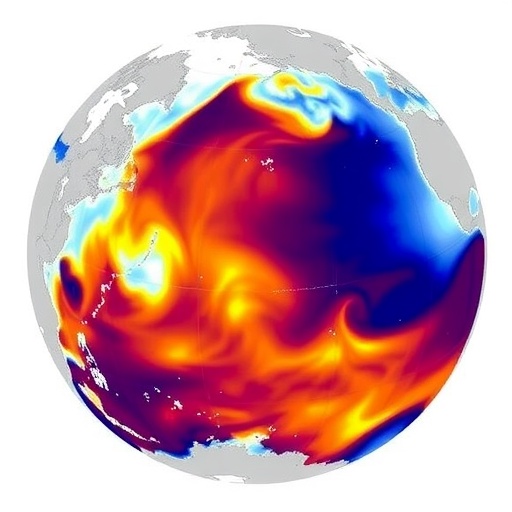
In the intricate web of Earth’s climate system, the oceans emerge as pivotal players, their vast expanses and dynamic processes profoundly influencing global atmospheric patterns and ecosystems. Recent groundbreaking research spearheaded by Ma, L., Liu, F., Wu, T., and their colleagues, published in Communications Earth & Environment in 2026, has shed new light on a critical phenomenon that links the Indian Ocean’s subsurface waters to the surface conditions of the Southern Ocean, with profound implications for climate modeling and prediction accuracy. This revelation centers on the transport of a “warm bias” — a persistent climatic anomaly — from the depths of the Indian Ocean into the upper layers of the Southern Ocean, uncovered through rigorous analysis within the framework of the Coupled Model Intercomparison Project Phase 6 (CMIP6) models.
The significance of this study lies in addressing a longstanding challenge in climate science: accurately capturing the intricate ocean-atmosphere interactions that govern regional and global climate variability. The CMIP6 models represent the newest generation of climate models, designed to simulate Earth’s climate response with improved precision by integrating multiple physical, chemical, and biological processes. However, despite advances, these models have continued to exhibit systematic biases — discrepancies between observed climate phenomena and modeled outputs — that hinder reliable climate forecasts. This research casts a spotlight on one such bias rooted in the ocean’s interior thermal profile and its extension across vast distances.
Detailed scrutiny of CMIP6 simulations revealed that beneath the surface of the Indian Ocean lies a notable warm anomaly that has not been adequately corrected by the models. This subsurface warm anomaly, or warm bias, appears to embark on a journey, transported by complex ocean circulation patterns and thermohaline processes toward the Southern Ocean. The Southern Ocean, encompassing the waters surrounding Antarctica, plays a critical role in global climate dynamics by serving as a major sink for atmospheric carbon dioxide and regulating heat exchange between the ocean and atmosphere. The intrusion of this warm bias into the Southern Ocean surface waters subsequently alters sea surface temperature patterns, which in turn influence atmospheric circulation, sea ice dynamics, and carbon cycling.
The mechanisms driving this transport of warmth from the Indian Ocean’s subsurface layers to the Southern Ocean’s surface involve a confluence of oceanographic phenomena, including intermediate and deep water currents, eddy activities, and vertical mixing processes that facilitate cross-basin heat transfer. These findings underscore the intricate interconnectedness of ocean basins and delineate pathways through which localized oceanic temperature errors can cascade across hemispheres, underscoring the need for refined parameterizations of subsurface oceanic heat transport in climate models.
Critically, the research team utilized a combination of observational datasets, including satellite measurements, in situ oceanographic profiles, and reanalysis data to validate the model’s behavior and to elucidate the nature and origin of the warm bias. Integrating these empirical data with CMIP6 output allowed for the isolation of discrepancies and improved understanding of model deficiencies, especially with respect to subsurface heat content representation and cross-basin exchange processes. Such empirical grounding is vital to enhance the fidelity of climate projections by informing model development and tuning.
Moreover, the implications of this subsurface to surface warm bias extend beyond mere temperature anomalies. The Southern Ocean’s capacity to absorb anthropogenic carbon dioxide is intimately tied to its temperature and circulation regimes. Warmer surface waters could potentially diminish the ocean’s carbon uptake capacity, thereby impacting global carbon budgets and amplifying atmospheric greenhouse gas concentrations. This creates a feedback loop wherein model biases, if uncorrected, could propagate errors into future climate scenarios, misguiding policy and mitigation strategies.
Further, altered sea surface temperatures in the Southern Ocean influence the formation and melting of sea ice, which modulates planetary albedo — the fraction of solar energy reflected back into space. A misrepresentation of sea ice patterns due to warm biases can therefore exacerbate uncertainties in radiative forcing estimates, complicating efforts to predict polar climate changes and their global reverberations. Given the Southern Ocean’s central role in global heat uptake, inaccuracies in this region disproportionately impact the overall climate system assessments.
The study also highlights the importance of vertical ocean structure representation in climate models. Many models tend to oversimplify or misrepresent subsurface oceanic layers, leading to cumulative errors in heat distribution. By illuminating how subsurface conditions in the Indian Ocean influence surface conditions thousands of kilometers away, the research advocates for enhanced vertical resolution and better parameterization of mixing and advection processes in coupled ocean-atmosphere models.
Importantly, the findings contribute to ongoing international efforts to improve climate model outputs as part of the CMIP6 initiative, which informs the Intergovernmental Panel on Climate Change (IPCC) assessments. Better understanding and correction of the warm bias will enhance confidence in climate projections, especially in regions sensitive to oceanic processes such as the Southern Ocean, which have historically been under-sampled and underrepresented in modeling efforts.
Beyond modeling improvements, the research underscores the need for expanded observational campaigns targeting subsurface ocean waters in the Indian and Southern Oceans. Sustained monitoring through autonomous floats, moorings, and research vessels would provide invaluable data to further refine model inputs and validate simulations. Such integrated observational-modeling approaches are essential to capturing the full complexity of oceanic heat transport and its climatic ramifications.
In conclusion, Ma and colleagues’ pioneering work illuminates a vital link in the Earth’s climate puzzle: the propagation of a warm bias from Indian Ocean subsurface waters to Southern Ocean surface layers within the latest generation of climate models. This newfound understanding not only challenges assumptions about isolated oceanic processes but also mandates a reevaluation of model parameterizations and observational strategies. Unraveling this thermal connectivity between distant ocean basins is crucial for enhancing the accuracy of climate change projections and for formulating informed mitigation and adaptation policies as the planet continues to warm.
As climate science advances, studies such as this remind us of the subtle and far-reaching influences hidden beneath the waves, influencing atmospheric dynamics and the fate of our global environment. The capacity to trace and rectify such model biases holds promise for more reliable climate scenarios, empowering humanity to better anticipate and respond to the evolving challenges of climate change on a planetary scale. This research thus stands as a testament to the intertwined nature of ocean systems and their profound role in shaping Earth’s climatic future.
Cite Scienmag News
Violet Maxwell. (June 6, 2026). Indian Ocean Heat Transfers to Southern Ocean Surface. Scienmag. https://scienmag.com/indian-ocean-heat-transfers-to-southern-ocean-surface/
Violet Maxwell. "Indian Ocean Heat Transfers to Southern Ocean Surface." Scienmag, 6 June 2026, https://scienmag.com/indian-ocean-heat-transfers-to-southern-ocean-surface/. Accessed 5 September 2026.
Violet Maxwell. "Indian Ocean Heat Transfers to Southern Ocean Surface." Scienmag. June 6, 2026. https://scienmag.com/indian-ocean-heat-transfers-to-southern-ocean-surface/


