


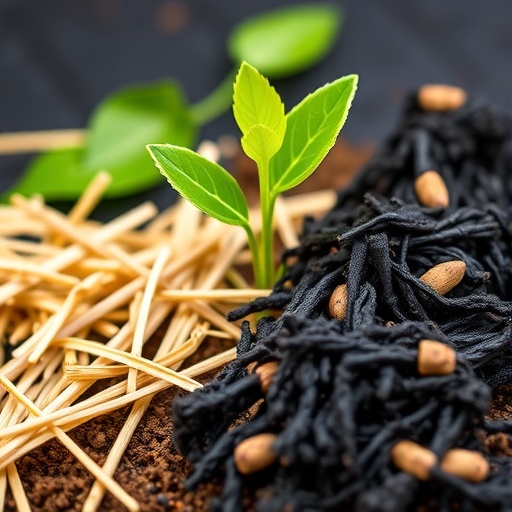
Soil organic matter underpins the very foundation of soil fertility, playing a crucial role in nutrient retention, water holding capacity, microbial activity, and carbon sequestration. Despite its vital importance, the intricate molecular dynamics governing how organic carbon inputs influence soil organic matter remain incompletely understood. Addressing this challenge, a groundbreaking study recently published in the journal Biochar offers novel insights by zeroing in on humic acid—an essential fraction of soil organic matter intimately linked to both soil fertility and long-term carbon stability.
Led by Rui Ma and colleagues, the research investigates the molecular transformations induced by the application of crop straw, biochar, and their combined use within agricultural soils. Over a controlled 180-day soil incubation experiment, the team comprehensively analyzed post-treatment humic acid to unravel how these carbon inputs affect its composition and molecular architecture. This study is the first to reveal the interactive effects of straw and biochar in a unified framework rather than treating them as isolated amendments.
The fundamental discovery challenges the conventional wisdom that individual carbon sources contribute independently to soil organic matter composition. Rather, the findings demonstrate that straw and biochar engage in complex molecular interactions that restructure the building blocks of humic acid, producing a hybrid architecture with enhanced chemical reactivity alongside improved persistence. Such characteristics suggest synergistic benefits for soil health and carbon stabilization when these amendments are combined.
Straw, characterized by its oxygen-rich and chemically reactive organic compounds, fosters transformations within soil organic matter that typically enhance biodegradability and nutrient availability. In contrast, biochar, derived from high-temperature pyrolysis, comprises aromatic, condensed structures noted for their chemical stability and resistance to microbial decomposition. The study reveals that when these divergent carbon sources co-apply, the resulting humic acids exhibit a molecular profile balancing the reactive properties of straw with the durability mediated by biochar’s aromatic matrices.
To elucidate these effects, Ma et al. employed a cutting-edge suite of analytical techniques. Elemental analysis provided quantification of the fundamental chemical components, while electron paramagnetic resonance (EPR) spectroscopy measured unpaired electron radicals—markers of chemical activity. Three-dimensional fluorescence spectroscopy enabled the team to probe structural and compositional nuances. Transmission electron microscopy revealed nanoscale morphological details, and advanced spectroscopic tools like solid-state carbon-13 nuclear magnetic resonance (NMR) and Fourier transform ion cyclotron resonance mass spectrometry (FT-ICR MS) granted unparalleled resolution into molecular networking and compound-specific interactions.
Isolated biochar addition led to humic acid enriched with aromatic and highly condensed carbon domains—features correlated with molecular persistence and resistance against microbial breakdown. Conversely, straw-only treatments produced humic acid rich in oxygenated functional groups, fostering chemical reactivity but with lower structural stability. The strident revelation arose from the combined treatment; humic acids formed under these conditions displayed enhanced radical concentrations and chemical activity while possessing aromatic structures less condensed than biochar-only treatments, indicating restructuring towards a more dynamic molecular ensemble.
This transformative architecture suggests that labile oxygen-rich compounds derived from straw become physically and chemically integrated within biochar’s aromatic frameworks, yielding humic acids that retain functional biochemical activity yet gain the stability associated with condensed organic matter. In essence, straw provides the active molecular components, while biochar forms a stabilizing scaffold, combining the virtues of both sources into a coherently organized molecular network.
Molecular network analysis further substantiated these conclusions by illustrating that the co-application of straw and biochar modifies the connectivity of humic acid constituents. Far beyond simple additive effects, this interconnected architecture implies emergent properties within soil organic matter, potentially heightening soil carbon retention and nutrient cycling efficiency in ways previously unappreciated.
These findings upend the traditional assumption that soils must balance reactive organic matter against long-term stability through trade-offs. Instead, Ma and co-authors propose that strategic co-application of organic amendments can yield humic materials that achieve both functional activity and structural persistence. This duality is critical for sustainable soil management, marrying short-term fertility benefits with durable carbon sequestration objectives.
Despite the promising outcomes, the authors acknowledge limitations arising from laboratory incubation conditions involving a single soil type. Real-world validation across diverse soils, climatic regimes, and agricultural practices remains imperative. Nevertheless, the study’s molecular-level insights establish a theoretical foundation for advancing integrated soil amendment strategies that optimize organic matter quality and enhance carbon management under field conditions.
By reconceptualizing straw and biochar as interacting, complementary materials rather than isolated inputs, the research opens new avenues for designing amendment protocols that more effectively foster soil fertility and contribute to global carbon mitigation efforts. The implications extend to agronomy, environmental chemistry, microbially mediated soil processes, and climate-smart agriculture.
In sum, this pioneering investigation provides a molecular roadmap for harnessing the synergistic potential of farm-based carbon inputs. By decoding the structural transformations within humic acid induced by combined straw and biochar applications, it lays the groundwork for next-generation soil health management tools that enhance productivity, resilience, and sustainability in agroecosystems.
News Publication Date: 3 June 2026
Web References: http://dx.doi.org/10.1007/s42773-026-00622-y
References: Ma, R., Zheng, X., Zhang, Y. et al. Interactive effects of straw and biochar alter humic acid composition and component associations. Biochar 8, 103 (2026).
Cite Scienmag News
Jason Bradley. (June 4, 2026). Straw and Biochar Collaborate to Transform the Molecular Structure of Soil Organic Matter. Scienmag. https://scienmag.com/straw-and-biochar-collaborate-to-transform-the-molecular-structure-of-soil-organic-matter/
Jason Bradley. "Straw and Biochar Collaborate to Transform the Molecular Structure of Soil Organic Matter." Scienmag, 4 June 2026, https://scienmag.com/straw-and-biochar-collaborate-to-transform-the-molecular-structure-of-soil-organic-matter/. Accessed 3 September 2026.
Jason Bradley. "Straw and Biochar Collaborate to Transform the Molecular Structure of Soil Organic Matter." Scienmag. June 4, 2026. https://scienmag.com/straw-and-biochar-collaborate-to-transform-the-molecular-structure-of-soil-organic-matter/


