

Tuesday, July 28, 2026
Science
No Result
View All Result
  • Login
  • HOME
  • SCIENCE NEWS
  • CONTACT US
  • HOME
  • SCIENCE NEWS
  • CONTACT US
No Result
View All Result
Scienmag
No Result
View All Result
Home Science News Biology

Nanotube Links Enable Communication Between Social Amoebae

July 28, 2026
in Biology
Reading Time: 2 mins read
0
Nanotube Links Enable Communication Between Social Amoebae

Nanotube Links Enable Communication Between Social Amoebae

65
SHARES
587
VIEWS
Share on FacebookShare on Twitter
ADVERTISEMENT

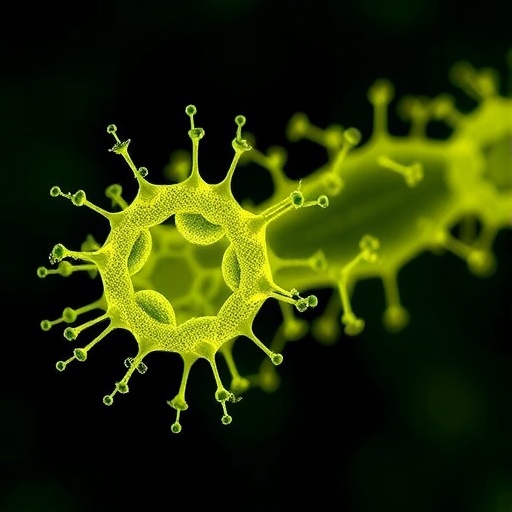
Social amoebae coordinate as individual cells form shifting, cooperative assemblies. New findings now suggest that this coordination is supported by more intimate physical exchange than previously thought. Researchers studying Dictyostelium discoideum report that cells can build tunneling nanotubes—thin, actin-rich bridges that directly connect neighboring cell membranes.

Using fluorescent labeling and advanced imaging, the team tracked how communication travels through these unicellular organisms. They confirmed that chemical signals can diffuse between cells and that membrane-bound vesicles also participate in cargo movement. But beyond these pathways, the study highlights an additional route: cytoplasmic material can be transferred through nanotubes that physically link distant cells.

Tunneling nanotubes (TNTs) proved capable of carrying cellular components and organelles across separation distances reaching about 100 micrometers. This is a crucial scale because it allows exchange beyond what diffusion alone would readily accomplish within relevant timeframes.

The nanotubes were not merely structural artifacts. The researchers tested whether TNTs persist under cytoskeletal stress by disrupting actin polymerization with depolymerizing agents. Remarkably, the protrusions continued to function, indicating that TNT-mediated transfer can remain operational even when the actin network is perturbed.

Their microscopy revealed multiple TNT architectures, including branching structures capable of connecting more than two cells at once. Such branching offers a plausible mechanism for routing material across a network rather than relying on simple pairwise contact.

The work also reports occasional cross-species connectivity, with nanotubes observed bridging cells from different amoeba species. This raises questions about what molecular features enable compatibility between cell types and how such bridges may influence ecological interactions.

Intercellular material transfer is a defining feature of multicellular life, where coordinated behavior depends on regulated exchange of signals and internal components. The authors propose that tunneling nanotubes could represent an evolutionary bridge from solitary unicellular signaling toward more integrated multicellularity.

Overall, the study reframes communication in early-branching eukaryotes by adding a direct, physical form of connectivity to the established chemical and vesicle-based modes. For viral-style science coverage, the headline is clear: social amoebae may be “networked” not only by messages, but by literal cellular bridges.

Subject of Research: Intercellular communication in the social amoeba Dictyostelium discoideum via tunneling nanotubes
Article Title: Nanotubes enable intercellular communication in early-branching eukaryotes
News Publication Date: 28-Jul-2026
Web References: Not provided
References: Not provided
Image Credits: Harikumar R. Suma
Keywords: tunneling nanotubes, Dictyostelium discoideum, actin, intercellular communication, cytoplasmic cargo transfer, organelles, cytoskeleton perturbation, fluorescent imaging

Tags: actin-rich membrane bridgesadvanced imaging of nanotubescytoplasmic transfer via nanotubescytoskeletal disruption effects on TNTsDictyostelium discoideum cell signalingintercellular communicationlong-distance cellular communication mechanismsnanotube architecture and branchingnon-diffusive signal transfer in amoebaeorganelle exchange in unicellular organismsrole of TNTs in cell coordinationtunneling nanotubes in social amoebae
Share26Tweet16
Previous Post

Solar Wind Entropy Rises Nonadiabatically, Driven by Velocity Spikes

Next Post

Losing Party Supporters Show Lower Trust in Fellow Citizens, Study Finds

Related Posts

AI Camera System Tracks Bumblebees, Offering Affordable Insect Monitoring
Biology

AI Camera System Tracks Bumblebees, Offering Affordable Insect Monitoring

July 28, 2026
TIE1 suppresses fertilization-independent endosperm development by recruiting PRC2
Biology

TIE1 suppresses fertilization-independent endosperm development by recruiting PRC2

July 28, 2026
Forces of Push and Pull Shape How Blood Flows Through Vessels
Biology

Forces of Push and Pull Shape How Blood Flows Through Vessels

July 28, 2026
How the body’s natural recycling system may reduce inflammation
Biology

How the body’s natural recycling system may reduce inflammation

July 28, 2026
Bubble streams help sperm whales sleep deeply underwater
Biology

Bubble streams help sperm whales sleep deeply underwater

July 28, 2026
Chitosan Hydrogel Stabilizes Red Blood Cell Membranes for Environmental Sensors
Biology

Chitosan Hydrogel Stabilizes Red Blood Cell Membranes for Environmental Sensors

July 28, 2026
Next Post
Losing Party Supporters Show Lower Trust in Fellow Citizens, Study Finds

Losing Party Supporters Show Lower Trust in Fellow Citizens, Study Finds

  • Mothers who receive childcare support from maternal grandparents show more

    Mothers who receive childcare support from maternal grandparents show more parental warmth, finds NTU Singapore study

    27656 shares
    Share 11059 Tweet 6912
  • University of Seville Breaks 120-Year-Old Mystery, Revises a Key Einstein Concept

    1061 shares
    Share 424 Tweet 265
  • Bee body mass, pathogens and local climate influence heat tolerance

    682 shares
    Share 273 Tweet 171
  • Researchers record first-ever images and data of a shark experiencing a boat strike

    546 shares
    Share 218 Tweet 137
  • Groundbreaking Clinical Trial Reveals Lubiprostone Enhances Kidney Function

    531 shares
    Share 212 Tweet 133
Science

Embark on a thrilling journey of discovery with Scienmag.com—your ultimate source for cutting-edge breakthroughs. Immerse yourself in a world where curiosity knows no limits and tomorrow’s possibilities become today’s reality!

RECENT NEWS

  • Heterointerface Engineering in Bimetallic Sulfides Cuts Polarization Loss for Better Microwave Absorption
  • Sanford Underground Facility Welcomes NEMESIS for Cutting-Edge Physics Research
  • Vitamin B3 therapy may reduce severity of rare genetic disease
  • Chicxulub impact dust ignited the fires that ended the dinosaurs’ world

Categories

  • Agriculture
  • Anthropology
  • Archaeology
  • Athmospheric
  • Biology
  • Biotechnology
  • Blog
  • Bussines
  • Cancer
  • Chemistry
  • Climate
  • Earth Science
  • Editorial Policy
  • Marine
  • Mathematics
  • Medicine
  • Pediatry
  • Policy
  • Psychology & Psychiatry
  • Science Education
  • Social Science
  • Space
  • Technology and Engineering

Subscribe to Blog via Email

Success! An email was just sent to confirm your subscription. Please find the email now and click 'Confirm Follow' to start subscribing.

Join 5,146 other subscribers

© 2025 Scienmag - Science Magazine

Welcome Back!

Login to your account below

Forgotten Password?

Retrieve your password

Please enter your username or email address to reset your password.

Log In
No Result
View All Result
  • HOME
  • SCIENCE NEWS
  • CONTACT US

© 2025 Scienmag - Science Magazine
