


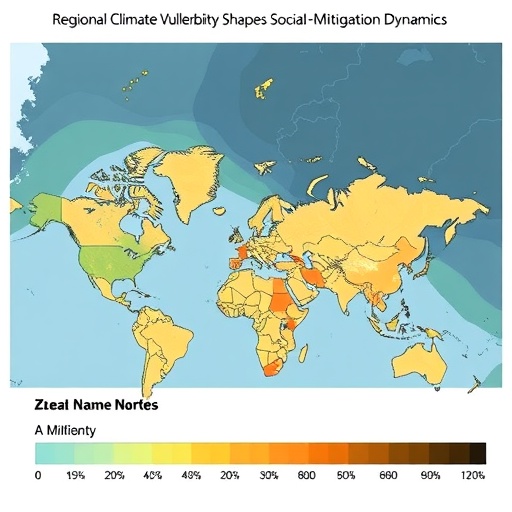
In the ongoing global confrontation with climate change, understanding the nuances of human behaviour and regional disparities in vulnerability is becoming ever more critical. A newly published study by Punnavajhala, Lenton, Bauch, and colleagues, featured in Nature Communications, takes a significant leap by dissecting how regional variations in vulnerability and mitigation efforts influence the broader social-climate dynamics. This research highlights the complex interplay between local climate risks, societal responses, and the emergent global environmental consequences, offering valuable insights for policymakers and scientists alike.
At the core of this investigation lies the recognition that no two regions on Earth are impacted equally by climate change. Geographic, socioeconomic, and political factors create a patchwork of vulnerability. Coastal regions face immediate threats from rising sea levels, while arid areas grapple with prolonged droughts and desertification. These disparate challenges necessitate tailored mitigation strategies that reflect the unique circumstances of each locality. The study underscores how these regional differences amplify or constrain collective actions aimed at emissions reductions and adaptation efforts.
Using advanced computational modeling and social simulation frameworks, researchers reconstruct the feedback loops that link human behaviour with climate outcomes. These models incorporate variables such as economic disparity, infrastructure resilience, cultural attitudes towards environmental risk, and political will. The results illustrate that regions with heightened vulnerability often experience a paradox: despite facing severe risks, they might lack the capacity or resources to implement robust mitigation behaviours. Conversely, less vulnerable regions sometimes exhibit greater willingness and means to adopt sustainable practices, leading to a complex, multi-scalar landscape of climate action.
A crucial finding from this research is the identification of social tipping points—critical thresholds where small changes in public opinion or policy lead to rapid shifts in collective behaviour. These tipping points are highly sensitive to regional contexts. For example, communities experiencing frequent climate disasters may reach a tipping point sooner due to increased urgency, while others remain complacent. Such dynamics reveal how localized experiences of climate change act as catalysts or inhibitors of broader social mobilization and policy change.
Another aspect explored in the study is the role of mitigation behaviour diffusion across regions. Information sharing, migration, and economic interdependencies spread environmental practices unevenly. The research emphasizes that adopting mitigation behaviours in one region can have ripple effects, encouraging neighbouring areas to follow suit. However, this diffusion is often hindered by regional inequalities in education, technological access, and governance structures, thereby limiting the global potential for coordinated climate action.
Furthermore, the authors delve into the psychological and social drivers behind climate-related behaviours. Risk perception, social norms, and trust in institutions shape individual and collective responses to climate change. Notably, regions afflicted by repetitive climate disasters tend to develop a heightened risk awareness, motivating mitigation. However, chronic exposure without effective interventions can also breed fatalism, reducing proactive efforts. Understanding these psychosocial patterns is essential for designing effective communication strategies that resonate across diverse regional contexts.
The interplay between mitigation behaviour and economic incentives receives particular attention. Financial mechanisms such as subsidies, carbon pricing, and insurance policies influence local decision-making. The study illustrates that well-designed economic tools tailored to regional vulnerabilities can bridge the gap between awareness and action. For instance, in areas where agriculture dominates livelihoods, incentives for sustainable farming practices correlate strongly with increased mitigation efforts, demonstrating the power of aligning economic interests with climate goals.
Climate governance structures emerge as a pivotal factor in shaping regional responses. Decentralized governance can empower local communities to implement context-specific strategies efficiently. Yet, fragmentation in authority often impedes coordinated action across borders. The authors argue for multilevel governance frameworks that balance local autonomy with integrated, trans-regional cooperation, enabling holistic approaches that address social-climate feedbacks comprehensively.
As the research projects future scenarios, it becomes evident that failure to account for regional variation risks undermining global mitigation targets. Uniform policy prescriptions may neglect the unique socio-environmental realities, fostering resistance or ineffective implementation. The study advocates for adaptive governance, where policies are continuously refined based on feedback from local outcomes and shifting regional circumstances. Such flexibility can better accommodate uncertainties inherent in climate projections and social dynamics alike.
Intriguingly, the investigation links climate vulnerabilities with migration patterns, revealing how environmental stressors drive population movements that, in turn, alter the socio-political fabric of both source and destination regions. Migration can exacerbate vulnerability in receiving areas but also catalyze cultural exchanges that promote mitigation awareness. This double-edged effect highlights the importance of integrating migration dynamics into climate policy frameworks to enhance resilience regionally and globally.
The study’s methodological rigor is reflected in its combination of empirical data from climate models, socioeconomic indicators, and behavioural surveys with scenario-based simulations. This multidisciplinary approach yields a granular understanding of not only “what” regions are vulnerable but “how” social responses develop and interact with climate processes over time. The findings serve as a foundation for transdisciplinary collaboration among climatologists, social scientists, economists, and policymakers aiming to translate science into actionable solutions.
Importantly, the authors highlight the need for enhanced data collection at regional scales to refine models further. Many current datasets lack the resolution necessary to capture localized vulnerabilities and behavioural patterns effectively. Investments in monitoring infrastructure, remote sensing technologies, and social sensing platforms are crucial for building datasets that inform more precise and equitable mitigation strategies tailored to diverse contexts.
The implications for international climate negotiations are profound. Recognizing regional disparities and behavioural complexities calls for differentiated responsibilities and support. Developed nations might intensify assistance to vulnerable regions through technology transfer, financial aid, and capacity-building initiatives. Aligning global commitments with ground-level realities enhances fairness and feasibility, fostering trust and cooperation necessary for sustained climate action.
In conclusion, this breakthrough study by Punnavajhala and colleagues illuminates the intricate tapestry of regional disparities and behavioural dynamics shaping humanity’s response to climate change. By unveiling how localized vulnerabilities influence social tipping points, mitigation behaviour diffusion, and governance efficacy, it provides a sophisticated framework for crafting more nuanced, effective, and socially equitable climate policies. The research underscores that addressing climate change is as much about understanding people and societies as it is about forecasting physical environmental changes.
As the global community intensifies efforts to curb greenhouse gas emissions and adapt to inevitable climate impacts, incorporating these social-climate dynamics into strategic planning becomes indispensable. This study not only enriches scientific knowledge but also galvanizes action towards a synchronized, inclusive response to one of the most pressing challenges of our time. The path to sustainability demands blending regional awareness with collective resilience, a challenge that this pioneering work begins to address comprehensively.
Cite Scienmag News
Sloane Callahan. (June 4, 2026). Regional Climate Vulnerability Shapes Social-Mitigation Dynamics. Scienmag. https://scienmag.com/regional-climate-vulnerability-shapes-social-mitigation-dynamics/
Sloane Callahan. "Regional Climate Vulnerability Shapes Social-Mitigation Dynamics." Scienmag, 4 June 2026, https://scienmag.com/regional-climate-vulnerability-shapes-social-mitigation-dynamics/. Accessed 6 September 2026.
Sloane Callahan. "Regional Climate Vulnerability Shapes Social-Mitigation Dynamics." Scienmag. June 4, 2026. https://scienmag.com/regional-climate-vulnerability-shapes-social-mitigation-dynamics/


