


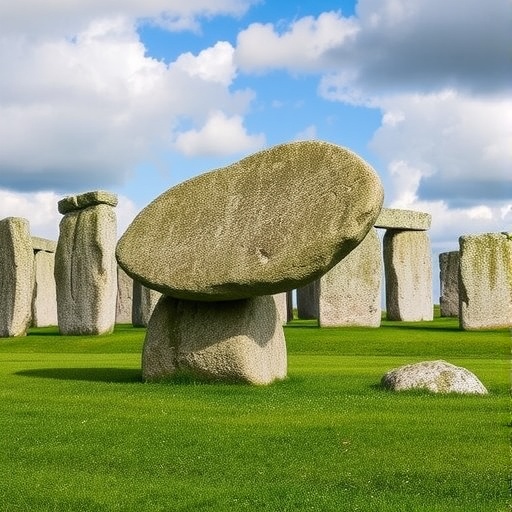
New groundbreaking research from Curtin University has shed light on the complex and awe-inspiring journey of Stonehenge’s enigmatic Altar Stone, revealing the incredible ingenuity and determination of prehistoric communities. This six-tonne sandstone monolith, central to one of the world’s most iconic prehistoric monuments, is now believed to have been transported over an astonishing distance of approximately 700 kilometers from its source in northeast Scotland to its final resting place on Salisbury Plain.
The origins of this towering megalith have long puzzled archaeologists and geologists alike, with speculation ranging from natural glacial movement to human endeavor. Previous studies had dismissed glaciers as the sole agents responsible for relocating these massive stones, but the specifics of how ancient peoples traversed great distances and complex terrain had remained elusive. By integrating mineral grain dating with sophisticated ice-sheet modelling, the Curtin University team set out to trace the stone’s provenance with unparalleled precision and to evaluate the plausible transport mechanisms involved.
At the core of this investigation was a detailed examination of the mineralogical fingerprint of the Altar Stone. Using state-of-the-art geochemical analysis, the researchers identified distinct mineral grains that unequivocally linked the stone’s origin to specific geological formations in the Scottish Highlands. This insight was crucial in challenging prior hypotheses and enabling the team to map potential routes that might have been taken during the Neolithic period.
Complementing these geochemical findings, computational modeling of ice-sheet dynamics during the last Ice Age helped establish the boundaries of glacial reach. The models demonstrated that while glaciers could have moved rocks regionally—potentially depositing stones as far as Dogger Bank in the North Sea—they failed to provide any viable pathway that would bridge the immense distance to southern England. This effectively rules out any natural ice-driven transportation of the stone all the way to Stonehenge, reinforcing the argument for human agency.
Dr. Anthony Clarke, a co-lead author and renowned expert in mineral systems at Curtin’s School of Earth and Planetary Sciences, emphasized that the findings point distinctly toward deliberate human transport. He highlighted the logistical challenges, noting that moving a multi-tonne sandstone block across a landscape punctuated by mountains, rivers, and coastal areas would have necessitated meticulously planned phases of conveyance, possibly combining overland hauling with riverine and coastal navigation.
Such an undertaking would demand a high degree of social organization, cooperative labor, and expert knowledge of the terrain—elements that have often been underappreciated in discussions about Neolithic capabilities. “Transporting a stone of this magnitude over hundreds of kilometers is a testament to the sophisticated planning and communal effort of prehistoric societies,” Dr. Clarke stated, underscoring the intellectual and physical demands of such an enterprise.
The study’s multi-disciplinary approach, incorporating geochemical provenance techniques and dynamic ice-sheet modeling, sets a new benchmark in archaeological science. It provides a robust analytical framework not only for unraveling Stonehenge’s mysteries but also for exploring other megalithic monuments worldwide where origins and transport methods remain enigmatic.
Intriguingly, the research hints at a complex network of prehistoric routes that could have been utilized for such monumental undertakings. These pathways may have leveraged natural waterways and coastal avenues, facilitating segments of transport that minimized overland challenges. The possibility of staging points and waystations aligns with emerging evidence of interconnected Neolithic communities capable of extensive cooperation.
This enhanced understanding of Stonehenge’s Altar Stone journey challenges previous narratives that underestimated ancient peoples’ capabilities and elevates the monument’s construction as a pinnacle of prehistoric ingenuity. It vividly portrays the monumental physical and cognitive challenges overcome, reflecting not only archaeological mechanics but also the cultural and symbolic significance invested in the monument by its builders.
Future research endeavors promise to refine the pinpointed exact source of the Altar Stone within the Scottish Highlands, further clarifying the routes employed in its transport. Additional geochemical and geographic data will continue to unravel the logistical sophistication behind these ancient projects, offering deeper insights into prehistoric landscape use and mobility.
Collaboration with leading institutions such as Sheffield Hallam University, the University of Sheffield, Wessex Archaeology, and the University of Bristol underscores the study’s interdisciplinary nature and the collective scholarly commitment to uncovering the secrets of Stonehenge. This synthesis of expertise from geology, archaeology, and computational modeling heralds a new era in understanding our shared heritage.
In conclusion, this research not only illuminates the monumental origins and journey of the Altar Stone but reframes it as a narrative of human perseverance, innovation, and cooperation that challenges our modern perceptions of prehistoric societies. The journey from the Highlands to Henge embodies a remarkable chapter of ancient human history, intricately woven through geological science and archaeological inquiry.
News Publication Date: June 4, 2026
Web References: https://doi.org/10.1002/jqs.70080
References: Clarke, A., et al. (2026). From Highlands to Henge: Refining the Provenance and Transport Pathways of Stonehenge’s Altar Stone. Journal of Quaternary Science. DOI: 10.1002/jqs.70080
Cite Scienmag News
Violet Maxwell. (June 4, 2026). New Study Unveils Epic Journey of Stonehenge Stone Across Ancient Britain. Scienmag. https://scienmag.com/new-study-unveils-epic-journey-of-stonehenge-stone-across-ancient-britain/
Violet Maxwell. "New Study Unveils Epic Journey of Stonehenge Stone Across Ancient Britain." Scienmag, 4 June 2026, https://scienmag.com/new-study-unveils-epic-journey-of-stonehenge-stone-across-ancient-britain/. Accessed 3 September 2026.
Violet Maxwell. "New Study Unveils Epic Journey of Stonehenge Stone Across Ancient Britain." Scienmag. June 4, 2026. https://scienmag.com/new-study-unveils-epic-journey-of-stonehenge-stone-across-ancient-britain/


