


In a groundbreaking development that could redefine recovery pathways for stroke survivors, researchers from the University of Pittsburgh School of Medicine have unveiled compelling evidence supporting the use of spinal cord stimulation to dramatically improve arm and hand functionality in individuals suffering from chronic post-stroke hemiparesis. This pioneering pilot clinical trial, recently published in Nature Medicine, elucidates a novel neurological intervention that harnesses electrical stimulation to augment motor function in profoundly weakened limbs, offering renewed hope for a patient population long challenged by limited rehabilitative options.
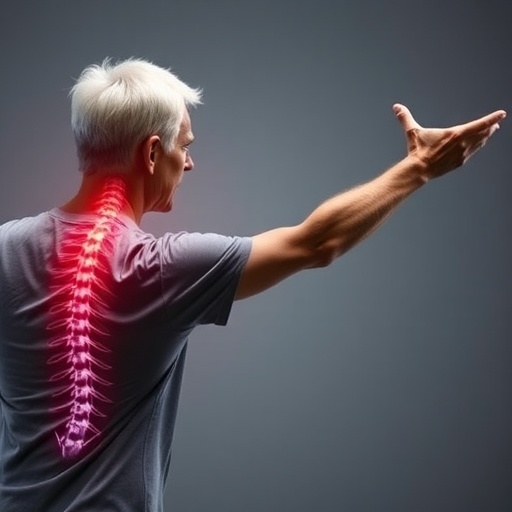
Stroke remains the principal cause of adult arm paralysis in the United States, afflicting nearly 400,000 individuals annually with chronic weakness that severely restricts daily activities and independence. Traditional rehabilitation strategies have been largely ineffectual in yielding significant improvements for many patients with severe muscle impairment. Addressing this pervasive shortfall, the University of Pittsburgh team embarked on a first-of-its-kind investigation into cervical epidural spinal cord stimulation—a technique that involves the implantation of ultra-thin electrodes around the neck region of the spinal cord to deliver precise electrical impulses.
The core mechanism driving the observed functional gains involves targeted electrical activation of sensory nerve fibers within the spinal cord. Such stimulation enhances the transmission and efficacy of residual neural signals descending from the brain, many of which remain dormant but intact despite stroke-related damage. By effectively “unmasking” these latent connections, the stimulation facilitates more efficient recruitment of motor circuits controlling arm and hand movements. This empowerment of residual neural pathways exemplifies an innovative shift from standard therapeutic paradigms toward assistive neuroprosthetic technologies.
Over the four-week trial, seven participants experiencing profound post-stroke arm weakness underwent this intervention with less than nine hours of supplementary movement-based training, a regimen remarkably brief compared to conventional rehabilitation protocols. Findings indicated an average 32% increase in arm strength across all subjects, irrespective of baseline impairment severity, accompanied by marked improvements in overall limb mobility. A crucial secondary outcome from the study was the substantial reduction in muscle spasticity, a common and debilitating sequela of stroke characterized by involuntary muscle stiffness and contractions caused by disrupted neural pathways.
Safety and tolerability, paramount concerns in innovative neurotechnological interventions, were thoroughly evaluated. Encouragingly, no serious adverse events or significant discomfort were reported during the trial, underscoring the feasibility of cervical epidural stimulation as a clinical tool. This safety profile, combined with the observed functional benefits, positions spinal cord stimulation as a viable candidate for broader application beyond controlled clinical environments.
Notably, the therapeutic effects manifested immediately upon activation of the stimulator, an observation distinguishing this approach from traditional rehabilitative techniques that necessitate prolonged and intensive training to generate change. However, researchers observed that motor improvements were contingent upon continuous stimulation; cessation of electrical impulses resulted in a regression of functional gains. This dependency highlights the technology’s role as an assistive device designed to supplement neural function in real time, rather than a permanent restorative treatment.
The clinical implications of these findings resonate profoundly. Co-author Dr. George Wittenberg emphasizes that even seemingly modest increments in motor strength translate into meaningful enhancements in the quality of life for stroke survivors, enabling basic tasks such as buttoning a shirt or opening the hand—milestones previously out of reach. These functional improvements can forge pathways for reengaging in cherished activities, fostering autonomy and psychological well-being.
This study sits at the confluence of engineering innovation and neurological science, drawing upon decades of experience harnessing spinal cord stimulation for chronic pain management. The adaptation of these devices for motor recovery signifies a transformative broadening of their therapeutic repertoire. Researchers utilized advanced electrode arrays and stimulation parameters tailored specifically to the cervical spinal segments governing upper limb function, emphasizing precision and customization in intervention design.
Looking forward, the research team has initiated recruitment for a larger-scale clinical trial aimed at assessing long-term efficacy, both as a stand-alone therapy and in synergy with physical therapy. This extended investigation will explore whether prolonged usage of spinal cord stimulators can engender neuroplastic changes that confer more sustained functional restoration. The study’s integration within the National Institute of Neurological Disorders and Stroke’s (NINDS) 75th-anniversary innovation spotlight underscores its significance in the quest for advanced neurorehabilitation technologies.
In summary, the successful demonstration of spinal cord stimulation facilitating meaningful arm movement and spasticity reduction in chronic stroke patients heralds a new chapter in neurorehabilitation. By leveraging targeted electrical modulation to potentiate the brain-spinal cord-muscle axis, this approach offers a pragmatic, implantable modality capable of enhancing daily function. As technology progresses and clinical trials expand, the potential for spinal cord stimulation to become a mainstay in stroke recovery is both promising and profound.
News Publication Date: June 4, 2026
Web References:
- Nature Medicine Article DOI
- University of Pittsburgh Stroke Information
- Clinical Trial NCT07153536
- Rehab Neural Engineering Labs, Pitt
- UPMC Rehabilitation Institute
References:
University of Pittsburgh School of Medicine et al., Nature Medicine, 2026.
Cite Scienmag News
Cassandra Pierce. (June 4, 2026). Spinal Cord Stimulation Enhances Arm Mobility in Stroke Survivors. Scienmag. https://scienmag.com/spinal-cord-stimulation-enhances-arm-mobility-in-stroke-survivors/
Cassandra Pierce. "Spinal Cord Stimulation Enhances Arm Mobility in Stroke Survivors." Scienmag, 4 June 2026, https://scienmag.com/spinal-cord-stimulation-enhances-arm-mobility-in-stroke-survivors/. Accessed 4 September 2026.
Cassandra Pierce. "Spinal Cord Stimulation Enhances Arm Mobility in Stroke Survivors." Scienmag. June 4, 2026. https://scienmag.com/spinal-cord-stimulation-enhances-arm-mobility-in-stroke-survivors/


