


Sleeve gastrectomy has become one of the most prevalent weight-loss surgeries in the United States, with approximately 250,000 procedures performed annually. For the majority of patients, postoperative recovery proceeds smoothly without complications. However, a small subset faces a serious and challenging complication: gastric leaks. Occurring in roughly one to three percent of primary surgeries and up to ten percent in revision operations, these leaks involve the escape of gastric fluid into surrounding tissues, resulting in abscess formation and prolonged recovery times.
The standard treatment for gastric leaks involves endoscopic internal drainage, which uses small plastic tubes known as double-pigtail stents. These stents are designed to facilitate the drainage of fluid trapped outside the stomach, thereby promoting healing. Nevertheless, the currently available stents were originally engineered for use in draining bile ducts and not the irregular cavities formed by gastric leaks. This mismatch in design often results in suboptimal drainage efficiency, stent slippage, and the need for multiple endoscopic interventions, increasing patient discomfort and healthcare costs.
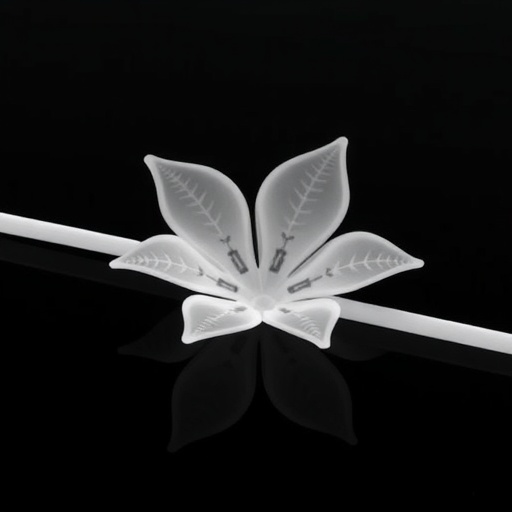
In response to these challenges, researchers at New York University have pioneered a novel stent design that promises to significantly improve the internal drainage of gastric abscesses. Their innovative device, dubbed the Lily stent, is emerging from a comprehensive design framework called PETALS—Personalized Endoscopic Transmural Abscess Leak Solution. This framework employs advanced mathematical modeling and computer simulations to optimize the stent’s geometry, adapting its shape based on the viscosity and pressure characteristics of gastric fluids. Significantly, this new approach extends beyond the realm of gastric leaks, offering potential solutions for a variety of medical scenarios where efficient drainage of complex biological fluids is needed.
The crux of the PETALS framework lies in the realization that the stent’s external geometry, rather than its internal diameter, plays the pivotal role in determining fluid flow rates. Contrary to intuitive assumptions that increasing tube diameter enhances drainage, the team found that wider tubes inadvertently reduce the exterior gap through which most fluid flows, thus impeding effective drainage. Instead, by engineering a cross-sectional shape that increases the exterior surface area and creates more pathways around the stent, fluid mobility is dramatically improved. The Lily stent incorporates a six-part structural design that carefully balances these parameters to maximize drainage performance.
Khalil Ramadi, assistant professor at NYU Abu Dhabi and NYU Tandon School of Engineering and senior author on the study, highlights the novelty of the approach: “We’re not just making it out of a different material. We’re changing the shape to make it work better.” This shift away from simply placing a tubular device towards strategically engineering its structural function exemplifies a new era of bio-inspired medical device design, focusing on form to enhance function at a fundamental level. By integrating fluid dynamics principles into stent geometry, the team has opened new pathways to optimize internal medical devices for treatment outcomes.
If clinical translation follows the encouraging laboratory results, the impact could be profound. Approximately 2,500 patients in the United States annually undergo interventions for gastric leaks post-bariatric surgery. Current protocols involve multiple endoscopic procedures over extended periods to ensure adequate drainage and healing. The Lily stent, with its improved drainage capacity, has the potential to reduce the duration and frequency of these procedures, leading to quicker recoveries and lower healthcare costs while also alleviating patient distress associated with repeated interventions.
At present, the Lily stent has advanced through extensive computer modeling and benchtop testing, demonstrating superior flexibility compared to conventional polyethylene stents. Flexibility is a critical feature for surgeons, correlating with easier device placement, enhanced patient comfort, and diminished tissue trauma. Moreover, initial short-term animal studies reveal no significant histological differences between tissue exposed to the Lily stent and that surrounding standard polyethylene devices, suggesting a favorable biocompatibility profile. This is a promising indication for future in vivo studies that are essential before clinical application.
A particularly advantageous aspect of the Lily stent is its constant cross-sectional geometry, enabling fabrication via standard extrusion manufacturing processes. This means the device can be produced efficiently and affordably, without requiring hospitals to invest in expensive 3-D printing capabilities or other specialized equipment. Scalability and ease of integration into existing clinical workflows are critical factors in the device’s potential adoption, and the design team has proactively addressed these considerations.
Research assistant Parima Phowarasoontorn, the paper’s first author, emphasizes the translational potential: “Instead of simple tubes, we introduce cross-sectional designs that improve drainage while remaining compatible with existing endoscopic delivery procedures.” This integration is crucial for clinical acceptance, allowing surgeons to seamlessly adopt the device without altering standard procedural protocols or retraining extensively. The Lily stent exemplifies a balance of cutting-edge design and practical utility.
The conceptual breakthrough achieved in the Lily stent mirrors innovations previously developed in Ramadi’s laboratory, notably the CORAL capsule. This ingestible pill utilizes a coral-inspired microstructure to trap microbiota within the small intestine, enabling unprecedented insights into gut microbial communities linked to various diseases. Both technologies reflect a broader philosophy that draws inspiration from natural geometries to tackle biomedical engineering challenges that conventional designs have struggled to overcome. This bioinspired design ethos continues to show promise in creating medical devices that perform more efficiently by mimicking complex structures found in nature.
While still in the early stages, the Lily stent has marked a significant step forward in the engineering of endoscopic drainage devices. The interplay between advanced fluid mechanics, mathematical optimization, and materials science exemplifies a modern multidisciplinary approach to medical innovation. Further animal studies are underway to evaluate long-term biocompatibility and functional efficacy, essential precursors to human clinical trials. Should these results remain consistent, the Lily stent could revolutionize the management of gastric leaks and set new standards for treating abscesses and fluid collections throughout the body.
This research heralds a shift in the paradigm of stent design, prioritizing strategic external surface geometry tailored to physiological fluid dynamics rather than traditional one-size-fits-all internal diameters. Such precision engineering, facilitated by the PETALS framework, opens doors for personalized medical devices designed for specific patient anatomies and pathologies. Ultimately, this bioengineering milestone underscores how rethinking fundamental device structures can yield significant improvements in patient care, recovery times, and healthcare efficiency.
The Lily stent’s design and development highlight a promising future wherein medical devices are no longer passive tools but actively optimized structures engineered at a microscopic and geometrical level to perform precisely as needed. This advancement in endoscopic internal drainage could lead to fewer complications, faster healing, and better overall outcomes for patients suffering from the challenging complication of gastric leaks, a testament to the power of innovation grounded in science and inspired by nature.
Keywords
Bioengineering, medical devices, gastric leak, sleeve gastrectomy, internal drainage, endoscopic stents, fluid dynamics, personalized medical devices, biocompatibility, PETALS framework, Lily stent, biomedical innovation
Cite Scienmag News
Ophelia Keating. (June 3, 2026). Lily-Shaped 3D-Printed Stent Promises Faster Recovery After Weight-Loss Surgery. Scienmag. https://scienmag.com/lily-shaped-3d-printed-stent-promises-faster-recovery-after-weight-loss-surgery/
Ophelia Keating. "Lily-Shaped 3D-Printed Stent Promises Faster Recovery After Weight-Loss Surgery." Scienmag, 3 June 2026, https://scienmag.com/lily-shaped-3d-printed-stent-promises-faster-recovery-after-weight-loss-surgery/. Accessed 4 September 2026.
Ophelia Keating. "Lily-Shaped 3D-Printed Stent Promises Faster Recovery After Weight-Loss Surgery." Scienmag. June 3, 2026. https://scienmag.com/lily-shaped-3d-printed-stent-promises-faster-recovery-after-weight-loss-surgery/


