


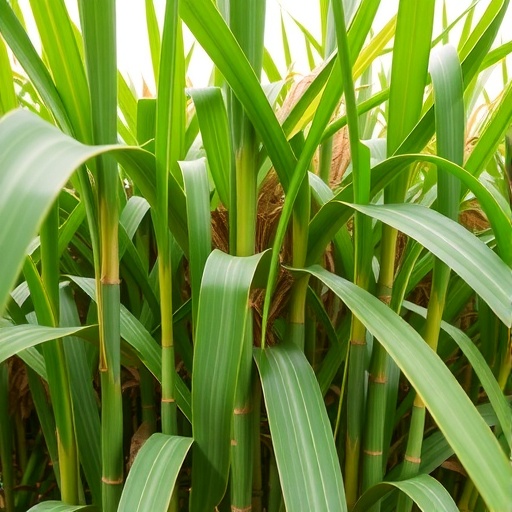
Sugarcane’s extraordinary genetic complexity has finally yielded one of its oldest biological secrets. A new study has resolved how certain sugarcane hybrids inherit an unusually large maternal genome, showing that the process is not a random failure of meiosis but a specific and reproducible form of chromosome restitution. The discovery explains a phenomenon that has influenced sugarcane breeding for more than a century and could provide breeders with a new way to control genetic inheritance in one of the world’s most important sugar and bioenergy crops.
In ordinary meiosis, the specialized cell division that produces eggs and sperm, chromosome numbers are reduced by half. This reduction ensures that fertilization restores the species’ characteristic chromosome complement rather than doubling it in every generation. Sugarcane hybrids, however, have long appeared to break this rule. In many interspecific crosses, the female parent contributes roughly twice as much genetic material as the male parent. The resulting offspring typically carry a two-to-one maternal-to-paternal genomic ratio, a pattern known as female restitution.
For decades, researchers debated the cellular mechanism responsible. One possibility was first division restitution, in which the first meiotic division fails to separate homologous chromosomes correctly. Another was second division restitution, in which the subsequent separation of sister chromatids is disrupted. Cytological observations offered clues but could not definitively distinguish between these alternatives, particularly in sugarcane, whose genome is exceptionally large, repetitive and polyploid.
The new research used haplotype-resolved genome assemblies from two highly complex sugarcane species: the octoploid Saccharum officinarum variety LA Purple and the decaploid Saccharum spontaneum line US56-14-4. Polyploid organisms possess more than two complete sets of chromosomes, and these sugarcane genomes contain multiple related copies of many genes. Separating those copies computationally is challenging because homologous chromosomes can be extremely similar while still carrying important genetic differences.
The researchers then examined eight first-generation hybrids produced between the two species. Their genomic analysis revealed a consistent inheritance pattern: the hybrids received approximately 80 maternal chromosomes and 40 paternal chromosomes. Two of the assemblies showed especially clear canonical haploid configurations, with approximately 40 paternal chromosomes paired with approximately 80 maternal chromosomes. These results demonstrate that the unusual inheritance is not merely an artifact of chromosome counting under a microscope. It is written directly into the DNA sequence and chromosome structure of the hybrids.
The maternal chromosome complement provided the crucial clue. Rather than representing two entirely independent maternal chromosome sets, the approximately 80 maternal chromosomes consisted of 40 pairs of duplicated sister chromatids. These chromatids were not exact copies. Before their duplication was retained, they had undergone partial recombination, meaning that genetic segments had been exchanged between homologous chromosomes during meiosis. The resulting maternal contribution preserved around 62.5 percent of the mother’s genetic diversity, a signature predicted for second division restitution.
In second division restitution, the first meiotic division proceeds sufficiently to allow homologous chromosomes to pair and recombine, but the second division fails to separate sister chromatids normally. Instead of producing reduced gametes containing one copy of each chromosome, the process generates an unreduced egg that retains duplicated maternal material. When this egg fuses with a normal haploid sperm, the offspring receives two maternal genomic sets for every one paternal set. The new genomic evidence indicates that this is precisely what occurs in the sugarcane hybrids examined.
To identify the mechanism at molecular resolution, the team combined single-molecule, long-read DNA sequencing with a new computational algorithm designed for highly polyploid genomes. Long-read sequencing can span large structural regions and resolve complex recombination patterns that are often fragmented by conventional short-read technologies. The algorithm detected two classes of recombination breakpoints, the locations where chromosome segments had exchanged partners. One class matched expected recombinant structures, while the second represented a previously unrecognized configuration supported by both recombinant and non-recombinant sequencing reads.
The presence of this distinctive breakpoint pattern across all of the hybrids provided an independent genetic signature of second division restitution. Instead of relying solely on chromosome appearance during meiosis, the researchers could trace the products of meiotic behavior through inherited DNA. That combination of chromosome-scale assemblies, long reads and breakpoint analysis effectively transformed a century-old cytological question into a genomic one—and supplied an answer.
The finding matters far beyond the resolution of a historical debate. Sugarcane is cultivated worldwide for sucrose, ethanol and other bio-based products, yet its breeding is slowed by a tangled genome and highly irregular chromosome inheritance. Female restitution allows breeders to transmit extensive maternal genetic material to offspring, potentially preserving favorable combinations of alleles that would otherwise be separated during meiosis. Understanding exactly how that transmission occurs could help breeders predict which traits will be inherited and design crosses more efficiently.
The study also presents a broader strategy for investigating unusual forms of meiosis in polyploid plants. Reproductive systems that generate unreduced gametes have played a major role in the evolution of flowering plants, where whole-genome duplication can create new genetic resources and sometimes contribute to the emergence of new species. By identifying recombination patterns that diagnose second division restitution, the researchers provide a genomic framework that may be applicable to other crops and polyploid organisms. In sugarcane, a biological oddity that once seemed difficult to control may now become a powerful tool for accelerating genetic gain.
Cite Scienmag News
Juliet Wilcox. (August 5, 2026). Revealing How Female Restitution Occurs in Sugarcane Hybrids. Scienmag. https://scienmag.com/revealing-how-female-restitution-occurs-in-sugarcane-hybrids/
Juliet Wilcox. "Revealing How Female Restitution Occurs in Sugarcane Hybrids." Scienmag, 5 August 2026, https://scienmag.com/revealing-how-female-restitution-occurs-in-sugarcane-hybrids/. Accessed 4 September 2026.
Juliet Wilcox. "Revealing How Female Restitution Occurs in Sugarcane Hybrids." Scienmag. August 5, 2026. https://scienmag.com/revealing-how-female-restitution-occurs-in-sugarcane-hybrids/


