


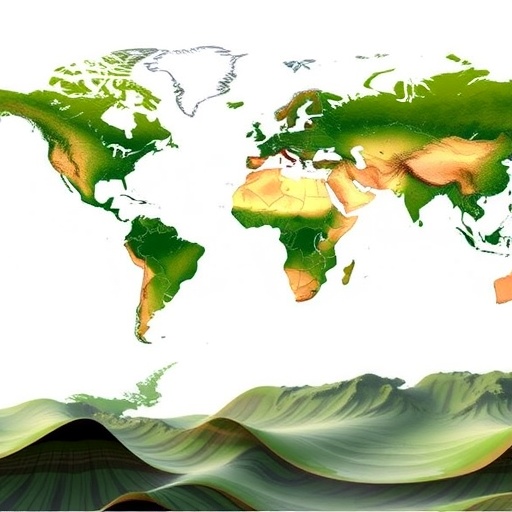
In a groundbreaking study set to reshape our understanding of terrestrial ecosystems, researchers have unveiled a novel differentiable land model that elucidates the complex and often hidden interactions governing ecological functions on a global scale. This innovative approach integrates cutting-edge machine learning techniques with classical ecological theory to reveal the subtle environmental controls that modulate latent ecological processes, potentially revolutionizing predictions of ecosystem responses to climate change and land-use alterations.
The team, led by Fang, Bowman, Zhao, and colleagues, employs a differentiable modeling framework that enables seamless integration of diverse datasets, ranging from remote sensing products to in-situ measurements. Unlike traditional models that often rely on fixed parameterizations and heuristic assumptions, this model leverages gradient-based optimization to fine-tune parameters dynamically. This allows for a much more precise capture of ecological variability across multiple spatial and temporal scales, unveiling previously obscured patterns in ecosystem function.
Central to this advancement is the concept of differentiability—a mathematical property that permits models to compute gradients with respect to inputs and parameters continuously. This capability facilitates end-to-end training of the model, akin to neural networks in deep learning, but tailored explicitly for ecosystem processes. Such an approach dramatically enhances the model’s ability to assimilate new data, adapt to changing environmental conditions, and improve predictive accuracy, marking a significant leap forward from static or rule-based land models.
The differentiable land model addresses persistent challenges in ecological forecasting, including the high dimensionality and nonlinearity inherent in ecological data. By incorporating adaptive optimization algorithms, the model disentangles the influences of complex environmental drivers such as temperature, soil moisture, nutrient availability, and anthropogenic impacts. This granular insight allows it to elucidate how these drivers interplay to control latent ecological functions like carbon sequestration, nutrient cycling, and biomass productivity, which are often masked in aggregate observational data.
A particularly striking outcome of this research is the revelation of global patterns of latent ecological functions that vary in response to subtle environmental gradients. These findings underscore the sensitivity of ecosystem processes to changes in climate variables and land management practices, providing policymakers and conservationists with refined tools for ecosystem monitoring and intervention. The model’s capacity to simulate hypothetical scenarios also allows stakeholders to anticipate the ecological consequences of future environmental perturbations, thereby enhancing preparedness and adaptation strategies.
The methodological innovation extends beyond ecological modeling, bridging disciplines by integrating techniques traditionally reserved for artificial intelligence into environmental science. This fusion enables unprecedented levels of model transparency and interpretability because each parameter can be traced back to physical or biogeochemical processes. Consequently, researchers can pinpoint specific environmental controls responsible for observed changes, fostering a deeper mechanistic understanding that transcends empirical correlations.
Moreover, the differentiable nature of the model promotes ecosystem-scale feature learning, enabling the system to infer underlying ecological functions directly from raw data. This contrasts sharply with conventional models that require extensive manual feature engineering and domain expertise. The automation of feature discovery accelerates model development cycles and enhances scalability, making the approach applicable to diverse ecosystems ranging from tropical rainforests to arid grasslands.
One of the most exciting implications of this work is its potential to improve Earth system models (ESMs), which form the backbone of climate projections. Traditional ESMs often struggle to accurately represent land-atmosphere interactions due to simplified or static representations of ecological processes. Integrating differentiable land models into these frameworks can enhance their fidelity, allowing more realistic simulations of feedback loops between vegetation, soil, and the atmosphere under varying climate scenarios.
In practical terms, the model’s outputs can inform carbon budget assessments by providing more nuanced estimates of terrestrial carbon fluxes. Given the critical role of land ecosystems in sequestering atmospheric carbon dioxide, understanding the controls on latent ecological functions is essential for achieving international climate targets. This insight also supports the design of nature-based solutions, where strategic restoration or management practices are implemented to amplify ecosystem services such as carbon storage and biodiversity conservation.
The study’s extensive use of remote sensing data underscores the importance of leveraging satellite and airborne observations in ecosystem research. By coupling real-time environmental monitoring with differentiable models, researchers can maintain continuously updated assessments of ecosystem health and function. This dynamic monitoring capability is particularly vital in the face of rapid environmental changes induced by human activity and natural disturbances like wildfires and droughts.
While the differentiable land model represents a significant advance, the authors acknowledge existing limitations, such as computational complexity and the need for high-quality input data. Addressing these challenges will require sustained interdisciplinary collaboration and investments in data infrastructure. Nevertheless, the framework is designed to evolve with ongoing improvements in computational power and data availability, positioning it at the forefront of future ecological modeling efforts.
Importantly, the generalizability of this modeling approach opens avenues for its application beyond terrestrial ecosystems. Similar differentiable frameworks could be adapted for aquatic, atmospheric, or urban ecological systems, fostering a holistic understanding of Earth’s biosphere. This versatility ensures that the model not only contributes to fundamental ecological science but also supports a broad spectrum of environmental management and policy needs.
The publication of this work in a prominent venue such as Nature Communications signifies its broad scientific impact and the high interest it has already garnered within the ecological and environmental science communities. The authors have made their model and associated datasets accessible, encouraging reuse and further development by researchers worldwide. Such openness is key to accelerating progress in this transformative area of ecological modeling.
As climate change continues to impose unprecedented stress on terrestrial ecosystems, tools capable of revealing the hidden workings of ecological functions hold immense value. This differentiable land model does not merely simulate ecosystem responses; it facilitates a profound understanding of the fundamental biophysical mechanisms at play. In doing so, it empowers society to anticipate, mitigate, and adapt to environmental changes with greater confidence and precision.
Looking ahead, the integration of such models with socio-economic data and human behavioral models could pave the way for comprehensive sustainability assessments. By linking ecological functions with human well-being metrics, these integrated frameworks could guide more equitable and effective environmental decision-making. This research thus lays crucial groundwork for the next generation of holistic environmental stewardship tools.
In conclusion, the differentiable land model developed by Fang, Bowman, Zhao, and their team marks a landmark in ecological science, blending machine learning and ecological theory to unlock latent functions of global ecosystems. Its capacity to dynamically and precisely capture the interplay of environmental controls sets a new standard for ecological modeling. As this approach gains traction, it promises to transform how we monitor, understand, and manage the vital ecosystems sustaining life on Earth.
Cite Scienmag News
Blake Davidson. (May 21, 2026). Differentiable Land Model Uncovers Global Ecological Controls. Scienmag. https://scienmag.com/differentiable-land-model-uncovers-global-ecological-controls/
Blake Davidson. "Differentiable Land Model Uncovers Global Ecological Controls." Scienmag, 21 May 2026, https://scienmag.com/differentiable-land-model-uncovers-global-ecological-controls/. Accessed 3 September 2026.
Blake Davidson. "Differentiable Land Model Uncovers Global Ecological Controls." Scienmag. May 21, 2026. https://scienmag.com/differentiable-land-model-uncovers-global-ecological-controls/


