


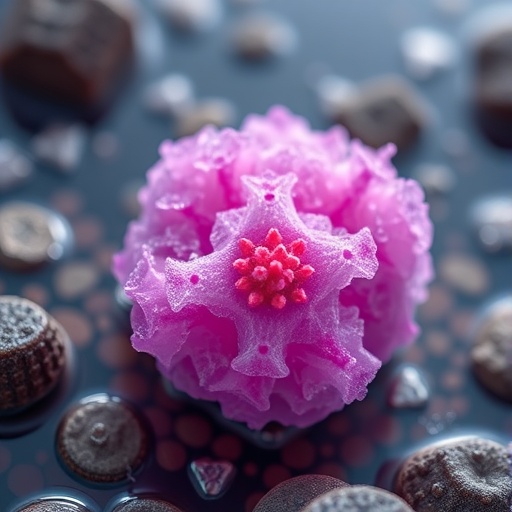
In the ongoing battle against environmental degradation and climate change, breakthroughs in biotechnology are increasingly steering the course toward sustainable and effective remediation strategies. An exciting development in this realm is the creation of artificial symbiotic granules, a novel biotechnological innovation promising to revolutionize water purification and methane reduction simultaneously. This cutting-edge research, published recently in Communications Earth & Environment, introduces a sophisticated biological marvel that adeptly integrates microbial ecosystems to address two critical environmental challenges—water contamination and greenhouse gas emissions—with remarkable synergy.
The foundation of this innovation lies in the engineering of artificial symbiotic granules, which are essentially bioengineered microbial aggregates composed of symbiotic microorganisms. These granules are designed to mimic and enhance natural microbial consortia found in aquatic ecosystems. By creating a microenvironment where distinct microbial species coexist and collaborate, these granules optimize biochemical reactions that remove pollutants from water while concurrently mitigating the release of methane—a potent greenhouse gas primarily responsible for accelerating global warming.
At its core, the development taps into the innate metabolic versatility of microbial communities. Microbes are nature’s adept chemists, capable of breaking down complex organic pollutants and transforming harmful substances into innocuous byproducts. In natural settings, however, the lack of efficient interaction between different microbial groups often limits the efficacy of pollutant degradation and methane consumption. The engineered symbiotic granules overcome this bottleneck by physically and functionally uniting complementary microbial species, thereby fostering an environment in which pollutant degradation and methane oxidation can occur in seamless concert.
Central to these granules are methanotrophic bacteria and heterotrophic microbes working in close proximity. Methanotrophs specialize in oxidizing methane, converting it from a gaseous form into carbon dioxide—a considerably less potent greenhouse gas—through complex enzymatic pathways involving methane monooxygenase enzymes. Meanwhile, heterotrophic bacteria degrade organic contaminants in water, mineralizing organic pollutants into stable components. The juxtaposition of these two functional groups within a single granule enhances electron transfer and metabolite exchange, creating a feedback loop that sustains high microbial activity and improves overall purification efficiency.
Technically, the granules exhibit structural stability in aquatic systems, maintaining their integrity under varying hydrodynamic shear forces, which is crucial for practical deployment in wastewater treatment plants or contaminated natural water bodies. Their granular form allows easier separation after treatment processes, reducing operational costs and environmental footprints. Moreover, these granules are engineered to possess surface characteristics optimizing substrate affinity and microbial colonization—a design achieved through advanced techniques in materials science coupled with microbial ecology principles.
Analytical assessments of the granules reveal impressive performance metrics. In pilot-scale trials, the symbiotic granules consistently reduced chemical oxygen demand (COD) and nutrient concentrations, such as nitrogen and phosphorus compounds, to levels well below environmental safety thresholds. Simultaneously, methane emissions associated with anaerobic degradation processes dropped dramatically, indicating robust bio-oxidation activity within the granules. These results underscore the potential of this technology to transform methane-rich wastewater management by converting liabilities into environmental assets.
The environmental implications resonate strongly in the narrative of climate change mitigation. Methane possesses a global warming potential approximately 28-36 times that of carbon dioxide over a 100-year period, making its reduction a top priority for climate policy and industrial practices. By embedding methanotrophic activity into water purification infrastructures, artificial symbiotic granules provide a dual-function system that tackles methane at its source, minimizing emissions and delivering high-quality effluent in parallel. This integrative approach is a bold stride away from traditional single-focus treatments that often neglect the interconnectedness of pollutant dynamics and greenhouse gas fluxes.
From a mechanistic perspective, the study delves into the interspecies electron transfer mechanisms facilitated by conductive pili and extracellular polymeric substances within the granules. These biological conduits enhance metabolic cooperation by enabling direct electron flow between methanotrophs and heterotrophs, reducing reliance on soluble electron carriers that can diffuse away and cause inefficiencies. The precise orchestration of these microbial interactions illuminates new pathways for bioengineering complex microbial systems with enhanced functional outcomes.
Further genomic and proteomic analysis reveals adaptive regulatory networks within the microbial consortia that respond dynamically to variations in pollutant loads and environmental stressors. Such plasticity is vital for maintaining system resilience during fluctuating operational conditions, ensuring sustained performance over extended periods. These insights not only advance our understanding of microbial ecology but also open avenues for the development of customizable granules tailored to diverse contamination profiles and climatic regimes.
A remarkable feature of these artificial symbiotic granules is their capacity for self-regeneration and growth within treatment environments. Unlike inert filtration media, these living aggregates adapt and propagate, reducing the need for frequent replacement or replenishment. This biological self-sustainability translates into long-term operational savings and minimizes secondary pollution issues associated with chemical regenerants or physical media disposal.
The implications for global water treatment infrastructures are profound. Traditional wastewater treatment facilities often grapple with the challenge of simultaneously removing pollutants and controlling methane emissions, with most solutions addressing either issue in isolation. Integrating artificial symbiotic granules into existing setups can significantly upgrade system efficacy without the need for extensive retrofitting, offering a scalable, cost-effective pathway toward greener industrial practices and improved regulatory compliance.
Beyond wastewater treatment, the technology holds promise for applications in natural water systems experiencing eutrophication and hypoxia due to anthropogenic stress. The finely tuned microbial interactions and pollutant degradation pathways within the granules could restore aquatic ecosystem health by curbing nutrient loads and suppressing methane bubble formation that exacerbates oxygen depletion.
Underlying this breakthrough is a multidisciplinary synergy involving environmental microbiology, materials science, bioengineering, and ecological modeling. The collaborative effort exemplifies the power of cross-sectoral innovation in crafting solutions that are biologically inspired, technically feasible, and environmentally impactful. As research progresses, refining the granule design to incorporate additional microbial functions—such as pathogen degradation or heavy metal sequestration—could further enhance their utility across a broader spectrum of environmental challenges.
Looking forward, field demonstrations and lifecycle assessments will be critical to validate the performance and sustainability credentials of artificial symbiotic granules at scale. Engaging with policymakers, industry stakeholders, and local communities will facilitate technology adoption and ensure alignment with diverse socio-economic contexts. Furthermore, integrating digital monitoring systems could enable real-time tracking of granule health and treatment efficacy, ushering in a new era of smart bioremediation platforms.
This pioneering work showcases how leveraging microbial symbioses can yield transformative advances in environmental technology. By harmonizing pollutant breakdown with greenhouse gas mitigation, artificial symbiotic granules offer an elegant, nature-inspired blueprint for sustainable water management and climate action. Their emergence signals a hopeful trajectory toward cleaner water bodies and a stabilized atmosphere—imperatives for a resilient planet and a thriving future.
Cite Scienmag News
Gregory Coleman. (May 20, 2026). Artificial Symbiotic Granules Boost Water Purification, Cut Methane. Scienmag. https://scienmag.com/artificial-symbiotic-granules-boost-water-purification-cut-methane/
Gregory Coleman. "Artificial Symbiotic Granules Boost Water Purification, Cut Methane." Scienmag, 20 May 2026, https://scienmag.com/artificial-symbiotic-granules-boost-water-purification-cut-methane/. Accessed 3 September 2026.
Gregory Coleman. "Artificial Symbiotic Granules Boost Water Purification, Cut Methane." Scienmag. May 20, 2026. https://scienmag.com/artificial-symbiotic-granules-boost-water-purification-cut-methane/


