


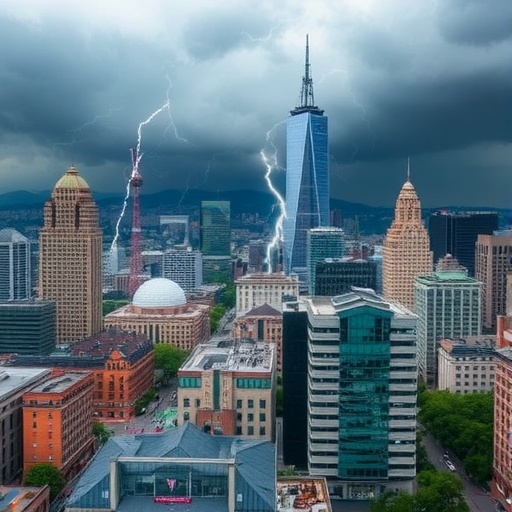
Cities are not merely concrete jungles reshaping the physical landscape—they actively reconfigure the atmospheric conditions around them, profoundly influencing weather patterns. A recent groundbreaking study, published in the esteemed journal Nature, dissects urban rainfall dynamics by analyzing over 40,000 warm-season storm events in four major Texas metropolitan areas: Dallas–Fort Worth, Austin, San Antonio, and Houston. Rather than painting cities as uniformly wetter or drier, this research reveals a far more nuanced picture where urban effects on precipitation hinge critically upon storm typology and structure.
By scrutinizing individual storms rather than relying on long-term averages, the scientific team employed advanced radar technology to unravel the three-dimensional morphology and behavior of distinct storm types as they traversed urban versus rural landscapes. This methodological shift unmasked previously obscured variations, precisely delineating how cities can simultaneously amplify some convective storms while diminishing the intensity of others. Such findings reconcile conflicting past studies and redefine our understanding of urban meteorology.
Among the five categorized storm types—single-cell thunderstorms, larger isolated storms, cold frontal systems, warm frontal systems, and tropical cyclones—small-scale convective thunderstorms exhibited the most consistent enhancement in urban environments. These rapidly developing, localized storms were found to occur 7% to 31% more frequently over cities compared to adjacent rural areas, a remarkable urban signature. Radar data further confirmed these storms grow taller and manifest more intense updrafts amidst urban heat islands, especially during nocturnal hours when cities retain warmth and rural areas cool, thus sustaining convective activity.
This amplification effect is mechanistically linked to the urban heat island phenomenon, whereby built environments trap heat after sunset, inducing stronger vertical motions that invigorate storm cells. The retention of thermal energy within metropolitan regions fuels sustained convection well into the night, offsetting the typical nocturnal weakening observed in rural single-cell thunderstorms. Consequently, urban areas face elevated risks of sudden, intense rainfall episodes that are both spatially confined and temporally brief, exacerbating flood vulnerabilities.
Larger isolated storms, which are more durable and expansive than single-cell varieties, also demonstrate pronounced urban enhancement. Their augmented frequency and increased precipitation intensity over cities pose particular challenges for flood risk management, as intense rainfall over impermeable urban surfaces overwhelms drainage infrastructure. These storms, while transient, contribute significantly to urban hydrological stress, demanding targeted mitigation strategies divergent from conventional reliance on average rainfall metrics.
Conversely, cold frontal storm systems illustrate an inverse trend, with urban areas diminishing their rainfall intensity by approximately 16% to 28%. These expansive, temperature-driven systems rely on stark contrasts in air masses to generate precipitation. The complex surface roughness introduced by buildings and urban structures, coupled with localized heat, disrupts airflow and smooths thermal gradients. This attenuation undermines the frontal dynamics, weakening the resultant precipitation as cold fronts migrate across metropolitan zones.
Intriguingly, the analysis detected subtle intensifications immediately preceding urban boundaries—likely a consequence of the warmer urban air mass sharpening the temperature gradient ahead of the front. However, this pre-urban intensification quickly dissipates as the front moves into the heart of the city and experiences dynamical weakening. Such phenomena highlight the intricate interplay between urban-induced thermal anomalies and synoptic weather systems.
Warm frontal storms, driven by more gradual temperature gradients, exhibit modest and less consistent intensifications over cities. Their precipitation responses are comparatively muted, hinting that urban contributions are subordinate to broader atmospheric controls governing these systems. Similarly, tropical storms and hurricanes showed negligible changes in occurrence frequency or overall intensity over urban areas. Despite this, a subtle shift in the vertical structure of rainfall was noted, with heavier precipitation forming closer to the ground, potentially altering urban flood dynamics by concentrating runoff more rapidly.
This differentiation is attributable to the dominant oceanic heat and synoptic-scale wind patterns fueling tropical systems, which overshadow local urban influences. Hence, while cities do exert secondary structural modifications, their impact pales compared to the vast energy and moisture fluxes inherent to tropical storm environments.
These revelations carry profound implications for urban planning and disaster preparedness. Current infrastructure design typically hinges on regional average precipitation statistics, which tend to obscure the critical explosive rainfall events that generate urban flooding and infrastructure strain. Recognizing which storm types are enhanced or suppressed enables more precise risk assessments and resilience-building, such as optimizing stormwater management to address intensified convective downpours.
Accurate event-scale understanding also elevates emergency response capabilities and weather forecasting accuracy within urban contexts. By transcending simple “wetter or drier” dichotomies, meteorologists and planners can anticipate how specific storm systems will evolve in metropolitan atmospheres, ultimately safeguarding public safety and economic vitality.
The collaborative research effort, funded by NASA and the U.S. Department of Energy, showcases the power of combining large-scale radar datasets with nuanced classification frameworks. It exemplifies how unraveling the complexities of urban meteorology can illuminate the multifaceted ways cities shape weather, steering future scientific inquiry and urban adaptation strategies in a warming world.
News Publication Date: 20-May-2026
Web References:
https://www.nature.com/articles/s41586-026-10479-7
References:
NASA Headquarters, U.S. National Science Foundation, National Institute of Standards and Technology.
Cite Scienmag News
Russell Cooper. (May 21, 2026). How Cities Modify Storms: Impacts Shaped by Storm Characteristics. Scienmag. https://scienmag.com/how-cities-modify-storms-impacts-shaped-by-storm-characteristics/
Russell Cooper. "How Cities Modify Storms: Impacts Shaped by Storm Characteristics." Scienmag, 21 May 2026, https://scienmag.com/how-cities-modify-storms-impacts-shaped-by-storm-characteristics/. Accessed 3 September 2026.
Russell Cooper. "How Cities Modify Storms: Impacts Shaped by Storm Characteristics." Scienmag. May 21, 2026. https://scienmag.com/how-cities-modify-storms-impacts-shaped-by-storm-characteristics/


