


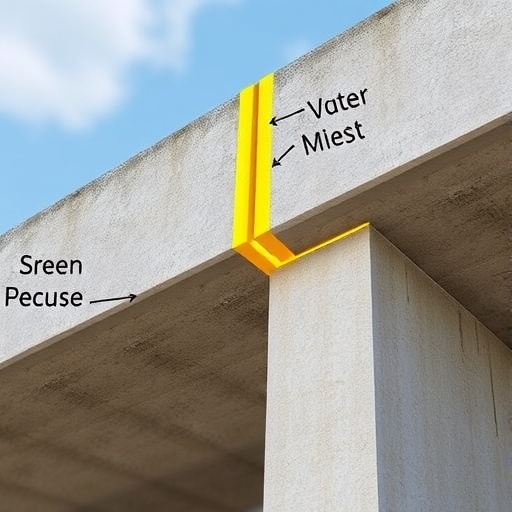
In a groundbreaking study set to reshape the field of civil engineering and materials science, researchers Li, Luo, Wang, and their team have unveiled pivotal insights into the factors influencing the repair performance of concrete beams embedded with shape memory alloys (SMA). The study, slated for publication in Scientific Reports in 2026, offers a transformative advancement in the development of crack self-repairing concrete beams, potentially revolutionizing infrastructure resilience worldwide.
Concrete, the backbone of modern infrastructure, is vulnerable to cracking over time, which compromises structural integrity and safety. Conventional repair methods are often costly, labor-intensive, and unsuitable for inaccessible structural elements. Enter the innovative application of SMAs—special alloys with the unique ability to recover pre-deformed shapes upon heating—integrated within concrete structures. This fusion promises an autonomous self-healing mechanism, enabling damaged beams to regain strength without manual intervention.
The researchers focused their efforts on elucidating the multifaceted variables that affect the effectiveness of SMA-embedded self-repairing concrete beams. These variables span from materials’ characteristics to external environmental conditions and internal stress responses. By systematically investigating these parameters, the study aims to address longstanding challenges in extending the lifespan of concrete infrastructures while minimizing maintenance efforts and costs.
Central to the study is the exploration of SMA activation temperatures. SMAs require a thermal trigger to revert to their original shape, generating the mechanical force necessary to close cracks. The team carefully analyzed the influence of different activation thresholds, noting that precise control of the heating process is critical. Excessive thermal stress could adversely impact the concrete matrix, whereas insufficient activation may lead to incomplete crack closure, hampering the material’s self-repair capability.
Structural design and geometric configuration of the concrete beams also played a crucial role in repair efficacy. The research highlights that beam thickness and the spatial distribution of SMA reinforcements significantly influence the internal stress redistribution during the crack healing process. Adequate placement of SMA fibers ensures uniform recovery forces, optimizing crack closure and restoring the beams’ load-bearing capacity.
Another dimension investigated was the mechanical interaction between the SMA elements and the concrete matrix. The interfacial bonding strength determines the transfer efficiency of recovery stress from the alloy to the concrete substrate. The team utilized sophisticated microscopic analysis to quantify bonding quality and identified that treatments enhancing adhesion substantially improve self-repair performance, reducing the residual crack width after activation cycles.
Environmental factors, including humidity, temperature fluctuations, and exposure to chemical agents, were rigorously tested for their impact on durability and repair efficiency. The findings reveal that prolonged exposure to harsh conditions can degrade both the concrete and SMA properties, potentially impairing long-term self-healing capabilities. Protective coatings and optimized alloy compositions emerged as promising solutions to mitigate environmental degradation effects.
The dynamics of cyclic loading—simulating real-world traffic and seismic activities—were incorporated into the experimental framework. The research demonstrated that repeated mechanical stresses alter the fatigue behavior of SMA-reinforced beams. Ensuring that SMAs retain their shape memory properties under repeated strains is essential for maintaining sustained crack repair functionality throughout the structure’s lifespan.
Advanced computational modeling supported the empirical studies, enabling the prediction of repair performance under variable conditions. Finite element analysis provided comprehensive visualization of stress fields and crack evolution patterns, assisting in the refinement of SMA placement strategies and activation protocols. The synergy between experimental data and computational insights empowered the researchers to propose optimized designs tailored for diverse infrastructure applications.
Importantly, the study introduces a novel method for in-situ monitoring of the self-repair process. Embedded sensors track real-time changes in structural integrity and thermal activation status, offering immediate feedback on repair progression. This smart monitoring system paves the way for intelligent infrastructure capable of autonomous health assessment and maintenance recommendations.
The implications of this research extend beyond traditional civil infrastructure to emerging fields such as smart cities and resilient defense installations. SMA self-repairing concrete beams could potentially reduce maintenance downtime, enhance safety margins, and substantially cut lifecycle costs. Urban planners and engineers stand to benefit from integrating these materials into future construction codes and standards.
The environmental advantages are equally compelling. By decreasing the frequency of manual repairs and the associated consumption of repair materials, the carbon footprint of concrete structures could be significantly lowered. This aligns with global efforts toward sustainable construction practices and the mitigation of material waste.
Looking forward, the research team advocates for scaling up the technology from laboratory samples to full-scale structural elements. They emphasize the need for interdisciplinary collaboration to tackle challenges such as large-scale manufacturing of SMA-embedded concrete and the development of reliable activation systems in field conditions. Additionally, studies on long-term durability under real-world operational loads are crucial.
This landmark research by Li et al. thus lays a robust foundation for next-generation self-healing infrastructure. By meticulously dissecting the intricate factors that dictate repair performance, the study advances the viability of SMA-based concrete beams as a revolutionary solution to structural degradation challenges. As this technology transitions from experimental phases to real-world applications, the future of resilient, sustainable construction appears brighter and smarter than ever before.
Cite Scienmag News
Denise Maddox. (May 21, 2026). SMA Crack Self-Healing Boosts Concrete Beam Repair. Scienmag. https://scienmag.com/sma-crack-self-healing-boosts-concrete-beam-repair/
Denise Maddox. "SMA Crack Self-Healing Boosts Concrete Beam Repair." Scienmag, 21 May 2026, https://scienmag.com/sma-crack-self-healing-boosts-concrete-beam-repair/. Accessed 4 September 2026.
Denise Maddox. "SMA Crack Self-Healing Boosts Concrete Beam Repair." Scienmag. May 21, 2026. https://scienmag.com/sma-crack-self-healing-boosts-concrete-beam-repair/


