


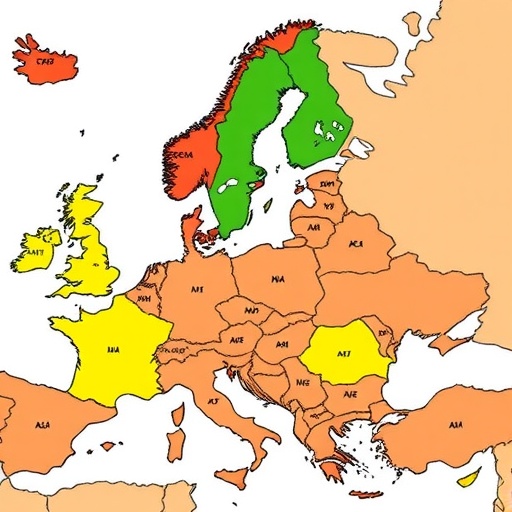
In a groundbreaking study set to transform our understanding of human mobility in Europe, researchers have uncovered the intricate ways in which regional characteristics dictate diverse patterns of movement across the continent. This research, published in the prestigious journal Nature Communications, delves deep into the socio-economic, geographic, and infrastructural factors that shape how people travel within and between European regions. By employing advanced data science techniques and comprehensive datasets, the study offers unparalleled insight into the spatial dynamics of human activity, holding profound implications for urban planning, transportation policy, and economic development.
The investigation leveraged a multidisciplinary approach, combining elements from geography, sociology, and computational modeling to dissect the complexity of mobility behaviors in a way never attempted before. Using anonymized mobility data sourced from mobile devices, the researchers tracked millions of individual movements over extended periods, thereby capturing nuances of daily commutes, long-distance travels, and even leisure-based trips. This methodology allowed them to quantify mobility typologies with remarkable precision, distinguishing between routine and occasional trips while contextualizing them within region-specific frameworks such as urban density, economic vitality, and transport infrastructure quality.
One of the pivotal findings of the study is the identification of distinctive mobility regimes that correlate strongly with regional socioeconomic conditions. Wealthier metropolitan areas exhibited intricate mobility networks with high trip frequencies but shorter travel distances on average, reflecting dense public transit options and economic interconnectivity. In contrast, less affluent or rural regions demonstrated a contrasting mobility pattern characterized by fewer but longer commutes, highlighting the reliance on private vehicles and limited access to efficient transportation services. These patterns not only elucidate the immediate travel behaviors of populations but hint at deeper structural inequalities embedded within the European mobility landscape.
Spatial heterogeneity, as the study reveals, is a fundamental driver behind human mobility disparities. Geographic barriers such as mountain ranges, rivers, and the urban-rural divide impose natural constraints on movement, which interact intricately with human-made infrastructures like road networks and rail systems. The research meticulously mapped these elements to explain regional mobility variations, emphasizing the need for tailored policy interventions that respect local topologies and demographic realities. For instance, enhancing connectivity in peripheral areas may require different strategies from those suitable for densely populated urban centers, where congestion and overcrowding pose bigger challenges.
Crucially, the research sheds light on how temporal factors influence mobility types. Seasonal shifts, economic cycles, and even unexpected disruptions (such as pandemics) have variable impacts depending on regional characteristics. Areas with diversified economies and resilient infrastructures showed greater adaptability, maintaining more stable mobility patterns amid disruptions. Conversely, regions heavily dependent on tourism or specific industries experienced significant fluctuations, underscoring vulnerabilities that policymakers must address to foster sustainable mobility systems.
The technological backbone of the study was a sophisticated analytical pipeline centered on machine learning algorithms capable of extracting meaningful patterns from vast and complex mobility datasets. By integrating spatial statistics with predictive modeling, the researchers could simulate future mobility scenarios under varying regional development plans and infrastructural investments. These simulations provide valuable foresight for urban planners and decision-makers aiming to optimize transport networks and reduce socio-economic disparities tied to mobility access.
Moreover, the study’s comprehensive dataset included multimodal transport data, allowing the differentiation between private car usage, public transit, cycling, and pedestrian movements. This granularity revealed important modal splits tied to regional characteristics. Metropolitan regions with robust public transport infrastructures exhibited higher proportions of sustainable mobility modes, whereas car-dependent regions faced environmental and social challenges stemming from heavy automobile reliance. Insights from this part of the analysis highlight critical opportunities to promote greener transport policies tailored to regional strengths and weaknesses.
Another dimension explored in the research is the role of demographic factors such as age distribution, household composition, and employment patterns in shaping mobility behaviors. Younger populations and working professionals tend to engage in more frequent and diverse trip types, while older demographics exhibit more localized and less frequent movements. The intersection of these demographic patterns with regional economic conditions provides a nuanced picture of the demand for mobility services, emphasizing the importance of inclusive transportation frameworks.
The study also probes into the interregional flow of people, investigating how labor market dynamics and housing affordability influence commuting distances and directions. In wealthier regions, shorter commutes reflect the proximity of living and working areas, whereas in high-cost cities, residents often endure longer daily travels due to housing scarcity in central neighborhoods. This spatial mismatch between residence and workplace locations creates pressures on transport infrastructures and affects urban sustainability, highlighting the urgency of integrated land use and transport policies.
Environmental implications form a critical aspect of the research discourse. By illuminating how regional mobility patterns correspond with carbon emissions and air quality metrics, the authors make a compelling case for regionally differentiated climate strategies. Urban centers with high-density transit systems benefit from relatively lower per capita emissions, whereas dispersed rural areas with extensive car usage present tougher challenges for decarbonization efforts. Recognizing these contrasts is essential for the design of effective environmental policies that balance equity and efficiency.
A particularly innovative feature of the research is its forward-looking component, which uses scenario analysis to evaluate the potential impact of emerging technologies such as autonomous vehicles, electric mobility, and smart infrastructure. The models suggest that these innovations could dramatically reshape human mobility, but their benefits and risks will vary substantially across regions depending on preexisting conditions. For example, while electric vehicle adoption might be rapid in affluent urban areas, rural regions may lag due to insufficient charging networks, exacerbating existing mobility disparities.
The policy implications arising from the study are manifold, urging a paradigm shift towards more regionally sensitive transport planning. A one-size-fits-all approach, the authors argue, ignores the complex socio-spatial realities and risks perpetuating inequalities. Instead, adaptive policies that emphasize local collaboration, context-aware infrastructure investments, and community engagement are likely to yield more equitable and efficient mobility outcomes. The research thus serves as a clarion call for mobility governance that marries scientific insights with pragmatic policymaking.
Importantly, the study also touches upon the cultural and behavioral determinants of mobility, acknowledging that regional identities and social norms influence travel choices. Regions with a strong tradition of cycling or walking, for example, display distinct mobility patterns even under similar infrastructural conditions. Understanding these socio-cultural dimensions is critical for designing interventions that resonate with local populations and encourage sustainable mobility shifts.
Methodologically, the research sets a new benchmark by integrating quantitative data analysis with qualitative contextualization, thus overcoming the limitations of previous studies that often focused narrowly on either big data or case-study approaches. This comprehensive approach enables a more holistic understanding of mobility that accounts for both measurable flows and intangible regional traits, advancing the field towards more robust, actionable knowledge.
Overall, this pioneering study contributes an essential piece to the puzzle of how human societies move and interact across space. By unraveling the complex tapestry of regional influences on mobility, it equips scientists, planners, and policymakers with powerful tools to navigate the challenges of urbanization, climate change, and social equity. As Europe and other regions confront transformative shifts in mobility dynamics, research such as this will prove indispensable in guiding the path forward.
The article thus stands as a testament to the power of interdisciplinary collaboration and data-driven inquiry in tackling one of the most pressing issues of our time. Through detailed regional analysis, advanced modeling techniques, and thoughtful policy reflections, it paints a future where human mobility is not merely a logistical challenge but a lever for sustainable progress and inclusive growth.
Cite Scienmag News
Denise Maddox. (May 21, 2026). How Regional Traits Shape Europe’s Human Mobility. Scienmag. https://scienmag.com/how-regional-traits-shape-europes-human-mobility/
Denise Maddox. "How Regional Traits Shape Europe’s Human Mobility." Scienmag, 21 May 2026, https://scienmag.com/how-regional-traits-shape-europes-human-mobility/. Accessed 5 September 2026.
Denise Maddox. "How Regional Traits Shape Europe’s Human Mobility." Scienmag. May 21, 2026. https://scienmag.com/how-regional-traits-shape-europes-human-mobility/


