


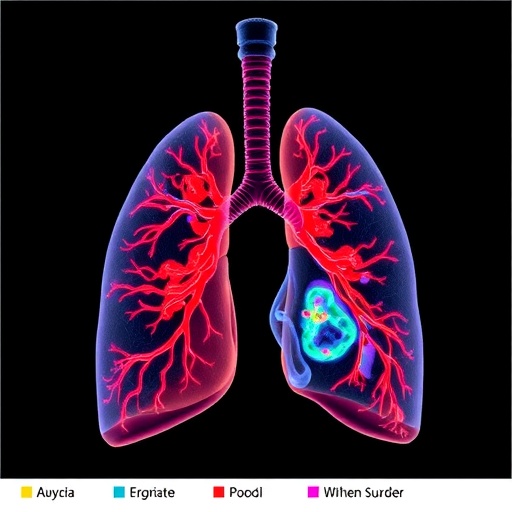
In a groundbreaking breakthrough that could transform the diagnosis and personalized treatment of chronic obstructive pulmonary disease (COPD), researchers have leveraged the power of artificial intelligence through variational autoencoders to jointly analyze clinical and molecular data, unveiling distinct disease subtypes with unprecedented precision. Published in Nature Communications, this pioneering study by Maiorino et al. offers a fresh lens to decode the complex heterogeneity of COPD, a leading cause of morbidity and mortality worldwide. The integration of advanced machine learning frameworks with rich biological data marks a critical leap towards tailored healthcare strategies, potentially improving patient outcomes significantly.
COPD, characterized by persistent respiratory symptoms and airflow limitation, has long posed diagnostic and therapeutic challenges due to its clinical and molecular diversity. Traditional classification relied heavily on spirometry and symptomology, which often fails to capture the underlying biological complexity driving disease progression. This research introduces a paradigm shift by employing variational autoencoders—a state-of-the-art type of unsupervised deep learning model—to extract latent representations from multidimensional datasets. Such models learn compressed, meaningful patterns embedded in both clinical records and high-throughput molecular profiles simultaneously, facilitating a nuanced stratification of COPD subtypes.
The study’s methodology is both intricate and innovative. Variational autoencoders (VAEs) operate by encoding input data into a probabilistic latent space and then decoding it to reconstruct the original inputs. This process enforces a structured representation capturing essential features while discarding noise. By jointly inputting clinical parameters—such as lung function tests, symptom scores, and demographic data—and multi-omics molecular information including transcriptomics and proteomics, the researchers crafted an integrative model that uncovered hidden biological signatures underpinning clinical phenotypes. Their approach surpasses traditional clustering by generating continuous latent variables, enabling a richer characterization of patient heterogeneity.
Crucially, the analysis identified novel subpopulations within COPD patients distinguished not only by clinical severity but also by distinct molecular pathways. For instance, certain identified clusters showed enrichment of inflammatory signaling networks, while others revealed signatures related to extracellular matrix remodeling or metabolic dysregulation. Such insights suggest potential mechanistic drivers of disease progression can be targeted therapeutically in a subtype-specific manner. This integrative subtyping framework could, therefore, inform more precise therapeutic interventions tailored to individual molecular profiles rather than a one-size-fits-all paradigm.
One of the most compelling aspects of this work is the incorporation of longitudinal clinical data that enabled dynamic tracking of disease trajectories across molecularly defined subtypes. The research demonstrated that patients classified into certain subgroups by the VAE framework experienced faster declines in lung function or differed in exacerbation rates, providing prognostic insights beyond standard measures. This predictive capacity opens pathways for early identification of high-risk patients, timely intervention, and personalized management regimens designed to alter the disease course effectively.
The implications for clinical practice are profound. By integrating cutting-edge machine learning with deep biological understanding, this approach bridges the gap between molecular research and patient care. Clinicians could soon access tools to classify COPD patients based on comprehensive profiles encompassing both symptomatology and underlying molecular drivers. Such precision medicine strategies would enable bespoke treatment decisions, optimizing therapeutic response while minimizing unnecessary side effects and healthcare costs. The scalability of variational autoencoders also promises broad applicability across diverse patient populations and healthcare settings.
From a technical perspective, the deployment of variational autoencoders is particularly suited to the challenge posed by COPD datasets, which often suffer from missing values, noisy measurements, and high dimensionality. VAEs’ probabilistic nature permits robust handling of incomplete and heterogeneous data, making them invaluable for integrative biomedical analyses. Moreover, the latent embeddings produced by these models facilitate interpretable downstream analyses, such as survival prediction and biomarker discovery, further enriching the translational potential of the findings reported.
The broader impact of this study extends beyond COPD to other complex, multifactorial diseases characterized by considerable heterogeneity in clinical presentation and molecular underpinnings. The joint clinical and molecular subtyping strategy exemplifies a scalable computational framework that could revolutionize precision medicine across a spectrum of respiratory, cardiovascular, neurological, and oncological conditions. By unveiling latent disease structures masked within high-dimensional data, deep learning advances like variational autoencoders can catalyze a new era of patient stratification and targeted therapeutic development.
Importantly, the researchers emphasized validation of their model using independent cohorts and multi-center datasets, underscoring the robustness and generalizability of their subtyping framework. Such rigorous confirmation is crucial to ensure that identified molecular signatures and clinical clusters are reproducible and clinically meaningful. Future research will likely focus on prospective clinical trials embedding this stratification system into decision-making workflows, assessing its impact on treatment outcomes and long-term prognosis.
In summary, the fusion of artificial intelligence methodologies with molecular and clinical data heralds a transformative moment in COPD research. Maiorino and colleagues have demonstrated that variational autoencoders provide a powerful mechanism for peeling back the layers of complexity inherent in chronic lung diseases, uncovering biologically and clinically relevant subtypes with deep translational implications. As the medical community increasingly embraces AI-driven approaches, such studies will pave the way for a future where individualized disease management is the norm rather than the exception.
Far from a purely theoretical exercise, the practical applications envisaged by this research resonate deeply with patients and healthcare providers alike. By identifying distinct COPD subphenotypes, interventions can be designed not just to alleviate symptoms but to modify disease pathways fundamentally, potentially preventing progression to end-stage respiratory failure. In an era of burgeoning biomedical data, harnessing the full potential of computational intelligence represents a beacon of hope for millions affected by COPD worldwide.
The convergence of molecular biology, clinical science, and artificial intelligence reflected in this study exemplifies the synergistic power of interdisciplinary collaboration. The authors’ ability to harness complex datasets and sophisticated machine learning tools to produce actionable insights stands as a testament to the evolving landscape of biomedical research. Importantly, their work underscores the necessity of integrating computational proficiency alongside traditional clinical expertise to unravel multifaceted diseases such as COPD.
Looking ahead, this paradigm may inspire similar integrative analyses in related airway diseases including asthma, bronchiectasis, and interstitial lung diseases, broadening the impact of such AI tools across pulmonary medicine. As technology continues to advance, the possibility of real-time patient stratification through electronic health records and molecular diagnostics becomes increasingly attainable, promising an exciting horizon for respiratory health.
In conclusion, the study “Joint clinical and molecular subtyping of COPD with variational autoencoders” represents a milestone in leveraging artificial intelligence for complex disease stratification. By merging clinical phenotyping with molecular insights, this research charts a path toward truly personalized medicine in COPD, heralding a future where patient care is guided by deep, data-driven understanding of disease biology. The transformative potential of such AI-powered approaches holds promise not only for COPD but for the broader biomedical community striving to decode and conquer chronic diseases through precision medicine.
Cite Scienmag News
Ophelia Keating. (May 19, 2026). Uncovering COPD Subtypes via Variational Autoencoders. Scienmag. https://scienmag.com/uncovering-copd-subtypes-via-variational-autoencoders/
Ophelia Keating. "Uncovering COPD Subtypes via Variational Autoencoders." Scienmag, 19 May 2026, https://scienmag.com/uncovering-copd-subtypes-via-variational-autoencoders/. Accessed 5 September 2026.
Ophelia Keating. "Uncovering COPD Subtypes via Variational Autoencoders." Scienmag. May 19, 2026. https://scienmag.com/uncovering-copd-subtypes-via-variational-autoencoders/


