

Saturday, August 8, 2026
Science
No Result
View All Result
  • Login
  • HOME
  • SCIENCE NEWS
  • CONTACT US
  • HOME
  • SCIENCE NEWS
  • CONTACT US
No Result
View All Result
Scienmag
No Result
View All Result
Home Science News Medicine

Physical Activity and Health Inequality in China’s Older Adults

July 19, 2026
in Medicine
Reading Time: 2 mins read
0
Physical Activity and Health Inequality in China’s Older Adults

Physical Activity and Health Inequality in China’s Older Adults

65
SHARES
587
VIEWS
Share on FacebookShare on Twitter
ADVERTISEMENT

Older adults in China are not experiencing health improvements evenly, and a new study links part of that gap to how physical activity is distributed across communities. Researchers report that physical activity is associated with better health outcomes, but the benefits are not uniform—creating measurable health inequality rather than a single “one-size-fits-all” effect.

The findings focus on older adults and examine whether differences in activity levels translate into unequal health trajectories across demographic and socioeconomic conditions. Instead of treating “activity” as a simple yes-or-no behavior, the analysis considers how gradients of movement relate to disparities in health.

To quantify inequality, the study employs population-level metrics commonly used in health economics and epidemiology. These approaches can separate overall health variation into components that reflect group differences, allowing investigators to estimate how much of the inequality is potentially attributable to physical activity patterns.

The work also emphasizes that health inequality can widen even when average health improves. In this scenario, some groups may adopt or maintain activity more easily—because of access to safe spaces, health literacy, social support, or fewer mobility constraints—while other groups fall behind.

Technically, the authors analyze observational data and control for key confounders that might otherwise explain both activity and health status. This helps reduce the chance that the observed association is merely driven by factors such as baseline chronic disease burden, education, or geography.

Importantly, the results suggest that physical activity does not just correlate with health—it may act as a modifiable lever shaping how evenly health benefits are shared. If interventions can shift activity patterns among disadvantaged groups, the study implies that inequality could shrink, not just outcomes improve.

Because the paper is based on real-world evidence from China, it also highlights cultural and structural realities that shape behavior. Urban design, community programming, and the availability of age-friendly exercise options may influence who can be active consistently.

From a “viral science news” perspective, the headline takeaway is straightforward: getting older doesn’t have to mean accepting unequal health. The study frames physical activity as both a health tool and an inequality amplifier—meaning targeting participation gaps could deliver outsized public health impact.

Subject of Research: Health inequality among older adults; physical activity effects
Article Title: The impact of physical activity on health inequality among older adults: evidence from China
Article References: Dang, X., Pan, J., Xing, X. et al. The impact of physical activity on health inequality among older adults: evidence from China. BMC Geriatr (2026). https://doi.org/10.1186/s12877-026-08008-2
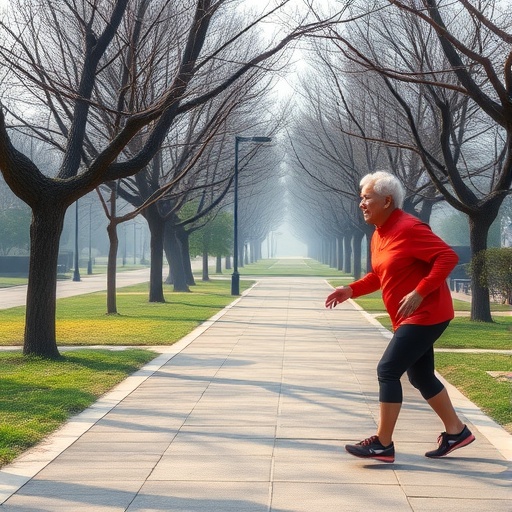
Image Credits: AI Generated
DOI: https://doi.org/10.1186/s12877-026-08008-2
Keywords: physical activity; health inequality; older adults; China; public health; epidemiology

Tags: health inequality and socioeconomic factors in aging populationshealth inequality widening despite overall health improvementshealth literacy and social support in older adult healthhealth trajectory differences across demographic groupsimpact of community environment on physical activity and health outcomesinfluence of mobility constraints on physical activity levelsmeasuring health disparities with epidemiological and economic metricsobservational study methods in aging health researchphysical activity as a social determinantPhysical activity disparities among older adults in Chinarole of safe spaces and access to recreational facilities in health equity
Share26Tweet16
Previous Post

Topological Jackiw-Rebbi States in Photonic Van der Waals Heterostructures

Next Post

Cognitive reserve helps older adults resist frailty and recover better

Related Posts

Multi-population GWAS maps bladder cancer loci and smoking-related genetic risk
Medicine

Multi-population GWAS maps bladder cancer loci and smoking-related genetic risk

August 8, 2026
Scientists map signaling networks driving disseminated glioblastoma cells in living brains
Medicine

Scientists map signaling networks driving disseminated glioblastoma cells in living brains

August 8, 2026
Engineered nanovesicles targeting m6A writer METTL3 curb neuroinflammation in cells and animals
Medicine

Engineered nanovesicles targeting m6A writer METTL3 curb neuroinflammation in cells and animals

August 8, 2026
ESM1-Mediated DNMT3A Suppresses Cervical Cancer Metastasis via ID3 Epigenetic Regulation
Medicine

ESM1-Mediated DNMT3A Suppresses Cervical Cancer Metastasis via ID3 Epigenetic Regulation

August 8, 2026
Ketamine improves ovarian function and egg quality in stress-induced depressed mice via ferroptosis
Medicine

Ketamine improves ovarian function and egg quality in stress-induced depressed mice via ferroptosis

August 8, 2026
Lancet Obesity Definition Differs From Other Diagnostic Criteria for Adults
Medicine

Lancet Obesity Definition Differs From Other Diagnostic Criteria for Adults

August 8, 2026
Next Post
Cognitive reserve helps older adults resist frailty and recover better

Cognitive reserve helps older adults resist frailty and recover better

  • Mothers who receive childcare support from maternal grandparents show more

    Mothers who receive childcare support from maternal grandparents show more parental warmth, finds NTU Singapore study

    27656 shares
    Share 11059 Tweet 6912
  • University of Seville Breaks 120-Year-Old Mystery, Revises a Key Einstein Concept

    1061 shares
    Share 424 Tweet 265
  • Bee body mass, pathogens and local climate influence heat tolerance

    682 shares
    Share 273 Tweet 171
  • Researchers record first-ever images and data of a shark experiencing a boat strike

    546 shares
    Share 218 Tweet 137
  • Groundbreaking Clinical Trial Reveals Lubiprostone Enhances Kidney Function

    531 shares
    Share 212 Tweet 133
Science

Embark on a thrilling journey of discovery with Scienmag.com—your ultimate source for cutting-edge breakthroughs. Immerse yourself in a world where curiosity knows no limits and tomorrow’s possibilities become today’s reality!

RECENT NEWS

  • Persistent Ash Emissions During Lava Effusion Reveal Hidden Hazard of Silicic Eruptions
  • Multi-population GWAS maps bladder cancer loci and smoking-related genetic risk
  • Scientists identify membrane transporter enabling DMSP uptake in marine phytoplankton
  • Scientists map signaling networks driving disseminated glioblastoma cells in living brains

Categories

  • Agriculture
  • Anthropology
  • Archaeology
  • Athmospheric
  • Biology
  • Biotechnology
  • Blog
  • Bussines
  • Cancer
  • Chemistry
  • Climate
  • Earth Science
  • Editorial Policy
  • Marine
  • Mathematics
  • Medicine
  • Pediatry
  • Policy
  • Psychology & Psychiatry
  • Science Education
  • Social Science
  • Space
  • Technology and Engineering

Subscribe to Blog via Email

Success! An email was just sent to confirm your subscription. Please find the email now and click 'Confirm Follow' to start subscribing.

Join 5,149 other subscribers

© 2025 Scienmag - Science Magazine

Welcome Back!

Login to your account below

Forgotten Password?

Retrieve your password

Please enter your username or email address to reset your password.

Log In
No Result
View All Result
  • HOME
  • SCIENCE NEWS
  • CONTACT US

© 2025 Scienmag - Science Magazine
