


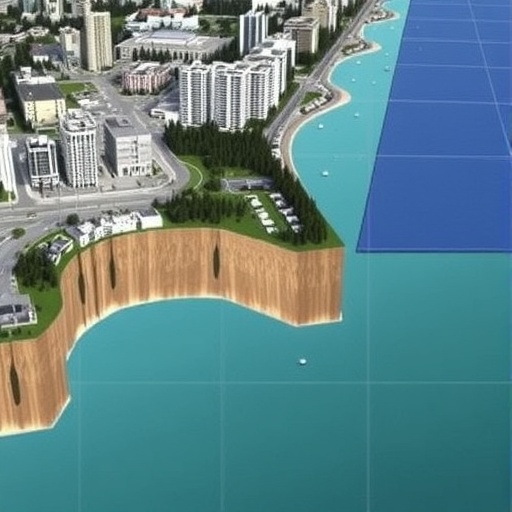
In the ongoing battle against rising sea levels, coastal communities stand at the forefront of climate change impacts. Recently published research in Nature Communications reveals a disturbing acceleration in sea-level rise effects along densely populated coastlines worldwide. The study, led by Oelsmann, Nicholls, Lincke, and colleagues, highlights how land subsidence—the gradual sinking of the Earth’s surface—has more than doubled the effective rate of sea-level rise in numerous urbanized coastal regions. This startling finding reshapes our understanding of the risks facing vulnerable populations and underscores the urgent need for improved coastal resilience strategies.
Sea-level rise is frequently discussed as a direct consequence of global warming, primarily driven by the thermal expansion of seawater and the melting of ice sheets and glaciers. However, this new study sheds light on a compounding factor: subsidence caused by human activities such as groundwater extraction, hydrocarbon depletion, and industrial infrastructure weight. When the land itself sinks, it intensifies local sea-level rise, leading to greater flooding, erosion, and saltwater intrusion than projected by global sea-level models alone.
The researchers utilized an extensive array of satellite observations, tide gauge data, and geological surveys to quantify vertical land motion in coastal regions spanning Asia, Europe, North America, and beyond. Their integrative approach combined high-resolution geospatial data with socio-economic metrics to identify densely populated urban centers where subsidence rates amplify the hazard of rising seas. Results revealed that subsidence in many major coastal cities effectively doubles local relative sea-level rise, meaning these areas face twice the magnitude of sea-level increase compared to adjacent stable regions.
One striking example from the study includes Southeast Asian megacities such as Jakarta and Manila, where intense groundwater withdrawal and rapid urbanization have accelerated subsidence rates to several centimeters per year. Such rates significantly outpace the global average sea-level rise of approximately 3.7 millimeters annually, compounding flood risks and threatening millions of inhabitants. Similarly, parts of the northeastern United States and European deltas have experienced measurable land subsidence exacerbating tidal inundation and storm surge vulnerabilities.
This landmark research integrates multidisciplinary insights highlighting that sea-level rise is not solely a climate phenomenon but a complex interplay between anthropogenic land-use changes and natural processes. Accordingly, failure to account for subsidence results in systematic underestimation of coastal flood risks and misallocation of resources aimed at building adaptive defenses such as sea walls and flood barriers. The study’s authors emphasize the critical importance of incorporating subsidence measurements into coastal risk assessments and urban planning.
Importantly, the team’s findings reveal that future projections of coastal flooding risks must be recalibrated to incorporate spatially heterogeneous subsidence patterns, particularly in fast-growing urban areas built atop soft sedimentary basins. These regions are inherently prone to compaction and deformation, exacerbating subsidence dynamics as extractive industries intensify. The consequences extend beyond immediate flood hazards, impacting groundwater salinization, infrastructure integrity, and ecosystem health.
Furthermore, the research calls attention to the socio-economic dimensions of subsidence-driven sea-level rise acceleration. Coastal neighborhoods with high population densities and limited financial resources frequently experience the highest rates of land subsidence, driven by unregulated resource extraction and inadequate urban governance. This pattern exacerbates environmental justice concerns, as marginalized communities bear disproportionate burdens of flooding, displacement, and economic disruption.
Given the grim outlook painted by these findings, the paper advocates for urgent policy interventions, including enhanced subsidence monitoring networks utilizing satellite and ground-based technologies, stricter regulation of groundwater and hydrocarbon extraction, and integrating subsidence data within urban resilience frameworks. Coordinated efforts among governments, scientists, engineers, and local stakeholders will be essential to implement adaptive measures tailored to unique regional subsidence profiles.
From a broader climate adaptation perspective, addressing subsidence offers a tangible opportunity to mitigate accelerated sea-level rise impacts. Unlike global warming drivers, some causes of subsidence—such as unchecked groundwater withdrawal—are locally manageable through improved resource management and regulatory frameworks. Strategic land-use planning, restoration of natural groundwater recharge, and investment in green infrastructure can reduce subsidence rates and enhance overall coastal resilience.
This research also underscores the imperative for global infrastructure investment to keep pace with doubling sea-level rise rates along subsiding coasts. Aging levees, seawalls, and drainage systems risk failure if designed under outdated assumptions excluding subsidence effects. Innovative engineering solutions incorporating flexible, nature-based interventions alongside conventional barriers will enhance adaptive capacity in the face of this compounded hazard.
In summary, the study by Oelsmann and colleagues profoundly advances our understanding of how human-driven subsidence accelerates the threats posed by rising seas along heavily populated coastlines. The revelation that subsidence can more than double local sea-level rise reshapes risk forecasts and elevates coastal vulnerability to new heights. This knowledge compels a paradigm shift toward integrated, data-driven coastal management strategies that proactively address both climate change and land subsidence to safeguard communities worldwide.
As the global population continues to urbanize near coasts, future research must prioritize high-resolution satellite monitoring, coupled with socio-economic analyses to identify subsidence hotspots and vulnerable demographic groups. Only by embracing the complexity of subsidence-driven sea-level rise can policymakers enact effective resilience strategies that protect lives, economies, and ecosystems amid accelerating climate challenges.
Ultimately, this pioneering work offers a vital scientific foundation empowering decision-makers to mitigate one of the most pernicious amplifiers of coastal flooding. It is a clarion call to elevate subsidence from a secondary consideration to a primary factor in adaptive responses—a critical step toward confronting the intertwined crises of climate change and urban sustainability.
Cite Scienmag News
Thomas Green. (May 18, 2026). Subsidence Doubles Sea-Level Rise Along Crowded Coasts. Scienmag. https://scienmag.com/subsidence-doubles-sea-level-rise-along-crowded-coasts/
Thomas Green. "Subsidence Doubles Sea-Level Rise Along Crowded Coasts." Scienmag, 18 May 2026, https://scienmag.com/subsidence-doubles-sea-level-rise-along-crowded-coasts/. Accessed 4 September 2026.
Thomas Green. "Subsidence Doubles Sea-Level Rise Along Crowded Coasts." Scienmag. May 18, 2026. https://scienmag.com/subsidence-doubles-sea-level-rise-along-crowded-coasts/


