


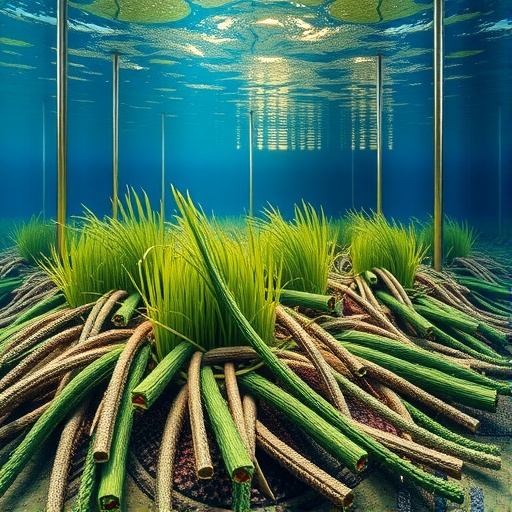
In recent years, the study of marine ecosystems undergoing change due to shifting climatic conditions has gained unprecedented urgency. A groundbreaking investigation by Tuya, Tejero-Caballo, Santos, and colleagues, published in Communications Earth & Environment, presents compelling evidence that past climate warming episodes fostered the expansion of seagrass meadows into higher latitude coastal waters. This finding offers a critical perspective on how future warming scenarios may reshape marine biodiversity and carbon sequestration processes in coastal habitats, challenging long-standing assumptions about seagrass distributions in colder regions.
Seagrasses, often overshadowed by more charismatic marine flora, are pivotal in maintaining coastal ecosystem health. These flowering plants, rooted in shallow seabeds, form dense underwater meadows that serve as habitat, nursery grounds, and foraging areas for diverse marine fauna. Equally important, seagrasses are among the most efficient biological carbon sinks on the planet, capturing and storing large quantities of CO2 beneath sediments. Understanding their historical and potential future ranges is essential to predicting carbon cycle feedbacks and ecological shifts in marine environments under global warming.
The study meticulously reconstructs the paleoecological history of seagrass distribution by analyzing sediment cores, fossil pollen, and macrofossil remains from coastal sites spanning various latitudes. Utilizing complex geochemical proxies and radiometric dating techniques, the research team charted seagrass presence back through multiple warming phases of the Quaternary period. Their results revealed that during warmer interglacial periods, seagrass species expanded dramatically beyond their contemporary equatorward limits, colonizing coastal waters previously considered too cold for their growth.
This latitudinal range expansion is especially noteworthy because modern seagrass beds are predominantly found in temperate to tropical regions with relatively stable and mild temperature regimes. Cold water temperatures have traditionally been viewed as critical limiting factors that restrict seagrass survival and reproduction. However, the paleorecord elucidated by Tuya et al. demonstrates that during warmer epochs, ocean temperatures at higher latitudes increased sufficiently to facilitate seagrass proliferation, overcoming thermal barriers and enabling new ecological niches to be exploited.
The implications of these findings extend beyond biogeographical curiosity. Seagrass meadows significantly influence coastal ecosystem services, including sediment stabilization, water filtration, and providing refuge for commercially important fish species. Their expansion into higher latitudes during past warmth suggests that future climate warming could similarly promote poleward shifts of these ecosystems, with cascading effects on coastal community structure and fisheries productivity. Such shifts could alter nutrient dynamics, sediment composition, and carbon sequestration potential in these regions, emphasizing the need to integrate seagrass dynamics into ecosystem management strategies.
Moreover, the study addresses the physiological adaptability and species-specific responses of seagrasses to temperature changes. It highlights that certain cold-tolerant species exhibited remarkable plasticity, enabling acclimation and survival in new, warmer habitats. This adaptability underscores the resilience potential of seagrass communities under fluctuating climate regimes but also points to the vulnerability of less adaptable species, which may face local extinctions if warming thresholds are surpassed without migration opportunities.
Additionally, the researchers examined the interplay between seagrass expansion and oceanographic phenomena such as shifts in currents, salinity gradients, and nutrient availability linked to climate oscillations. The findings suggest that warming-driven physical oceanographic changes synergistically supported the colonization of new habitats by modifying environmental parameters beyond mere temperature elevation. This multifactorial perspective provides a more nuanced understanding of how climate systems interact with biological communities at large spatial scales.
From a methodological standpoint, the study represents a significant advancement in paleoenvironmental reconstruction. The integration of high-resolution geochemical analyses with modern ecological modeling offered robust evidence linking past climate warming to precise ecological responses. This interdisciplinary approach sets a benchmark for future research seeking to unravel complex climate-ecosystem feedbacks and validate projections of marine ecological transformations in a warming world.
Importantly, the study also raises awareness about potential “novel ecosystems” emerging in polar and subpolar coastal zones as warming persists. The colonization by seagrasses could modify habitat structures, biogeochemical cycles, and species assemblages, creating ecosystems with no contemporary analogs. It calls for heightened monitoring and adaptive management to anticipate and mitigate unforeseen ecological disruptions resulting from these shifts.
The research further contributes to the global discussion on natural climate solutions by reinforcing the role of seagrass meadows in carbon sequestration under changing climatic regimes. Expanding seagrass populations at higher latitudes could enhance blue carbon storage capacity, representing a natural mitigating force against escalating greenhouse gas concentrations. This aspect highlights the importance of incorporating seagrass conservation and restoration into broader climate change mitigation frameworks.
Moreover, the timing and drivers of seagrass expansion elucidated by the study may inform conservationists seeking to optimize seagrass translocation or restoration projects. Understanding species’ historical thermal thresholds and colonization patterns equips managers with data to identify suitable future habitats and design resilience-enhancing interventions under climate change scenarios.
The broader biogeographical shifts documented echo similar poleward range expansions reported for other marine organisms, reinforcing the concept of climate-driven redistribution of marine biodiversity. Seagrasses, however, as habitat-forming foundation species, exert disproportionate influence on coastal ecosystems, making their migration a bellwether for widespread ecological transformations and highlighting cascading impacts on associated flora and fauna.
In conclusion, the pioneering research led by Tuya and colleagues illuminates the dynamic nature of seagrass ecosystems over geological timescales and their sensitivity to climatic fluctuations. As global temperatures continue to rise, recognizing and anticipating the expansion of these vital coastal meadows into previously inhospitable latitudes will be critical for safeguarding marine biodiversity, managing carbon budgets, and maintaining the resilience of coastal ecosystems worldwide. The study serves as both a caution and a guidepost, demonstrating nature’s remarkable adaptability while underscoring the urgency of proactive stewardship in the Anthropocene era.
Cite Scienmag News
Violet Maxwell. (May 18, 2026). Past Warm Climates Expanded Seagrass to Poles. Scienmag. https://scienmag.com/past-warm-climates-expanded-seagrass-to-poles/
Violet Maxwell. "Past Warm Climates Expanded Seagrass to Poles." Scienmag, 18 May 2026, https://scienmag.com/past-warm-climates-expanded-seagrass-to-poles/. Accessed 4 September 2026.
Violet Maxwell. "Past Warm Climates Expanded Seagrass to Poles." Scienmag. May 18, 2026. https://scienmag.com/past-warm-climates-expanded-seagrass-to-poles/


