


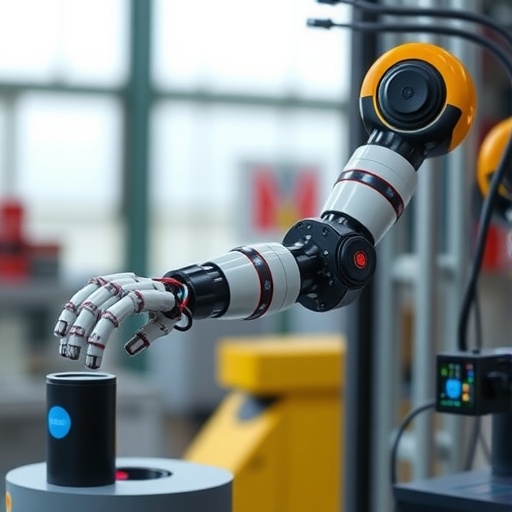
In a groundbreaking study set to redefine the landscape of industrial automation, Changtian Z., Jiaxuan H., Xinyang L., and their colleagues have unveiled a novel hybrid intelligent optimization strategy designed specifically for multi-objective trajectory planning of robotic arms. This advancement promises to significantly enhance the precision and efficiency of robotic systems employed in high-stakes assembly environments, marking a pivotal step forward in the integration of artificial intelligence with mechanical engineering.
The core challenge addressed by this pioneering research revolves around optimizing the movement trajectories of robotic arms in environments where precision and the balance of multiple objectives are paramount. Traditional trajectory planning often grapples with conflicts between speed, accuracy, and energy consumption, especially when applied to complex assembly tasks requiring microscopic tolerances. By introducing a hybrid intelligent approach, the researchers combine the strengths of various optimization algorithms to create a system that can simultaneously consider and harmonize multiple criteria, providing a more robust and adaptable solution.
Multi-objective optimization inherently demands the careful balancing of competing goals. For robotic arms in precision assembly, this includes minimizing trajectory time while maximizing positional accuracy and minimizing energy consumption to extend the lifespan of mechanical components. The novel strategy incorporates intelligent algorithms that dynamically learn and adjust to the specific constraints and objectives of each task scenario. This adaptability allows the planning system to navigate the high-dimensional space of potential movements with unprecedented efficiency and effectiveness.
At the heart of the hybrid strategy is the integration of heuristic optimization methods with machine learning techniques. Heuristic methods provide the foundational frameworks for exploring solution spaces, leveraging experience-based rules and approximations to reduce computational overhead. Meanwhile, machine learning enhances the system’s ability to predict and evaluate the consequences of different trajectory decisions, facilitating a more informed and nuanced optimization process. This confluence of methodologies enables the robotic arms to function with a level of foresight and adaptability that traditional deterministic models cannot match.
One of the remarkable features of this approach is its capacity to deal with uncertainties inherent in real-world assembly settings. Robotic arms operate in dynamic environments where slight variations in component dimensions or positional deviations can quickly degrade performance quality. The hybrid optimization strategy incorporates robust uncertainty modeling, allowing it to anticipate and compensate for these variations, thereby maintaining high assembly accuracy and consistency.
The implementation of this innovative optimization framework was tested across a range of precision assembly scenarios, encompassing tasks such as microelectronics manufacturing and delicate biomedical device assembly. In each case, the robotic arms equipped with the new system demonstrated superior trajectory planning capabilities, achieving faster completion times without compromising precision. This dual improvement underscores the practical value of the strategy, especially in industries where accelerated production cycles and quality assurance are critical.
From a technical standpoint, the research integrates advanced bio-inspired algorithms such as genetic algorithms and particle swarm optimization within its hybrid framework. These algorithms mimic natural evolutionary and swarming behaviors to iteratively refine the set of possible trajectories, effectively balancing exploration and exploitation in the search space. The machine learning component utilizes neural networks trained on extensive simulation data to predict the feasibility and performance of candidate motions, facilitating real-time decision-making that adapts to novel task conditions.
The authors also emphasize the scalability of their solution. As manufacturing systems become increasingly complex, demand escalates for trajectory planning tools capable of handling higher degrees of freedom and more intricate assembly processes. The hybrid intelligent strategy is designed to accommodate this complexity by modularly incorporating additional objectives and constraints, allowing it to evolve alongside technological advancements without loss of efficacy.
Moreover, energy efficiency emerged as a key consideration in the design of the trajectory planning system. By optimally managing motion paths, the strategy reduces unnecessary motor activations and mitigates wear and tear on robotic joints. This not only lowers operational costs but also contributes to sustainability goals by diminishing the environmental impact of manufacturing processes. Such an integrated approach to operational efficiency and ecological responsibility sets a new benchmark in robotic system design.
A particularly compelling aspect of the study is its focus on the interpretability of the optimization outcomes. Autonomous systems often act as black boxes, making it difficult for engineers to understand the rationale behind specific trajectory choices. The hybrid intelligent optimization strategy incorporates transparent decision-making frameworks, providing human operators with insight into the trade-offs and priorities driving each planned movement. This transparency enhances trust and facilitates collaborative human-robot work environments.
The potential applications of this research are far-reaching. Beyond the industrial sector, the principles underpinning the trajectory planning strategy could be adapted for use in surgical robotics, where multi-objective optimization is vital to balancing patient safety, procedural speed, and tool precision. Similarly, the aerospace industry stands to benefit from more precise and efficient robotic assembly of complex components in conditions where manual interventions are impractical.
Looking ahead, the researchers propose further refinement of the hybrid optimization approach through the incorporation of reinforcement learning. This would enable the robotic arms to improve their planning strategies based on real-world feedback rather than relying solely on simulated data, enhancing resilience and adaptability over time. The inclusion of real-time sensory data to continually update trajectory plans represents an exciting frontier for intelligent robotic systems.
In addition, cross-disciplinary collaboration is highlighted as essential for future improvements. Merging insights from biomechanics, control theory, data science, and materials engineering will drive the evolution of smarter, faster, and more energy-efficient robotic arms. The foundation laid by this study provides a versatile platform upon which such synergistic innovations can be built, propelling the entire field toward new heights of performance and reliability.
The transformative potential of this research lies not only in its immediate practical benefits but also in its demonstration of how hybridization of AI and optimization techniques can unlock novel capabilities in autonomous systems. By solving one of the longstanding challenges in trajectory planning, the study paves the way for a new generation of robotic technologies that can seamlessly integrate into precision-critical workflows, augmenting human capabilities and setting new industry standards.
Ultimately, this work exemplifies the future trajectory of automation—one where intelligence is embedded at every level of system design, enabling machines to operate with unprecedented agility, precision, and efficiency. As industries increasingly adopt these cutting-edge robotic trajectories, the resultant gains in productivity, quality, and sustainability will resonate far beyond the factory floor, contributing to a smarter and more connected world.
Changtian, Z., Jiaxuan, H., Xinyang, L. et al. A novel hybrid intelligent optimization strategy for multi-objective trajectory planning of robotic arms in precision assembly scenarios.Sci Rep (2026). https://doi.org/10.1038/s41598-026-56529-y
Cite Scienmag News
Denise Maddox. (June 7, 2026). Hybrid AI Optimizes Robotic Arms for Precision Assembly. Scienmag. https://scienmag.com/hybrid-ai-optimizes-robotic-arms-for-precision-assembly/
Denise Maddox. "Hybrid AI Optimizes Robotic Arms for Precision Assembly." Scienmag, 7 June 2026, https://scienmag.com/hybrid-ai-optimizes-robotic-arms-for-precision-assembly/. Accessed 4 September 2026.
Denise Maddox. "Hybrid AI Optimizes Robotic Arms for Precision Assembly." Scienmag. June 7, 2026. https://scienmag.com/hybrid-ai-optimizes-robotic-arms-for-precision-assembly/


