


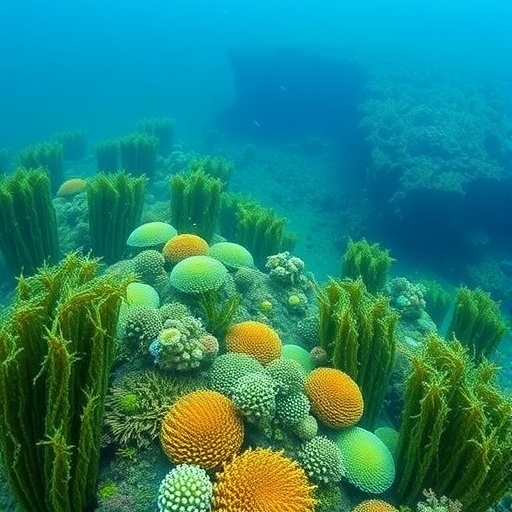
The sprawling underwater forests along the southern California coastline are undergoing profound ecological shifts as marine heatwaves strike with increasing frequency and intensity. In a recent groundbreaking study published in Communications Earth & Environment, researchers Michaud, Reed, and Miller unveil the complex dynamics of macroalgal communities that are being reshaped during these successive marine thermal anomalies. Their findings not only emphasize the vulnerability of these vibrant kelp ecosystems but also signal broader implications for marine biodiversity and coastal resilience in a warming world.
For decades, kelp forests have been recognized as hotspots of marine productivity and biodiversity, supporting an array of species from tiny invertebrates to large fish and marine mammals. However, as the planet’s climate continues to warm, prolonged elevated sea surface temperatures have emerged as a critical stressor for these fragile habitats. Marine heatwaves—periods of anomalously warm ocean conditions lasting days to months—are becoming more recurrent and severe, driving shifts in the delicate balance of species that comprise these underwater forests. The new research captures how these climatic events orchestrate a transformation of macroalgal communities, which serve as the foundation of kelp forest ecosystems.
The authors conducted an extensive longitudinal survey across multiple locations in southern California, spanning several marine heatwave events. Their meticulous fieldwork integrated satellite sea surface temperature data with detailed underwater assessments of algal species composition and abundance. By comparing macroalgal assemblages before, during, and after heatwave episodes, they delineated the trajectory of community changes linked to rising ocean temperatures. This integrative approach allowed the team to identify patterns of species replacement, shifts in dominance, and reductions in overall kelp cover, painting a compelling picture of ecosystem reorganization under thermal stress.
One of the most salient findings highlighted by Michaud and colleagues is the decline of giant kelp (Macrocystis pyrifera), an ecosystem engineer whose towering fronds provide critical habitat and modulate coastal hydrodynamics. Successive marine heatwaves greatly diminish giant kelp abundance, leaving vast stretches of rocky substratum exposed. This loss disrupts habitat complexity that many marine organisms rely on, triggering cascading effects throughout the food web. The research documents that following these kelp declines, more heat-tolerant and opportunistic macroalgae, such as certain red and green algal species, increasingly colonize the available substrates, fundamentally altering the structure and function of these communities.
Furthermore, the transition from kelp dominance to more simplified macroalgal assemblages compromises the productivity and biodiversity of these coastal zones. The new macroalgal communities do not support the same diversity or abundance of associated fauna, thereby eroding ecosystem services such as nursery habitats for fish populations critical to commercial fisheries. The authors emphasize that the homogenization of macroalgal communities may reduce resilience against future disturbances, locking these systems into a degraded state from which recovery could be prolonged or even unattainable.
The work also sheds light on the compounding effects of multiple, successive heatwaves. Rather than allowing ecosystems time to recover between events, repeated thermal stress appears to exacerbate declines in key kelp species and accelerates the shift toward heat-tolerant, lower-complexity macroalgal assemblages. This phenomenon suggests that increased frequency of heatwaves may fundamentally reshape kelp forest dynamics, pushing them beyond ecological tipping points.
Importantly, the researchers underscore that these transformations have profound implications for ocean carbon cycling. Giant kelp forests are significant carbon sinks, sequestering large amounts of atmospheric CO2 through rapid growth and biomass accumulation. As kelp cover diminishes, the capacity of these ecosystems to capture carbon is jeopardized, potentially weakening a natural buffer against climate change. The rise of less productive macroalgal species may not compensate for this loss, creating feedback loops that exacerbate global warming.
Beyond biological metrics, the study integrates oceanographic data that reveal how physical changes in the marine environment modulate algae responses to heatwaves. Variations in nutrient availability, water column stratification, and local upwelling intensity interact with temperature stress, influencing whether kelp can persist or succumb. This detailed understanding of environmental drivers enhances predictive capacity for how kelp forests might fare under future climate scenarios.
The authors advocate for targeted management strategies aimed at bolstering kelp forest resilience. These include protecting refugia areas with cooler microclimates, minimizing additional stressors like pollution and overgrazing by herbivores, and exploring active restoration techniques. Monitoring networks and early warning systems for marine heatwaves are also critical to providing timely interventions that could mitigate irreversible losses.
This research also contributes to a growing recognition that marine heatwaves are not isolated incidents but recurring agents of ecological change. The cumulative impacts on foundational species, such as giant kelp, may translate into large-scale regime shifts with ripple effects across coastal marine ecosystems globally. Recognizing the signals of such transformations early is vital for conservation efforts and adapting to the rapidly changing ocean environment.
Given the social and economic importance of kelp forest ecosystems—which support fisheries, tourism, and coastal protection—understanding their vulnerability to climate extremes is imperative. The study by Michaud, Reed, and Miller offers a sobering glimpse into the future of these underwater forests in the face of global warming. It challenges scientists, policymakers, and stakeholders to consider how to balance human activities with the preservation of marine biodiversity under unprecedented thermal stress.
In conclusion, this pioneering research illuminates the mechanisms driving macroalgal community transformation during successive marine heatwaves in southern California’s kelp forests. By integrating field observations, remote sensing, and oceanographic data, the authors demonstrate how increasing ocean temperatures orchestrate shifts from giant kelp dominance to simplified macroalgal communities. These findings not only highlight the vulnerability of these ecosystems but also stress the urgency of climate action and adaptive management. As marine heatwaves intensify globally, understanding and mitigating their ecological consequences remains a crucial scientific and societal priority.
Cite Scienmag News
Violet Maxwell. (May 18, 2026). Kelp Forests Shift Amid Successive Marine Heatwaves. Scienmag. https://scienmag.com/kelp-forests-shift-amid-successive-marine-heatwaves/
Violet Maxwell. "Kelp Forests Shift Amid Successive Marine Heatwaves." Scienmag, 18 May 2026, https://scienmag.com/kelp-forests-shift-amid-successive-marine-heatwaves/. Accessed 3 September 2026.
Violet Maxwell. "Kelp Forests Shift Amid Successive Marine Heatwaves." Scienmag. May 18, 2026. https://scienmag.com/kelp-forests-shift-amid-successive-marine-heatwaves/


