


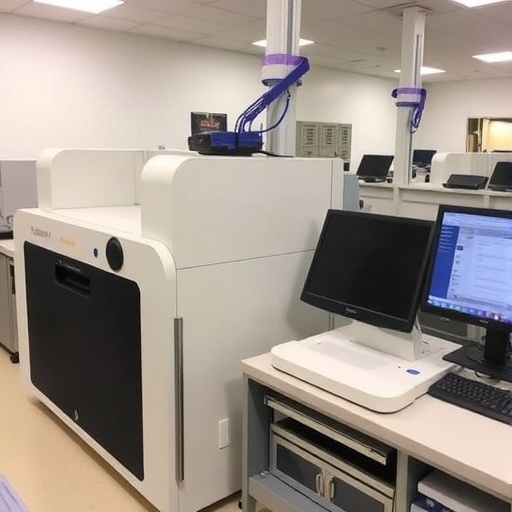
The Flow Cytometry Resource (FCR) at University of Rochester Medicine has garnered international acclaim by being selected among the 2026 cohort of Recognized Shared Resource Laboratories by the International Society for the Advancement of Cytometry (ISAC). This eminent honor underscores the facility’s unwavering commitment to operational excellence and strict adherence to globally recognized standards in cytometry. Remarkably, the FCR stands out as the sole academic medical center laboratory acknowledged in this distinguishing cycle, signifying its exceptional stature within the biomedical research community.
Under the expert stewardship of co-scientific directors Tim Bushnell, PhD, and Ravi Misra, PhD, along with technical director Matt Cochran, MS, and director of development Wojciech Wojciechowski, PhD, the Flow Cytometry Resource has matured into a cutting-edge hub offering a comprehensive array of advanced cytometry techniques. The scope of services delivered ranges from analytical and high-parameter spectral flow cytometry to cutting-edge imaging cytometry and mass cytometry platforms. These multifaceted capabilities enable precise phenotypic and functional profiling of cellular populations, thereby providing invaluable insights across diverse disciplines such as immunology, cancer biology, stem cell research, and infectious disease studies.
The recognition by ISAC not only highlights the technical prowess and innovation embodied by the facility’s instrumentation and methodologies but also aptly reflects the rigorous operational frameworks sustaining these achievements. The laboratory maintains an unwavering focus on quality assurance, reproducible data acquisition, and meticulous adherence to best laboratory practices, ensuring that the results generated are both reliable and replicable. This stringent operational discipline aligns seamlessly with the pioneering standards articulated in a seminal 2016 publication on Shared Resource Laboratory best practices, a cornerstone guiding contemporary cytometry operations internationally.
Stephen Dewhurst, PhD, the University of Rochester Medicine’s Vice President for Research, emphasizes that this accolade mirrors the high regard held by the institute’s research community for the Flow Cytometry Resource. He notes that the laboratory’s commitment to accessibility and cutting-edge technology has been instrumental in catalyzing innovative discoveries. ISAC’s endorsement further cements the resource’s role as a pivotal contributor to the institution’s research infrastructure, facilitating robust scientific exploration that consistently pushes disciplinary boundaries.
The ISAC Shared Resource Laboratory Recognition Program employs a comprehensive peer review protocol rooted in seven evaluative domains: operational excellence, staff expertise and infrastructure robustness, stringent quality assurance mechanisms, advanced training and educational support, comprehensive data management strategies, laboratory safety adherence, and standardized operating procedures. Laboratories excelling across these parameters are celebrated for creating a culture of excellence and continuous improvement, qualities that the Flow Cytometry Resource embodies with distinction.
Paula Vertino, PhD, Senior Associate Dean of Basic Research, underscores the dedication of FCR’s scientific team to maintaining dynamic access to the latest technological advancements and their steadfast commitment to operating within a framework of internationally prescribed standards. This recognition reflects not only on the facility’s technological capabilities but also highlights the integral role that high-standard shared resource laboratories play in enhancing institutional research outputs and facilitating high-impact scientific breakthroughs.
In its quest to foster excellence and innovation globally, ISAC’s recognition initiative prioritizes continual improvement and best practices adoption within shared resource laboratories. By aligning precisely with these standards, the Flow Cytometry Resource ensures that University of Rochester investigators benefit from current, state-of-the-art cytometric technologies underpinned by rigorous quality frameworks. These frameworks are vital for safeguarding the reproducibility and validity of scientific findings, an increasingly critical factor amid the growing complexity of biomedical research.
The Flow Cytometry Resource’s advanced analytical capabilities utilize spectral flow cytometry, allowing simultaneous detection of multiple fluorochromes beyond traditional spectral overlaps. This innovation significantly expands the dimensionality of cellular analysis and enables researchers to dissect highly complex cellular landscapes with unprecedented granularity. High-parameter cell sorting further augments experimental design flexibility, permitting precise isolation of rare or phenotypically defined cell populations crucial for downstream functional analyses or therapeutic exploration.
Moreover, the facility’s integration of imaging cytometry complements traditional flow approaches by providing spatial context to phenotypic markers, thus opening new vistas in understanding cellular heterogeneity within tissue microenvironments. The inclusion of mass cytometry techniques, combining mass spectrometry with cytometric analysis, introduces the ability to quantify over forty markers simultaneously with minimal signal overlap, dramatically enhancing multiplexing capabilities and data richness.
This multifaceted technological repertoire, supported by a robust infrastructure managed by seasoned technical staff, positions the FCR as a linchpin in facilitating multidisciplinary research projects. From elucidating immune responses in infectious diseases to unraveling cellular mechanisms in cancer, the resource supports robust experimental workflows that demand precision, scalability, and reproducibility.
The formal announcement of ISAC’s 2026 Recognized Shared Resource Laboratories is highly anticipated within the global cytometry community, with the official award presentation scheduled to take place during the forthcoming ISAC CYTO conference. This event serves as a prestigious platform for celebrating excellence, fostering knowledge exchange, and inspiring shared resource laboratories worldwide to pursue continuous innovation and excellence.
Operating within the broader framework of the University of Rochester Medicine’s Center for Advanced Research Technologies (CART), the Flow Cytometry Resource benefits from an integrative approach that couples technological sophistication with expert scientific guidance. CART’s mission to accelerate discovery by providing state-of-the-art shared research tools and expertise is exemplified in FCR’s achievements and its impact on advancing biomedical knowledge and therapeutic innovation.
The International Society for the Advancement of Cytometry itself stands as a cornerstone in the field, dedicated to the advancement of cytometry through comprehensive education, meticulous standards development, and fostering an international collaborative network. Recognition from ISAC serves as an emblem of quality and operational mastery in this specialized domain, enhancing the visibility and credibility of recognized laboratories on a global stage.
In sum, the Flow Cytometry Resource at University of Rochester Medicine exemplifies the harmonious fusion of technological innovation, operational excellence, and scientific leadership. Its selection as a 2026 Recognized Shared Resource Laboratory by ISAC not only celebrates its current achievements but also sets a benchmark for future developments in cytometric science, underscoring its indispensable role in propelling biomedical research forward.
News Publication Date: 2024
Web References: Not provided
References: Referenced 2016 ISAC Shared Resource Laboratory Best Practices publication in Cytometry Part A
Cite Scienmag News
Kristina Jarvis. (May 15, 2026). University of Rochester Medicine’s Flow Cytometry Resource Earns Prestigious Recognition from International Society for the Advancement of Cytometry. Scienmag. https://scienmag.com/university-of-rochester-medicines-flow-cytometry-resource-earns-prestigious-recognition-from-international-society-for-the-advancement-of-cytometry/
Kristina Jarvis. "University of Rochester Medicine’s Flow Cytometry Resource Earns Prestigious Recognition from International Society for the Advancement of Cytometry." Scienmag, 15 May 2026, https://scienmag.com/university-of-rochester-medicines-flow-cytometry-resource-earns-prestigious-recognition-from-international-society-for-the-advancement-of-cytometry/. Accessed 6 September 2026.
Kristina Jarvis. "University of Rochester Medicine’s Flow Cytometry Resource Earns Prestigious Recognition from International Society for the Advancement of Cytometry." Scienmag. May 15, 2026. https://scienmag.com/university-of-rochester-medicines-flow-cytometry-resource-earns-prestigious-recognition-from-international-society-for-the-advancement-of-cytometry/


