


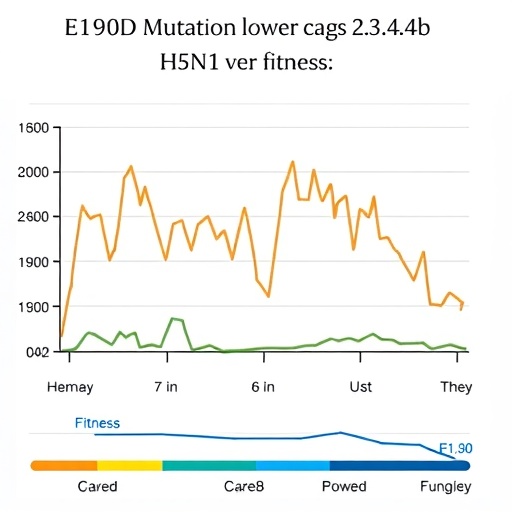
In a groundbreaking study published in npj Viruses in 2026, researchers Sun, Lisboa, Carney, and colleagues have delivered new insights into the molecular dynamics of the highly pathogenic avian influenza A(H5N1) virus, specifically focusing on the clade 2.3.4.4b lineage. Their investigation centered on a critical amino acid substitution within the viral hemagglutinin (HA) protein, pinpointing the E190D mutation, and how this seemingly subtle genetic alteration significantly impacts the virus’s receptor binding affinity and overall viral fitness. This work sheds light on the nuanced mechanisms that govern influenza virus infectivity and has far-reaching implications for understanding viral evolution, host adaptation, and pandemic risk assessment.
Hemagglutinin is a surface glycoprotein fundamental to the influenza virus’s ability to initiate infection. This trimeric protein facilitates attachment and subsequent entry into host cells by recognizing and binding sialic acid receptors on the cell surface. The specificity and strength of this interaction largely dictate host range, transmission efficiency, and ultimately viral pathogenicity. Within the hemagglutinin structure, residues in the receptor-binding domain (RBD) are especially critical, as mutations here can re-tune receptor preferences from avian-type α2,3-linked sialic acids to human-type α2,6-linked sialic acids, altering the virus’s zoonotic potential.
The study homes in on a residue at position 190 within the HA RBD—glutamic acid (E) to aspartic acid (D)—a conservative substitution that nonetheless entails a charge and size difference subtle enough to perplex prior assumptions about HA flexibility. Typically, such an E190D change might be considered minor due to both amino acids being acidic and structurally similar. However, the research reveals that even these subtle modifications can have profound consequences on the hemagglutinin’s ability to bind receptors effectively. Their data indicate that this mutation reduces receptor binding affinity, thereby influencing the virus’s capacity to infect host cells efficiently.
Using a combination of structural biology techniques, including cryo-electron microscopy and X-ray crystallography, the researchers resolved conformational changes induced by the substitution. They observed shifts within the receptor-binding pocket that disrupted optimal interaction with sialic acids on host cells. These structural perturbations were complemented by biochemical assays demonstrating decreased binding avidity, which translated into reduced viral entry efficiency. The meticulous approach allowed them to connect atomic-level changes to functional consequences at the viral replication level.
Moreover, the study employed in vitro and in vivo models to assess viral fitness under varying biological conditions. Cell culture experiments showed that viruses carrying the E190D mutation replicated less efficiently in mammalian respiratory epithelial cells compared to the wild-type clade 2.3.4.4b virus. This diminished replication correlated with lowered receptor binding efficiency and supported the hypothesis of fitness impairment. In vivo studies using animal models further affirmed these findings, as mutated viruses exhibited reduced pathogenicity and transmissibility relative to their progenitors.
These findings carry significant implications for understanding how mutations at key HA residues affect the balance between viral fitness and immune escape. While some substitutions enhance the virus’s ability to evade host immune responses, others, as evidenced here, can exact a fitness cost that potentially limits spread. This tug-of-war between receptor affinity and immune evasion is a hallmark of influenza virus evolution, contributing to the emergence of pandemic strains or the attenuation of virulence depending on the adaptive landscape.
The clade 2.3.4.4b A(H5N1) lineage is particularly important as it has been responsible for recent avian outbreaks with zoonotic spillover, making its evolutionary trajectory critical for public health surveillance. This study enriches the predictive models used to monitor and respond to emerging influenza threats by emphasizing the nuanced role of specific HA mutations that might otherwise be overlooked due to their conservative nature. Such molecular-level insights facilitate smarter targeting of vaccines and antiviral therapeutics.
Intriguingly, the E190D mutation might arise as a compensatory adaptation in response to other mutations or host pressures that select for altered receptor usage or immune evasion. The study posits that this amino acid change could be part of a broader mutational network that balances receptor binding with other fitness parameters. Understanding the epistatic interactions among mutations promises to deepen our knowledge of influenza virus adaptability and resilience.
Furthermore, this research highlights the utility of integrating multi-disciplinary tools—from structural analysis and virology to computational modeling—to dissect influenza virus biology. The structural changes identified by the microscopic techniques were corroborated by functional assays and evolutionary analysis, providing a comprehensive picture of how a single residue change can ripple through the viral lifecycle. Such integrative approaches set a new standard for viral pathogenesis studies.
Importantly, these findings underscore the necessity of continuous genomic surveillance of influenza viruses, especially those circulating in wild and domestic avian populations that serve as reservoirs for zoonotic viruses. Detecting mutations like E190D early can inform risk assessments and guide public health interventions to prevent potential outbreaks. This is particularly vital for regions harboring diverse avian species where interspecies viral reassortment and mutation rates are high.
In light of the observed decrease in receptor binding and fitness due to the E190D substitution, questions arise about its persistence in viral populations. The study speculates that while this mutation might transiently reduce transmissibility, it could pave the way for compensatory mutations that restore or enhance fitness, thereby contributing to long-term viral evolution. Such dynamics exemplify the complex fitness landscapes influenza viruses navigate.
From a broader perspective, the study also raises fundamental questions about the constraints governing protein evolution in rapidly mutating viruses. The conservation of the acidic residue at position 190 suggests strong functional pressures; however, the observed mutation illustrates that viruses can tolerate and test different molecular configurations. These explorations could reveal vulnerabilities in the viral life cycle exploitable for therapeutic interventions.
The implications of this work extend beyond influenza. Understanding how single-site mutations modulate receptor interactions is crucial for a range of viruses that rely on receptor-binding proteins. Insights gained here might translate into improved predictive frameworks for other viral pathogens, aiding in the design of broad-spectrum antivirals and the anticipation of zoonotic jumps.
Looking ahead, the authors advocate for deeper investigations into how the E190D substitution interacts with host immune factors and environmental conditions. Studies probing the mutation’s effects during serial passages or co-infection scenarios could elucidate its role in viral adaptation under diverse pressures. Coupling molecular analyses with ecological data promises a more holistic understanding of influenza virus evolution.
In conclusion, the work by Sun and colleagues constitutes a significant advancement in our grasp of influenza virus molecular ecology. Their detailed delineation of the hemagglutinin E190D substitution’s impact illuminates the delicate balance viruses maintain between receptor affinity and replicative fitness. As influenza remains a perennial global health challenge, such insights are invaluable for refining strategies to mitigate its impact and prepare for future pandemics.
Cite Scienmag News
Kristina Jarvis. (May 15, 2026). E190D Mutation Lowers Clade 2.3.4.4b H5N1 Fitness. Scienmag. https://scienmag.com/e190d-mutation-lowers-clade-2-3-4-4b-h5n1-fitness/
Kristina Jarvis. "E190D Mutation Lowers Clade 2.3.4.4b H5N1 Fitness." Scienmag, 15 May 2026, https://scienmag.com/e190d-mutation-lowers-clade-2-3-4-4b-h5n1-fitness/. Accessed 5 September 2026.
Kristina Jarvis. "E190D Mutation Lowers Clade 2.3.4.4b H5N1 Fitness." Scienmag. May 15, 2026. https://scienmag.com/e190d-mutation-lowers-clade-2-3-4-4b-h5n1-fitness/


