


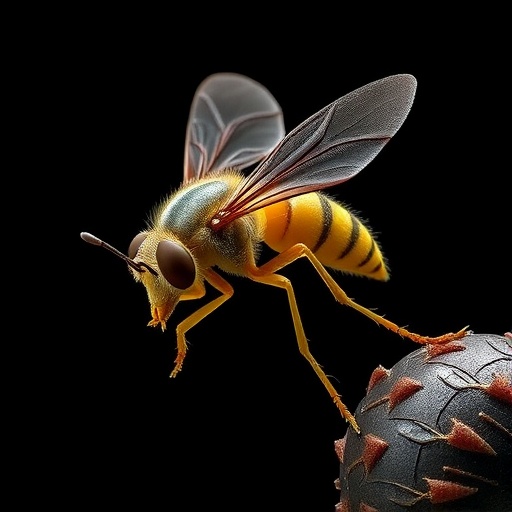
In a remarkable example of evolutionary adaptation, researchers in Tsukuba, Japan, have unveiled a novel behavioral mechanism that facilitates the emergence of parasitic male insects from within their hosts. The study focuses on the enigmatic order Strepsiptera, a group of endoparasitic insects characterized by their complex life cycle and intimate host relationships. Unlike other insects, all species within Strepsiptera invade their hosts during an early larval stage, subsequently developing inside the host body. This research sheds light on the male emergence process of Blissoxenos esakii, a strepsipteran parasite specifically targeting stink bugs of the species Macropes obnubilus.
Strepsipteran females exhibit a highly unusual life history trait, remaining permanently embedded within the body of their insect hosts. Adult males, by contrast, undergo complete development inside the host before emerging to undertake the critical role of seeking out and mating with the females. Previously, scientific literature has documented male emergence in only three strepsipteran families, wherein males exit through host body sites readily exposed to the environment, such as the posterior abdomen of hornets or planthoppers. However, this new research identifies a major difference in male emergence tactics within the family Corioxenidae—the group parasitizing stink bugs.
The emergence site for males belonging to Corioxenidae is anatomically concealed beneath the host’s wings on the dorsal abdomen, representing a potential physical barrier to exit. This scenario poses an intriguing question regarding how the parasitic males overcome this significant morphological obstruction to successfully leave their host. Despite longstanding awareness of this anatomical constraint in the scientific community, there has been no direct observation or documentation of the males’ emergence behavior from this obscured site until now.
In their meticulous observations, the research team discovered a previously unknown strategy employed by the host that facilitates the parasite’s emergence. Specifically, during the male parasite’s eclosion phase, the stink bug host actively raises its wings. This wing-raising behavior temporarily uncovers the concealed dorsal abdomen area, providing an opening for the immature male parasite to extend and ultimately exit the host’s body. This behavior is notable as it is absent in non-parasitized individuals of the same stink bug species, indicating a parasite-induced modification or co-option of host behavior.
This finding reveals a fascinating example of host-parasite interaction where the host’s behavioral response plays an integral role in the parasite’s life cycle completion. The host wing-raising does not serve its usual functions such as flight or escape; instead, it acts as a crucial facilitator allowing the parasite to overcome the morphological barrier of the wings which would otherwise impede emergence. This behavioral adaptation highlights the complexity and subtlety of evolutionary arms races between parasites and their hosts.
From a broader evolutionary and ecological perspective, these results contribute significant insights into the diversity of host utilization strategies among strepsipteran lineages. The ability of Blissoxenos esakii males to emerge beneath the protective wings is an example of a specialized evolutionary adaptation that reflects dynamic host-parasite coevolution. The discovery that the host itself participates behaviorally to permit the parasite’s emergence expands our understanding of how parasitic insects adapt to morphological constraints imposed by their hosts.
Furthermore, this research underscores the importance of fine-scale behavioral studies in elucidating the life histories of cryptic parasitic species. The observation of wing-raising in parasitized stink bugs was achieved through careful long-term monitoring and documented video analysis, marking the first direct empirical evidence of this behavior’s role in male strepsipteran emergence in the family Corioxenidae. Such detailed behavioral data are critical for unraveling the mechanisms underpinning host-parasite interactions and the evolutionary processes shaping them.
The significance of this study extends into the fields of parasitology, insect morphology, and behavioral ecology, providing a vivid example of behavioral manipulation or co-option in host organisms driven by internal parasitic pressures. While parasitism often involves host manipulation to enhance parasite fitness, this case illustrates an indirect facilitation by the host that circumvents morphological limitations. It opens new avenues for investigating the neural and physiological pathways triggering wing-raising behavior in parasitized hosts.
Additionally, the revelation that the wings serve as a significant physical barrier for parasite egress prompts reconsideration of the selective pressures acting on both host morphology and parasite emergence strategies. It suggests that parasitic species evolving in hosts with wing structures may develop specialized emergence pathways or behavioral tactics to bypass such obstacles. Studies like this one emphasize the diversity of adaptive solutions in nature’s parasitic relationships and encourage further comparative analyses across strepsipteran families.
This research also has implications for understanding host specificity and host range diversification within Strepsiptera. The requirement for a host to exhibit particular behaviors or anatomical features essential to parasite emergence likely influences which species can serve as suitable hosts for parasitic lineages. By elucidating these intricate interdependencies, scientists can better comprehend the ecological and evolutionary factors that shape parasite host selection and the consequent biodiversity patterns.
In conclusion, the discovery of host wing-raising behavior as a facilitator for Blissoxenos esakii male parasite emergence represents a landmark finding in entomological science. It exemplifies how parasitic organisms and their hosts engage in complex multi-level interactions involving morphology, behavior, and life history strategies. This insight enriches our broader appreciation of the evolutionary innovations and ecological dynamics that characterize parasitism and insect biology.
News Publication Date:
8-April-2026
Web References:
https://doi.org/10.1111/ens.70015
Cite Scienmag News
Gavin Prescott. (May 14, 2026). Parasite Spread Enhanced by Host Wing-Raising Behavior. Scienmag. https://scienmag.com/parasite-spread-enhanced-by-host-wing-raising-behavior/
Gavin Prescott. "Parasite Spread Enhanced by Host Wing-Raising Behavior." Scienmag, 14 May 2026, https://scienmag.com/parasite-spread-enhanced-by-host-wing-raising-behavior/. Accessed 5 September 2026.
Gavin Prescott. "Parasite Spread Enhanced by Host Wing-Raising Behavior." Scienmag. May 14, 2026. https://scienmag.com/parasite-spread-enhanced-by-host-wing-raising-behavior/


