


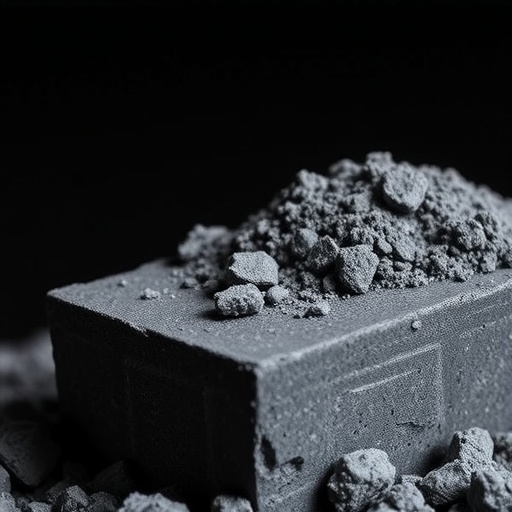
In the global effort to combat climate change, the spotlight often falls on renewable energy, electric vehicles, and energy efficiency improvements. However, an unsung heavyweight in the battle against carbon emissions lies in a material integral to modern infrastructure: cement. Although rarely discussed in public discourse as a major contributor to greenhouse gases, cement production mirrors the carbon footprint of all the world’s passenger vehicles combined, accounting for roughly 4.4% of total global emissions. This staggering statistic underscores the urgent need to rethink how this essential construction material is made.
A pioneering study by researchers at the University of California, Santa Barbara, led by geologist Jeff Prancevic, alongside industrial innovator Cody Finke of Brimstone Energy, Inc., proposes a transformative reimagining of cement production. Their research offers a pathway that could drastically reduce the carbon intensity of Portland cement—the predominant cement type used worldwide. Central to their approach is a fundamental shift in raw material sourcing: instead of the entrenched use of limestone, typically composed of calcium carbonate, they suggest harnessing calcium-rich silicate rocks such as basalt as the primary feedstock. This novel approach promises not only significant energy savings but also a tremendous reduction in accompanying CO2 emissions.
Cement production traditionally hinges on sourcing calcium from limestone, which is abundant yet brimming with carbon. Refining limestone involves subjecting it to extreme heat—exceeding 1,500°C—to produce calcium oxide, or quicklime. This calcination releases immense quantities of carbon dioxide directly into the atmosphere; approximately 500 kilograms of CO2 are emitted per metric ton of cement from the decomposition process alone, before accounting for additional fuel combustion emissions. The limestone’s inherent carbon is thus a major, unavoidable source of emissions in the cement lifecycle, posing a challenging barrier to decarbonization.
The UCSB team’s creative pivot to silicate rocks addresses this fundamental problem. Basalt and gabbro, both calcium-rich silicate minerals, do not contain significant amounts of carbonate, meaning their processing releases far less CO2. The researchers conducted extensive geological assessments and concluded that surface deposits of these silicate rocks are abundant enough to meet global cement demand for hundreds of thousands of years. While some of these deposits may be logistically challenging to mine, the resource base is effectively inexhaustible, presenting a sustainable long-term alternative to limestone.
A key insight from the study involves the energy dynamics of the alternative process. Processing silicate rock to extract calcium requires considerably less energy compared to limestone calcination. The team estimated that the minimal theoretical energy necessary for silicate-derived cement production is under 60% of that required for traditional limestone pathways. When fueled by natural gas, this method could reduce CO2 emissions from around 609 kilograms per ton down to about 50 kilograms, depending on the specific silicate mineral used—signifying an emissions drop exceeding 80%. This represents a potentially game-changing decrease in the carbon footprint of one of the world’s most ubiquitous materials.
Moreover, the researchers proposed practical processing routes leveraging existing industrial technologies, including those from sectors like metallurgy and chemical manufacturing. Even without refining and optimization, using average grid electricity, this method could already yield a 25% reduction in associated emissions relative to current limestone-derived Portland cement production. Such findings not only underscore the feasibility but also suggest economic viability, especially as energy and carbon costs rise globally.
While the benefits are apparent, the transition from limestone to silicates for Portland cement is fraught with engineering and industrial challenges. The purification and extraction of calcium from silicate minerals is more complex than from calcium-rich limestone, demanding innovative processing technologies and infrastructural revisions. Nevertheless, Prancevic expressed surprise and optimism about the identification of viable, energy-efficient processes for silicate extraction, highlighting an exciting frontier in cement research that had previously been overlooked.
An additional advantage of utilizing basalt isn’t limited to calcium extraction alone. Basalt contains metals such as iron and aluminum in ratios highly compatible with industrial consumption patterns, implying the potential for simultaneous recovery of valuable by-products during cement production. The ratio of calcium to iron in basalt aligns closely with societal needs for cement and steel production, enabling co-production without surplus waste. Notably, basalt holds approximately twentyfold more aluminum than current consumption levels, hinting at lucrative opportunities within multiple industrial sectors through integrated resource utilization.
Despite the promising environmental and economic implications, widespread adoption may face inertia. Cement markets are notoriously conservative, driven by century-old optimized processes and entrenched supply chains. Construction standards are tightly regulated; even incremental changes in cement composition undergo exhaustive testing and slow adoption rates. This reality poses a formidable barrier to the novel silicate-based approach, necessitating that new cement products not only meet but match the exacting performance standards familiar to builders worldwide.
Historically, alternative, lower-carbon cements have existed but lacked market penetration partly due to limited financial incentives and concerns about performance and cost. The advantage of the UCSB and Brimstone team’s approach is its focus on producing Portland cement itself—retaining compatibility with current construction methodologies, materials handling, and infrastructure. Still, convincing the industry to replace time-tested limestone routes with a novel silicate feedstock will require demonstrable cost savings, improved efficiency, and regulatory endorsement.
Currently, Brimstone Energy is actively refining pilot programs to operationalize these scientific breakthroughs into scalable industrial processes. Ongoing research aims to enhance both the energy efficiency of calcium extraction and the economic recovery of mineral by-products, potentially creating profitable new industrial symbioses. The researchers’ call to action emphasizes collaborative experimentation and innovation across academic and industrial boundaries, aiming to accelerate the widespread adoption of decarbonized cement production technologies.
In summary, this groundbreaking study presents a compelling case for reengineering one of humanity’s most pivotal materials through geological ingenuity. By substituting carbonate-rich limestone with calcium extracted from silicate rocks such as basalt, cement production can slash carbon emissions by more than 80% at the theoretical minimum energy threshold. This paradigm shift offers a scalable, practical solution that does not require abandoning Portland cement but instead integrates seamlessly into existing supply chains, thus holding the potential to address a climate challenge as substantial as the global transportation sector. The pathway now lies open for the construction industry, scientists, and policymakers to embrace this quiet revolution, potentially reshaping the built environment into a harbinger of sustainability.
News Publication Date: Not specified in the provided content.
Web References: Not provided.
References: Communications Sustainability (journal where the study was published).
Keywords
Applied sciences and engineering, Civil engineering, Construction engineering, Construction materials, Carbon emissions, Ore deposits, Cement
Cite Scienmag News
Denise Maddox. (May 14, 2026). Basalt: The Game-Changer for Greener, More Affordable Cement. Scienmag. https://scienmag.com/basalt-the-game-changer-for-greener-more-affordable-cement/
Denise Maddox. "Basalt: The Game-Changer for Greener, More Affordable Cement." Scienmag, 14 May 2026, https://scienmag.com/basalt-the-game-changer-for-greener-more-affordable-cement/. Accessed 4 September 2026.
Denise Maddox. "Basalt: The Game-Changer for Greener, More Affordable Cement." Scienmag. May 14, 2026. https://scienmag.com/basalt-the-game-changer-for-greener-more-affordable-cement/


