


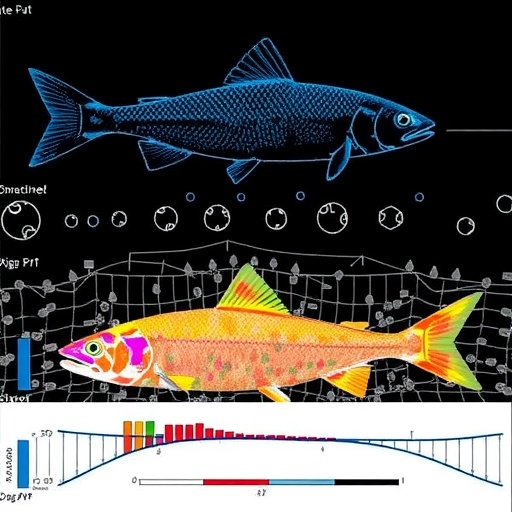
As the planet’s climate continues to warm and human influence alters marine environments, the distribution and behavior of marine species are undergoing profound transformations. Among these changes, coastal fish species are particularly vulnerable, as they must constantly adapt to shifting oceanic conditions or face local extinction. Predicting how fish populations will redistribute requires an intimate understanding of their ecological niches—the range of environmental parameters within which each species can survive and reproduce. However, these niches are often shaped by complex, interwoven factors, many of which remain elusive to direct measurement or observation, posing a formidable challenge to ecologists seeking to anticipate future marine biodiversity patterns.
In an unprecedented effort to unravel these hidden drivers of fish distribution, a team of researchers led by Yutaka Osada of the Advanced Institute for Marine Ecosystem Change (WPI-AIMEC) deployed cutting-edge eDNA sampling technology across an extensive network of coastal sites around Japan. Environmental DNA, or eDNA, represents genetic material shed by organisms into their surroundings—from skin cells to mucus and feces—allowing for non-invasive, far-reaching biodiversity assessments. By collecting seawater samples rather than individual fish, this methodology captures a broad snapshot of marine life within vast spatial domains, offering unprecedented data resolution and sensitivity.
The team sampled 528 coastal locations spanning diverse biogeographical regions of Japan over a concentrated three-month window during the summer, capturing a seasonal cross-section of regional fish biodiversity. This comprehensive sampling encompassed eight geographically and ecologically distinct districts, including the Hokkaido Islands, various sectors of the Japanese main islands adjoining both the Pacific Ocean and the Japan Sea, as well as the Izu-Ogasawara and Satsuma-Ryukyu Islands. Such spatial breadth allowed the researchers to probe ecological patterns on scales rarely attainable by traditional survey methods.
Analyzing this massive influx of eDNA-derived biodiversity data required sophisticated computational techniques capable of inferring environmental parameters indirectly influencing fish distribution—so-called “hidden niche axes.” The researchers employed advanced statistical models and machine learning algorithms to dissect the complex relationships embedded within the data. By examining co-occurrence patterns, species assemblages, and environmental gradients, the team could back-calculate previously unquantified ecological factors shaping where and how fish communities assemble along Japan’s diverse coastal waters.
The results, published in the prestigious journal Scientific Reports on February 17, 2026, were striking. The study imparted a clear picture of coastal biodiversity, confirming the presence of 1,220 fish species within the surveyed waters—accounting for nearly half of Japan’s known coastal fish diversity. Beyond mere species counts, the analysis revealed five distinct biogeographic boundaries where fish communities shift abruptly, signaling environmental or oceanographic barriers that influence distribution. One notable boundary lies near Yakushima Island, known as the Osumi Line, where closely related species segregate on either side due to the formidable Kuroshio Current—a powerful, warm ocean flow that acts as both a physical and ecological delimiter.
This discovery underscores the critical role that ocean currents play in shaping marine biodiversity at regional scales. Currents not only mediate larval dispersal and nutrient flows but also create conditions that can isolate populations, fostering speciation and unique community assemblages. The study highlights that such oceanographic features must be integrated into models predicting future fish distributions under climate change, emphasizing the need to understand more than just temperature or acidity gradients.
Professor Osada emphasizes the ecological and societal significance of these coastal fish communities. “Our coastal ecosystems provide vital fisheries resources that sustain millions of people. Understanding the mechanisms driving fish distributions is fundamental to managing and conserving these resources amid rapidly changing marine environments,” he explains. The study’s insights complement ongoing efforts to forecast the responses of marine ecosystems to intensifying climate pressures, offering tools to safeguard ecosystem services essential to human well-being.
Global warming’s multifaceted impact on oceans extends beyond warming waters to include altered current systems, which can have cascading effects on marine life distribution and productivity. This study’s approach—leveraging big data from eDNA with innovative analytical frameworks—presents a pioneering avenue for unraveling the mechanistic underpinnings of these dynamics. The capacity to detect hidden environmental factors indirectly enables more accurate ecological niche models, improving the fidelity of future projections.
In the broader context of biodiversity conservation, these findings align with the international community’s ambitious “Nature Positive” goals, aimed at halting and reversing biodiversity loss. Efficient and scalable tools like eDNA surveillance are poised to revolutionize how ecosystems are monitored, particularly in marine environments where traditional survey methods are logistically challenging and costly. By providing timely and high-resolution data, such approaches empower policy makers and conservationists to implement adaptive management strategies grounded in rigorous science.
Japan’s coastal waters stand as a microcosm of global marine biodiversity challenges, where high species richness intersects with dynamic oceanographic forces and intense anthropogenic pressures. This study’s integrative methodology offers a blueprint for similar efforts worldwide, demonstrating that coupling non-invasive genetic monitoring with advanced ecological modeling can illuminate the often hidden complexities governing species distributions.
The revelation that nearly half of Japan’s coastal fish diversity is detectable through eDNA further validates this innovative technology’s promise. As the database grows and methods refine, continuous monitoring will enhance the understanding of temporal shifts driven by both natural seasonal cycles and long-term climate trends. Such data streams are invaluable for early warning systems, conservation prioritization, and sustainable fisheries management amidst uncertain futures.
Looking forward, the integration of eDNA data with other oceanographic datasets—such as temperature, salinity, and current flow measurements—could facilitate even more nuanced modeling of fish niche axes. Combining biological and physical data layers will allow scientists to foresee how emerging environmental stressors may rewrite the map of marine biodiversity. Moreover, this convergence of genetics, ecology, and oceanography heralds a transformative era in marine sciences, where hidden ecological patterns yield to cutting-edge technology and analytics.
In conclusion, this landmark study not only enriches our scientific understanding of coastal fish ecology in Japan but also establishes a novel framework for biodiversity observation and ecological forecasting. By exposing the hidden niche axes that structure fish communities, researchers have taken a significant step toward predictive ecology under climate change. The implications extend far beyond Japan’s shores, offering hope that innovative science can guide the preservation of marine biodiversity and the ecosystems services upon which humanity depends.
News Publication Date: 17-Feb-2026
Web References: DOI link
Cite Scienmag News
Russell Cooper. (May 14, 2026). Extensive eDNA Survey Uncovers Hidden Drivers Shaping Regional Fish Communities. Scienmag. https://scienmag.com/extensive-edna-survey-uncovers-hidden-drivers-shaping-regional-fish-communities/
Russell Cooper. "Extensive eDNA Survey Uncovers Hidden Drivers Shaping Regional Fish Communities." Scienmag, 14 May 2026, https://scienmag.com/extensive-edna-survey-uncovers-hidden-drivers-shaping-regional-fish-communities/. Accessed 4 September 2026.
Russell Cooper. "Extensive eDNA Survey Uncovers Hidden Drivers Shaping Regional Fish Communities." Scienmag. May 14, 2026. https://scienmag.com/extensive-edna-survey-uncovers-hidden-drivers-shaping-regional-fish-communities/


