


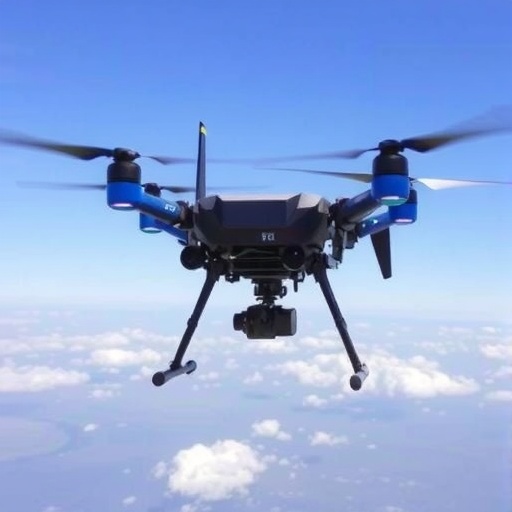
As the domain of autonomous technology surges forward, the distinctly pressing challenge lies not in crafting individual systems capable of intelligent operation, but in fostering seamless collaboration within networks of autonomous agents. While contemporary machines have demonstrated remarkable proficiency in operating independently, their ability to synchronize, communicate, and function collectively remains rudimentary, especially in complex and contested environments. This fragmentation of intelligence limits the potential of autonomous assets in both commercial and defense sectors, where coordination and adaptability are paramount for mission success.
A transformative stride towards overcoming this barrier is underway through the pioneering efforts of the Center for Connected Autonomy and Artificial Intelligence (CA-AI) at Florida Atlantic University (FAU). Bolstered by a substantial $2.25 million grant from the United States Air Force Research Laboratory (AFRL), CA-AI is spearheading research aimed at engineering advanced networks of autonomous systems capable of collaborative operation. This initiative is a multi-institutional collaboration encompassing FAU, the University at Buffalo (UB), and the University of Minnesota, pooling expertise in intelligent wireless systems, edge artificial intelligence (AI), swarm networking, and scalable testing frameworks to architect the future of networked autonomy.
At the nexus of this research is a paradigm shift from cloud-centered processing to edge AI implementations, where autonomous agents undertake sensing, inference, and decision-making locally on-board their hardware platforms. This empowerment at the network’s edge enables real-time responsiveness and robust adaptability, crucial in dynamic environments where latency and connectivity constraints render cloud reliance infeasible. By enabling machines to share information fluidly and coordinate responses, these intelligent collectives strive to emulate biological swarms, offering emergent behaviors far exceeding the sum of individual capabilities.
Dr. Dimitris Pados, Ph.D., principal investigator and director of CA-AI, emphasizes this transition: “Our goal is to move beyond the concept of isolated smart units towards integrated networks of intelligent systems that learn and operate in concert. This synergy is foundational for realizing fully autonomous operations in contested spaces.” His team is focused on infusing wireless communication systems with embedded AI that senses spectral environments and autonomously adapts transmission protocols to avoid interference, ensuring secure, resilient connections amid adversarial conditions and signal degradation.
This embedding of AI within communication hardware chains—from antennas through processors, GPUs, and field-programmable gate arrays (FPGAs)—enables the dynamic modulation of data flow across the autonomous networks. Such on-the-fly adaptability facilitates robust, distributed intelligence, allowing continuous information exchange and collective decision-making without centralized oversight. These capabilities underscore the shift toward cognitive radios that learn environmental characteristics in real time, a technological breakthrough heralded as transformative in recent Nature Reviews discussions.
The research trajectory of CA-AI encompasses three core domains: designing secure, networked edge-AI algorithms for efficient learning and inference; translating these algorithms into hardware implementations spanning diverse platforms; and cultivating a comprehensive educational ecosystem. This workforce development pipeline nurtures talent ranging from high school students to doctoral scholars, equipping them with hands-on expertise in AI-driven networking and robotics essential for driving next-generation autonomy.
Recognizing the strategic importance of this endeavor, Dr. Stella Batalama, dean of FAU’s College of Engineering and Computer Science, underscores the institution’s commitment: “FAU is pioneering research at the intersection of engineering and AI, cementing our leadership in technologies that will redefine autonomous systems. Collaborative intelligence among machines not only advances research but fortifies our nation’s technological edge and security posture.”
The underpinning groundwork laid through prior AFRL investments exceeding $8 million in joint research between FAU and UB has catalyzed advancements in programmable wireless networking, providing a robust foundation for this endeavor. Scaling these innovations to operate effectively amidst increasing environmental complexity remains a focal challenge, alongside expanding educational initiatives to ensure a steady influx of proficient engineers and researchers prepared to navigate the multifaceted landscape of AI-enabled autonomy.
CA-AI’s integrated approach orchestrates expertise in machine learning, cognitive radio technologies, secure wireless communications, and software-defined radios. Supported by sophisticated testbeds and realistic simulation environments, the center is uniquely positioned to push the boundaries of autonomous collaboration via wireless robotic systems capable of negotiation and adaptability under stringent operational constraints.
This research harbors profound implications: it promises to unlock capabilities where networks of autonomous platforms dynamically integrate sensor data, adapt communication strategies for resilience, and execute cooperative mission objectives with minimal human intervention. These advancements have potential applications spanning military operations—including secure UAV swarms and battlefield reconnaissance—to commercial sectors such as intelligent transportation networks, environmental monitoring, and disaster response systems.
In sum, the collaborative, intelligent ecosystems envisioned through CA-AI’s efforts herald a future where autonomous agents function less as isolated actors and more as cohesive entities, leveraging distributed AI to sense, learn, and act collectively. This evolution is poised to redefine the landscape of autonomous intelligence, shaping technologies that embody resilience, adaptability, and cooperative sophistication at unprecedented scales.
News Publication Date: Not specified
Web References:
– CA-AI Center at FAU: https://www.fau.edu/engineering/research/c2a2/
– FAU College of Engineering and Computer Science: https://www.fau.edu/engineering/
– Dimitris Pados Faculty Directory: https://www.fau.edu/engineering/directory/faculty/pados/
– FAU Main Website: https://www.fau.edu/
Keywords
Autonomous robots, Artificial intelligence, Human-robot interaction, Robot navigation, Swarm robotics, Military robots, Systems engineering, Military aviation, Machine learning, Complex adaptive systems, Network dynamics, Military science
Cite Scienmag News
Denise Maddox. (May 14, 2026). FAU’s CA-AI Awarded $2.2M U.S. Air Force Grant to Advance Next-Generation Autonomous Systems. Scienmag. https://scienmag.com/faus-ca-ai-awarded-2-2m-u-s-air-force-grant-to-advance-next-generation-autonomous-systems/
Denise Maddox. "FAU’s CA-AI Awarded $2.2M U.S. Air Force Grant to Advance Next-Generation Autonomous Systems." Scienmag, 14 May 2026, https://scienmag.com/faus-ca-ai-awarded-2-2m-u-s-air-force-grant-to-advance-next-generation-autonomous-systems/. Accessed 4 September 2026.
Denise Maddox. "FAU’s CA-AI Awarded $2.2M U.S. Air Force Grant to Advance Next-Generation Autonomous Systems." Scienmag. May 14, 2026. https://scienmag.com/faus-ca-ai-awarded-2-2m-u-s-air-force-grant-to-advance-next-generation-autonomous-systems/


