


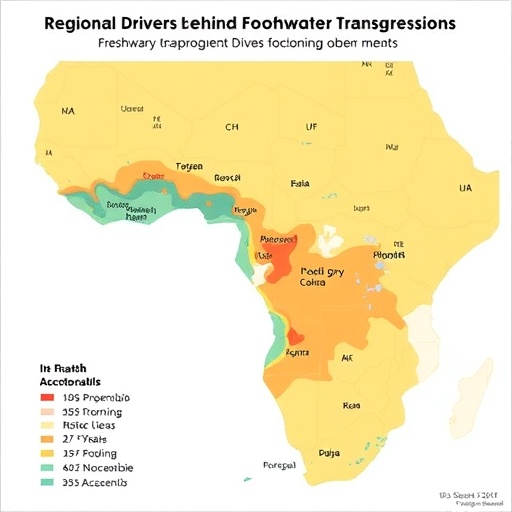
In an era where planetary boundaries define the safe operating space for humanity on Earth, freshwater resources have emerged as a critical point of concern. A groundbreaking study published in Nature Communications in 2026 by Virkki, Andersen, te Wierik, and colleagues delves into the complex and regionally diverse factors that drive transgressions of the freshwater change planetary boundary. This research offers unprecedented insights into how human activities and natural processes converge to push global freshwater systems beyond sustainable limits, with implications that reverberate across environmental, social, and economic dimensions.
The planetary boundary framework delineates thresholds for various Earth system processes, and freshwater use is among the most vital, given its essential role in sustaining ecosystems and human societies. Traditionally, freshwater availability and consumption have been viewed through a global lens; however, this novel research emphasizes that the drivers of freshwater boundary transgressions are not homogenous but instead vary significantly across different regions. This regional divergence points to the necessity of localized, tailored management strategies rather than one-size-fits-all global solutions.
Freshwater systems are inherently dynamic, influenced by climatic variables, hydrological cycles, geological formations, and anthropogenic pressures. The study harnesses a multidisciplinary approach integrating hydrological modeling, socio-economic data, and climate science to unravel the spatial complexity of freshwater use and stress. By coupling geospatial analysis with innovative data assimilation techniques, the authors identify distinct regional patterns where human water use exceeds renewable freshwater supplies, leading to boundary crossings that risk long-term ecological and societal stability.
One of the critical technical contributions of the research lies in the development of region-specific indices that account for variations in precipitation patterns, groundwater recharge rates, and evapotranspiration dynamics. These indices enable precise quantification of freshwater stress, accommodating the heterogeneity inherent in climatic and geological settings. For example, arid and semi-arid regions show pronounced over-extraction of groundwater reserves, driven by agricultural irrigation demands amplified by population growth and economic development.
Conversely, in temperate zones, the primary drivers of freshwater boundary transgressions are linked more closely to industrial and domestic water consumption. Urbanization trends trigger increased demands on surface and groundwater, often outpacing sustainable replenishment rates. Furthermore, alterations in land use patterns disrupt natural water cycles, reducing infiltration and increasing runoff, thereby exacerbating freshwater scarcity issues. The intricate feedback loops between urban growth, land management, and freshwater systems illuminate the multifaceted nature of water crises.
Climate change acts as a critical overlay, modulating freshwater availability through changing precipitation regimes, increased frequency of droughts, and altered snowmelt dynamics. The study elucidates how these climate-induced shifts interact with regional human water use patterns, sometimes compounding stress, other times offsetting consumption depending on localized climatic trajectories. This nuanced understanding challenges simplistic assumptions of global water scarcity projections and underscores the need for adaptive, regionally sensitive water governance frameworks.
The researchers also highlight how socio-economic factors profoundly influence freshwater boundary transgressions. Economic activities such as agriculture, mining, and energy production impose distinct water footprints that differ across cultural and developmental contexts. In some developing regions, inefficient water usage and lack of infrastructure intensify the strain, leading to unsustainable withdrawal rates that compromise both human well-being and ecosystem health. Meanwhile, affluent regions face challenges related to high per capita water consumption and intensive commodity production, indicating that economic prosperity does not inherently equate to sustainable freshwater stewardship.
Institutional and policy frameworks emerge as pivotal in mediating freshwater stress trajectories. The study identifies cases where governance models integrating community participation, technological innovation, and cross-sector collaboration effectively mitigate overuse risks. Conversely, weak regulatory environments and fragmented water management structures exacerbate boundary transgressions, reflecting a governance dimension that is as critical as physical and socio-economic drivers. This recognition calls for an integrative approach that blends science, policy, and societal engagement to preserve freshwater systems.
Additionally, the research uncovers underappreciated linkages between freshwater boundary breaches and biodiversity loss. Aquatic and riparian ecosystems reliant on steady water flows are disproportionately vulnerable to over-extraction and altered hydrological regimes. The cascading effects on flora and fauna biodiversity, in turn, jeopardize ecosystem services crucial for water purification, flood regulation, and climate resilience. This ecological perspective enriches the planetary boundary discourse by connecting anthropogenic water demand to broader biosphere integrity concerns.
The study’s methodological innovations, including the use of remote sensing data and machine learning algorithms to monitor and predict freshwater use patterns, represent a technological leap forward. These tools enable near-real-time detection of stress hotspots, supporting proactive management interventions. By integrating large datasets from diverse sources, the researchers demonstrate how cutting-edge data analytics can inform water sustainability science and policy, fostering a proactive approach to preventing further boundary transgressions.
Importantly, the results challenge preconceived notions about global water scarcity by revealing that transgressions are not uniformly attributable to overconsumption alone but are often linked with inefficient water use, infrastructural deficits, and socio-political complexities. For example, some regions display ample renewable water endowments yet suffer water stress due to unequal distribution, pollution, and governance failures. This distinction is vital as it reframes freshwater sustainability away from mere hydrological constraints towards encompassing human system dynamics.
The authors also explore future scenarios under varying socio-economic development pathways and climate change projections. These forward-looking analyses emphasize that without targeted interventions, many regions will face increasingly severe freshwater boundary transgressions. However, the scenarios simultaneously illustrate that integrated water resource management, technological innovation such as precision irrigation, wastewater recycling, and demand-side interventions can forge pathways back within safe operating limits.
A particularly transformative aspect of the research is its advocacy for designing water management policies that reflect the regionally divergent drivers identified. Recognizing that policy transferability is limited by contextual nuances, the authors recommend the co-creation of solutions with local stakeholders, integrating traditional knowledge with scientific insights. This participatory governance approach can enhance legitimacy, adaptability, and effectiveness, ultimately contributing to the resilience of freshwater systems and dependent communities.
Moreover, the study posits that understanding freshwater boundary transgressions provides a critical early warning system for broader Earth system instability. Given the connectivity of water cycles with carbon fluxes, land use, and climate feedbacks, breaches in freshwater boundaries may precipitate cascading ecological and climatic tipping points. This interconnectedness amplifies the urgency for immediate and sustained action to safeguard global freshwater frameworks.
Lastly, the implications of this research extend beyond academia, touching on public health, food security, and geopolitical stability. Water scarcity and quality issues stemming from boundary transgressions can provoke conflicts, migration, and economic disruptions. Hence, integrating scientific findings into international development agendas and diplomatic dialogues is essential for holistic sustainability strategies. By elevating awareness of regional freshwater challenges in a global context, the study invites collective responsibility and innovation.
In conclusion, Virkki et al.’s pioneering work offers a paradigm shift in understanding freshwater planetary boundaries by revealing the spatially differentiated drivers of transgressions. Through a sophisticated combination of empirical data, modeling, and interdisciplinary analysis, the study underscores the complexity of sustaining global freshwater resources amid growing anthropogenic pressures and a changing climate. Its insights pave the way for nuanced, regionally tailored solutions that can reconcile human development with planetary stewardship, thus supporting a sustainable and equitable water future for all.
Cite Scienmag News
Sloane Callahan. (May 14, 2026). Regional Drivers Behind Freshwater Boundary Transgressions. Scienmag. https://scienmag.com/regional-drivers-behind-freshwater-boundary-transgressions/
Sloane Callahan. "Regional Drivers Behind Freshwater Boundary Transgressions." Scienmag, 14 May 2026, https://scienmag.com/regional-drivers-behind-freshwater-boundary-transgressions/. Accessed 4 September 2026.
Sloane Callahan. "Regional Drivers Behind Freshwater Boundary Transgressions." Scienmag. May 14, 2026. https://scienmag.com/regional-drivers-behind-freshwater-boundary-transgressions/


