


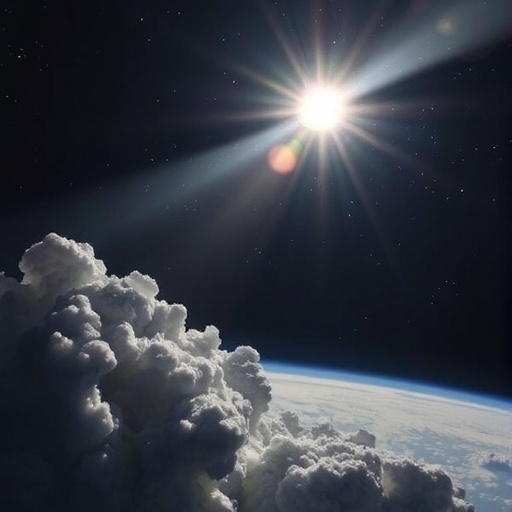
A newly published study led by researchers at University College London (UCL) reveals that the rapidly increasing satellite megaconstellations are causing a substantial accumulation of pollution in the upper atmosphere, with potentially far-reaching climatic consequences. The study, appearing in the respected journal Earth’s Future, underscores how the surge in rocket launches supporting these megaconstellations is creating an intensifying layer of black carbon soot that lingers in the stratosphere much longer than pollutants generated at ground level. This soot, produced primarily from the combustion of kerosene-based rocket fuels, is found to have an outsized warming effect on the planet’s climate compared to terrestrial sources.
Since 2019, the deployment of satellite megaconstellations — which consist of hundreds to thousands of small satellites designed mainly for global internet connectivity — has skyrocketed rocket launch activity globally. SpaceX’s Starlink constellation, boasting nearly 12,000 satellites alone at present, exemplifies this megaconstellation era and propels much of the emissions surge. The UCL team quantified how contributions to space sector-related climate impact from these large satellite constellations stood at 35% in 2020 and are projected to climb to 42% by the end of the decade, emphasizing their growing share in atmospheric pollution. This finding is particularly concerning given the accelerating pace of launches, with the number of annual rocket liftoffs nearly tripling between 2020 and 2025.
What sets rocket emissions apart is their injection height: the black carbon particles are directly deposited into the upper layers of the atmosphere, where air circulation is sluggish, and removal mechanisms like precipitation are virtually absent. This contrasts sharply with soot from cars, industry, and biomass burning near the surface, where rain and weather systems efficiently cleanse the air within days to weeks. In these lofty altitudes, black carbon can persist for years, amplifying its radiative forcing — the net change in energy balance at Earth’s surface due to atmospheric constituents. The study estimates that space-based soot is approximately 540 times more potent per unit mass in altering the climate than surface-emitted particles.
By 2029, the annual black carbon emissions from rocket launches alone are expected to reach around 870 tonnes, an amount comparable to the entire UK passenger vehicle fleet’s soot emissions, calculated at roughly 728 tonnes per year. This striking statistic reveals how the comparatively nascent space launch industry is becoming a non-negligible source of climate-altering pollution. Despite the current magnitude of this effect being smaller relative to well-established industrial activities, the researchers warn that without intervention, its unique characteristics and rapid growth could precipitate irreversible harm to the planet’s atmospheric system.
Beyond climate warming, the team also analyzed the impact of megaconstellation launches on the Earth’s protective ozone layer. The ozone layer in the stratosphere acts as a shield against the Sun’s harmful ultraviolet radiation, and it is sensitive to the release of chlorine- and other halogen-containing compounds. While some rocket propellants do emit chlorine, most megaconstellations to date have been launched with kerosene-fueled rockets that do not produce chlorine emissions. Consequently, the study projects a minimal decrease in global ozone from these launches—about 0.02% depletion by 2029—especially when compared to the 2% depletion caused by regulated ozone-depleting substances covered under the Montreal Protocol.
That said, emerging megaconstellation projects such as Amazon’s Leo system and China’s Guowang constellation might pose different risks, as they could involve rockets using chlorine-emitting solid boosters or other propellant types with unknown impacts. Amazon-Leo is expected to rely mainly on Blue Origin rockets, which use cleaner liquid hydrogen or methane fuels, though some contracts include launches on rockets with chlorine emission potential. China’s intentions remain less clear but have traditionally employed solid-fuel rockets rich in chlorine, underscoring the necessity for rigorous emissions tracking and regulatory frameworks as the space launch industry evolves.
The researchers caution that the accumulation of black carbon at high altitudes mimics, in some respects, the mechanisms envisioned in solar geoengineering proposals aimed at cooling Earth’s surface by injecting reflective particles into the stratosphere. However, the unregulated and inadvertent nature of this satellite launch pollution differs fundamentally from deliberate geoengineering efforts, which seek controlled and reversible climate interventions. This accidental “experiment” risks unforeseen consequences, including disruptions to atmospheric chemistry and radiation balance, which could complicate climate change mitigation strategies.
Professor Eloise Marais, leading the research from UCL Geography, emphasized the urgency of proactive regulation: “The space industry pollution is like a small-scale, unregulated geoengineering experiment that could have many unintended and serious environmental consequences. Currently, the impact on the atmosphere is small, so we still have the chance to act early before it becomes a more serious issue that is harder to reverse or repair.” Her comments highlight a critical gap in governance concerning atmospheric pollution from space activities, which has seen limited attention despite the rapidly expanding scale of satellite deployments and launches worldwide.
Further compounding concerns is the reality that the projected emissions data spanning 2020 to 2022 used in the study likely underestimates actual growth trends. Rocket launches between 2023 and 2025 have already surpassed prior predictions, and upcoming satellite networks could involve tens of thousands more spacecraft requiring frequent launches. This trajectory implies that atmospheric pollution from the space sector—and its associated climatic influence—may accelerate faster than currently modeled, stressing the need for real-time monitoring and adaptive policymaking.
Interestingly, while the soot effectively reduces sunlight reaching Earth’s surface and produces a mild cooling effect, this natural “filtering” is negligible compared to the overwhelming warming induced by anthropogenic greenhouse gases, and certainly cannot offset ongoing global warming trends. Dr. Connor Barker, co-lead author, underscored the special nature of rocket pollution, stating, “Rocket launches are a unique source of pollution, injecting harmful chemicals directly into the upper layers of the atmosphere and contaminating Earth’s last remaining relatively pristine environment. Though this soot’s impact on climate is currently much smaller than other industrial sources, its potency means we need to act before it causes irreparable harm.”
The study employed meticulous statistical analysis of emissions data, launch frequencies, fuel burn, and atmospheric chemistry to model radiative forcing and ozone interactions over the coming decade. By integrating satellite mission schedules, rocket fuel compositions, and deposition rates, the research team delivered a comprehensive forecast that not only quantifies current impacts but also positions future space industry trends within the broader context of global environmental change. These technical insights underscore the pressing need to balance humanity’s expanding presence in orbit with the stewardship of Earth’s fragile atmospheric systems.
Overall, the findings illuminate an emerging environmental challenge: the unchecked expansion of megaconstellations and their launch activities impose a rapidly intensifying burden on Earth’s upper atmosphere—a domain critical to planetary climate regulation and biological health. As mega-launch rates skyrocket, international cooperation and innovative regulatory frameworks become essential to mitigate black carbon accumulation and chemical perturbations in the stratosphere. Otherwise, humanity risks compounding climate instability through a space industry whose atmospheric footprint has so far gone largely unnoticed.
News Publication Date: 14-May-2026
References:
Barker, C., Marais, E., et al. (2026). Radiative Forcing and Ozone Depletion of a Decade of Satellite Megaconstellation Missions. Earth’s Future. https://doi.org/10.1029/2025EF007229
Web References:
https://www.ucl.ac.uk/
https://maraisresearchgroup.co.uk/
https://cbarker211.github.io/
Keywords
Satellite megaconstellations, black carbon pollution, upper atmosphere, rocket launches, radiative forcing, climate impact, ozone depletion, kerosene rocket fuel, SpaceX Starlink, geoengineering, stratospheric soot, environmental regulation
Cite Scienmag News
Russell Cooper. (May 14, 2026). Rapid Accumulation of Satellite Launch Pollution in the Upper Atmosphere. Scienmag. https://scienmag.com/rapid-accumulation-of-satellite-launch-pollution-in-the-upper-atmosphere/
Russell Cooper. "Rapid Accumulation of Satellite Launch Pollution in the Upper Atmosphere." Scienmag, 14 May 2026, https://scienmag.com/rapid-accumulation-of-satellite-launch-pollution-in-the-upper-atmosphere/. Accessed 4 September 2026.
Russell Cooper. "Rapid Accumulation of Satellite Launch Pollution in the Upper Atmosphere." Scienmag. May 14, 2026. https://scienmag.com/rapid-accumulation-of-satellite-launch-pollution-in-the-upper-atmosphere/


