


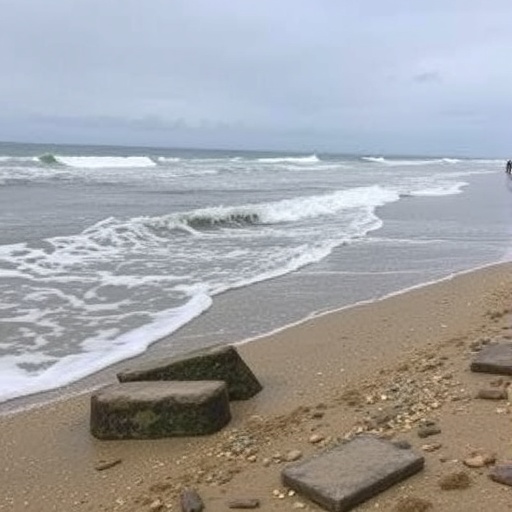
In an era defined by intensifying climate dynamics, the rising concern over changing sea levels has predominantly centered on mean sea-level rise and its catastrophic consequences. However, cutting-edge research now reveals that the variability in seasonal sea levels—the natural ebb and flow tied to annual climatic cycles—may be poised to undergo transformations of its own, presenting a formidable challenge to coastal ecosystems. Recent projections illuminate an unsettling trend: widespread increases in the amplitude of seasonal sea-level variability. This subtle yet profound shift carries the potential to reshape the fundamental rhythms of intertidal environments, upending long-held ecological equilibriums and threatening the resilience of coastal biodiversity.
The study, spearheaded through a conceptual modeling approach, systematically explores how even modest expansions in the range of the annual sea-level cycle can drastically modify coastal dynamics. Unlike the steady incremental rise often cited, seasonal variability refers to the natural fluctuations in sea level within a given year, driven by factors such as atmospheric pressure, wind patterns, temperature cycles, and oceanic currents. When these fluctuations expand beyond historical norms, the length and frequency of periods during which intertidal zones are either submerged or exposed are transformed. The implications of this change extend beyond mere hydrological curiosity; they strike at the core physiological and biological processes of species inhabiting these delicate zones.
Intertidal zones, narrow strips of coastline that alternate between marine and terrestrial exposure, are ecological hotspots supporting a unique assemblage of flora and fauna adapted to rhythmic inundation. These organisms have evolved complex life strategies finely tuned to predictable exposure times—often measured in hours rather than days or months. The new projections show that increasing seasonal sea-level variability can intensify exposure durations drastically, shifting the temporal scale at which these habitats experience inundation and emergence. This shift fundamentally disrupts feeding cycles, reproductive timing, and habitat availability, cascading into broader ecosystem stress and potential collapse.
Using a sophisticated conceptual framework that integrates physical sea-level data with biological response models, the researchers demonstrate that the increased fluctuation in annual sea-level ranges has profound bearings on ecosystem dynamics. For example, species that are highly sensitive to desiccation due to prolonged exposure during low tides may face increased mortality. Conversely, organisms depending on periodic submersion may find the altered timing challenging for crucial activities like spawning or larval dispersal. This nuanced interplay showcases an underappreciated avenue through which climate change imposes stress on marine and coastal communities, beyond what average sea-level rise projections indicate.
Critically, the transformation in seasonal variability can trigger shifts not merely in short-term biological responses but also in longer-term community structures and biogeography. The altered timing and frequency of inundation can promote invasive species better adapted to variable conditions, thereby destabilizing indigenous populations. Moreover, prolonged exposure or flooding can enhance nutrient runoff and disrupt sediment transport, affecting water quality and habitat formation. The compounded effect of these physical and biological interactions heightens the vulnerability of already stressed coastal ecosystems, undermining their capacity to provide essential services such as shoreline protection, carbon sequestration, and fisheries support.
Methodologically, the research employs a conceptual model calibrated against empirical sea-level datasets encompassing seasonal oscillations and interannual variability. This approach allows for the disentanglement of the impacts attributable solely to changes in seasonal range from those related to mean sea-level trends. Importantly, the model captures nonlinear threshold effects whereby small increases in the range of sea-level variation disproportionately amplify changes in exposure duration. Such nonlinearities are critical for accurately forecasting ecosystem responses, underscoring the necessity for models that move beyond simplistic linear assumptions common in traditional sea-level rise projections.
The findings underscore a compelling need to integrate seasonal variability considerations into coastal risk assessments and resilience planning. Whereas much policy focus concentrates on permanent sea-level rise—managing floods, storm surges, and permanent habitat loss—the evidence suggests that the cyclical nature of sea levels demands equal attention. Seasonally variable exposure times govern key ecological processes and organismal life cycles. Failure to factor these dynamics into conservation strategies risks underestimating ecosystem vulnerability and misdirecting resource allocation aimed at preservation.
Furthermore, the projected increases in seasonal variability complicate existing adaptation frameworks. Many coastal ecosystems and human activities depend on the regularity and predictability of tidal cycles for sustainable management—for instance, aquaculture practices, coastal infrastructure maintenance, and fisheries management. Changes in temporal patterns of sea-level exposure could induce unforeseen operational challenges, especially in scenarios where prolonged inundations hinder harvesting or extended drying periods reduce productivity. Effective adaptation will require multidisciplinary approaches integrating oceanography, ecology, and socioeconomics to anticipate and mitigate risks.
From a broader climate science perspective, this research highlights the role of atmospheric and oceanic teleconnections in influencing seasonal sea-level variance. Phenomena such as shifting wind patterns associated with the jet stream, changes in monsoonal flows, and evolving ocean circulation modes bear directly on the intensity and timing of seasonal sea-level oscillations. By elucidating connections between large-scale climatic systems and local intertidal dynamics, the study offers a pathway toward improved predictive models capable of capturing complex feedbacks between climate variability and coastal environments.
Importantly, this emerging understanding places coastal ecosystems at a new frontier in climate impact research. While massive concerns about glaciers melting and ocean warming dominate headlines, the nuanced dance of seasonal sea-level variability presents an underrecognized driver of ecosystem change. This realization opens fresh avenues for scientific inquiry, necessitating closer monitoring networks, refined hydrodynamic models, and robust ecological field studies aimed at capturing the intricate consequences of altered sea-level seasonality.
Environmental stress induced by shifting sea-level variability also interacts with other anthropogenic pressures such as pollution, habitat fragmentation, and overexploitation, reinforcing the cumulative burden on coastal zones. In many areas, rapid urbanization and infrastructure development amplify ecosystem sensitivities, limiting natural adaptive capacities. This confluence of natural and human factors strengthens the call for integrated coastal zone management that acknowledges the multi-scalar dimensions of sea-level variability and its ecological ramifications.
The study’s conceptual model also raises critical questions about potential tipping points and thresholds in coastal ecosystems. If increases in seasonal variability push exposure or inundation beyond species-specific tolerance limits, entire biotic communities could face abrupt regime shifts. Identifying such thresholds remains an urgent challenge for marine ecologists and environmental managers, bearing significant implications for biodiversity conservation and sustainable use of coastal resources.
From a technological perspective, advancements in remote sensing, tide gauge data integration, and climate model downscaling will be instrumental in tracking and predicting evolving patterns of sea-level variability. Enhanced observational capacity will enable the identification of emerging hotspots where seasonal amplitudes magnify most dramatically, guiding targeted interventions. Combined with ecological monitoring, such tools will form the backbone of adaptive management strategies designed to bolster coastal resilience in the face of fluctuating environmental baselines.
Ultimately, this research calls for a paradigm shift in how the scientific community and policymakers conceptualize sea-level change impacts. By moving beyond the static notion of rising averages toward embracing the dynamic and oscillatory nature of seasonal variation, more nuanced and effective mitigation and adaptation frameworks can be developed. Coastal ecosystems harbor immense ecological, cultural, and economic value; safeguarding their future depends on acknowledging and accounting for the full spectrum of sea-level change scenarios illustrated by this study.
In summary, the portrayal of future changes in seasonal sea-level variability as a transformative factor for coastal ecosystems expands the climate change discourse considerably. The projection that increased amplitude in the annual sea-level cycle can extend exposure times from hours to days or even months poses critical challenges to the biophysical functioning of intertidal zones. By integrating conceptual modeling with empirical data analyses, this research offers a pivotal insight into the complex processes driving ecosystem vulnerability, urging comprehensive reevaluation of coastal resilience strategies amid a rapidly transforming climate regime.
Cite Scienmag News
Sloane Callahan. (May 13, 2026). Future Seasonal Sea-Level Changes Threaten Coastal Ecosystems. Scienmag. https://scienmag.com/future-seasonal-sea-level-changes-threaten-coastal-ecosystems/
Sloane Callahan. "Future Seasonal Sea-Level Changes Threaten Coastal Ecosystems." Scienmag, 13 May 2026, https://scienmag.com/future-seasonal-sea-level-changes-threaten-coastal-ecosystems/. Accessed 3 September 2026.
Sloane Callahan. "Future Seasonal Sea-Level Changes Threaten Coastal Ecosystems." Scienmag. May 13, 2026. https://scienmag.com/future-seasonal-sea-level-changes-threaten-coastal-ecosystems/


