


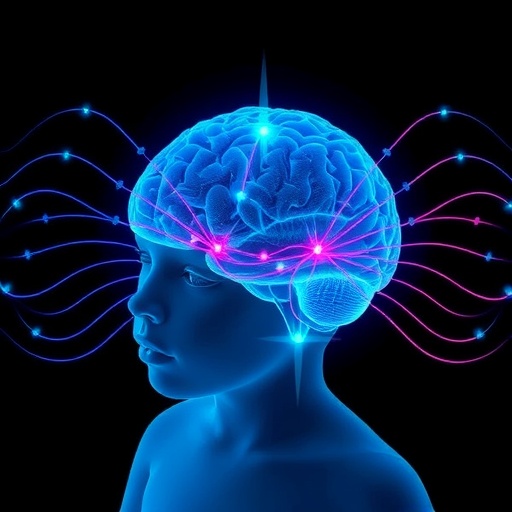
In a groundbreaking study published in Nature Neuroscience, researchers have uncovered a novel neural signature that governs the delicate process of attentional shifting in children. This investigative work delves into the underlying mechanisms that allow young brains to flexibly redirect attention in response to changing goals and environments — a cognitive ability often impaired in pediatric populations with attention deficit disorders. By harnessing intracranial electrophysiology combined with cutting-edge machine learning techniques, the team offers compelling evidence of a real-time biomarker predictive of imminent lapses in attentional control, marking a significant advance toward precision neuromodulation therapies.
Attention shifting, the capacity to disengage focus from one stimulus and reorient it to another, is critical for adaptive behavior. In children, however, spontaneous fluctuations in attention frequently disrupt this ability, hampering learning and daily functioning. These disruptions are particularly pronounced in those diagnosed with disorders affecting executive function, such as ADHD, but the neural basis for these lapses remains poorly characterized. Seeking to fill this knowledge gap, the researchers performed intracranial recordings in pediatric epilepsy patients who underwent neurosurgical electrode implantation. This approach enabled direct measurement of electrical oscillations underpinning cognitive processes with exceptional spatial and temporal resolution.
During the experiments, children were tasked with an attentional set-shifting paradigm designed to evoke shifts in focus according to evolving rules. The team recorded activity from cortical and subcortical regions implicated in attentional control as participants navigated the changing task demands over multiple days. Applying machine learning classifiers, the investigators decoded patterns in the neural signals that preceded observable delays in attention shifting. Notably, these classifiers demonstrated robust prediction of impending lapses—generalizing across different individuals and sessions—highlighting the reproducibility of this neural signature.
To illuminate the functional relevance of these predictive signals, the researchers implemented a closed-loop electrical stimulation protocol. Upon detection of the neural pattern signaling an imminent attentional delay, targeted intracranial stimulation was delivered to modulate ongoing brain activity. Remarkably, this intervention effectively rescued attention shifting performance, as measured by metrics such as eye tracking trajectories, reaction times, and task accuracy. These findings provide the first proof of concept that precise, closed-loop neuromodulation can dynamically enhance cognitive flexibility in real time.
Complementing the invasive electrophysiology experiments, simultaneous scalp EEG recordings revealed identifiable noninvasive analogs of the intracranial biomarkers. This parallel discovery opens avenues for translation of closed-loop modulation approaches to less intrusive settings. In a cohort of healthy participants, the team demonstrated that noninvasive stimulation guided by the scalp EEG signatures could modulate attention shifting similarly to the intracranial protocol, underscoring the broad therapeutic potential.
The implications of this work are manifold. By defining a quantifiable and actionable neural correlate of attentional flexibility, the study paves the way for next-generation interventions tailored to individuals’ real-time cognitive states. This precision approach contrasts sharply with traditional treatments for attention disorders, which rely on static dosing of pharmacological agents and do not adapt dynamically to fluctuating symptoms. Moreover, the neural mechanisms elucidated here enhance our fundamental understanding of how the brain orchestrates executive control processes during development.
Critically, this research bridges an important gap between basic neuroscience and clinical application. The pediatric context is particularly challenging for such translational work, given the ethical and practical constraints around invasive monitoring. Yet by studying epilepsy patients already undergoing neurosurgery, the investigators leveraged a rare but invaluable opportunity to access human brain signals intimately tied to natural cognitive behavior without additional risk. The multi-day recordings also ensured the stability and reliability of signals underlying the predictive model.
From a methodological perspective, the integration of machine learning with neurophysiological data represents an elegant strategy to unravel complex brain-behavior relationships. The classifiers learned to detect subtle, transient changes in oscillatory dynamics that herald attentional lapses—information that could not easily be extracted through traditional analysis. Such computational approaches are poised to transform neuroscience by extracting actionable insights from high-dimensional, continuous brain data streams.
Looking forward, the challenge will be to extend these findings beyond highly controlled clinical environments. Scaling closed-loop neuromodulation for widespread use requires refinement of noninvasive biomarkers and stimulation paradigms to achieve comparable specificity and efficacy outside hospital settings. Additionally, long-term studies are needed to assess the durability of cognitive improvements and identify any potential side effects of repeated stimulation in developing brains.
Nevertheless, this study marks a major milestone in neurotechnology and cognitive neuroscience. The demonstrated capacity to predict and modulate moment-to-moment attentional dynamics embodies a conceptual shift toward adaptive brain therapies. Such approaches promise to revolutionize treatment for attention deficits and other neuropsychiatric conditions characterized by impaired cognitive flexibility.
The findings also prompt intriguing scientific questions about the circuit-level origins of the recorded neural signatures. Future research could investigate how interactions between frontal regions, basal ganglia, and sensory cortices coordinate to enable fluid attentional transitions. Moreover, dissecting how developmental factors influence these mechanisms may inform age-specific interventions to optimize cognitive growth.
In summary, this pioneering research offers a compelling vision for personalized neurocognitive enhancement. By unlocking a neural code predictive of attentional shifts and demonstrating its manipulability, the work opens unprecedented opportunities to restore and augment executive function in children affected by attention impairments. As neuromodulation technology continues to mature, such closed-loop systems could become pivotal tools in both clinical practice and everyday cognitive augmentation.
Ultimately, this innovative blend of systems neuroscience, engineering, and clinical neurophysiology exemplifies the potential of interdisciplinary collaboration to tackle some of the most pressing challenges in child mental health. The convergence of precise neural monitoring, sophisticated computational modeling, and targeted intervention sets a new standard for studying and improving brain function, heralding a future where cognitive lapses are not merely managed but preemptively controlled.
Cite Scienmag News
Ophelia Keating. (May 13, 2026). Closed-Loop Stimulation Enhances Children’s Attention Shifting. Scienmag. https://scienmag.com/closed-loop-stimulation-enhances-childrens-attention-shifting/
Ophelia Keating. "Closed-Loop Stimulation Enhances Children’s Attention Shifting." Scienmag, 13 May 2026, https://scienmag.com/closed-loop-stimulation-enhances-childrens-attention-shifting/. Accessed 4 September 2026.
Ophelia Keating. "Closed-Loop Stimulation Enhances Children’s Attention Shifting." Scienmag. May 13, 2026. https://scienmag.com/closed-loop-stimulation-enhances-childrens-attention-shifting/


