


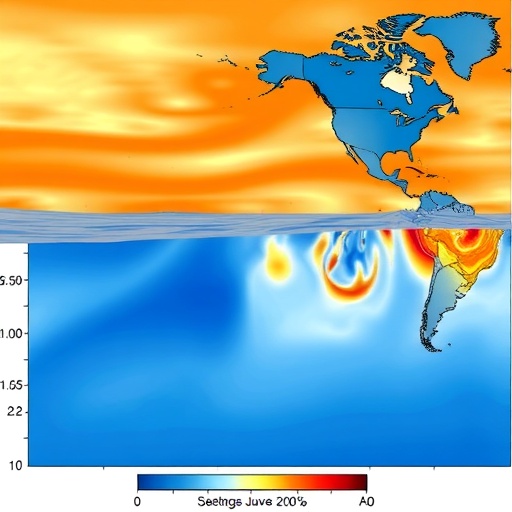
As the global dialogue on climate change evolves, the increasing focus on sea-level rise has predominantly centred on the long-term increment of the mean annual sea level. However, emerging research from a collaboration between Utrecht University, the University of Antwerp, the Royal Netherlands Institute for Sea Research (NIOZ), and Wageningen Marine Research unveils a critical and largely unrecognized dimension of oceanic shifts— the intensification of seasonal sea-level variability. This dynamic, occurring on much shorter timescales than the gradual rise in average sea levels, offers profound implications for the health and sustainability of coastal ecosystems worldwide.
Climate scientist Tim Hermans, part of the investigative team, underscores the significance of these intra-annual fluctuations. Unlike the slow and steady mean sea-level rise, seasonal variations manifest and evolve over weeks or months, imposing rapid and acute changes in water levels that coastal flora and fauna must withstand. This has profound consequences, particularly for ecosystems in the intertidal zones, where flora and fauna are adapted to finely balanced cycles of submersion and exposure.
In a groundbreaking approach, coastal ecologist Jim van Belzen utilized a novel flooding model to simulate and visualize the impact of escalating seasonal sea-level variability on coastal wetlands. The model reveals that even modest amplifications in seasonal fluctuations dramatically shift flooding regimes, effectively submerging these habitats for periods far exceeding historical norms. This submersion, in turn, challenges the survival thresholds of species adapted to shorter inundation cycles, potentially leading to drastic ecosystem shifts.
These prolonged flooding episodes do not solely affect the time underwater but also extend dry periods, creating a paradoxical scenario of both increased and decreased water exposure times. Such shifts can transform what was once a habitat flooded for mere hours into one submerged for several consecutive weeks, thereby reshaping the living conditions for myriad coastal species. This phenomenon is anticipated to be most acute in intertidal areas characterized by relatively narrow tidal ranges, such as those found in the Mediterranean Sea and the Sea of Japan.
The ramifications for biodiversity in these delicate zones are profound. Greg Fivash, an ecologist from the University of Antwerp, emphasizes that tidal ecosystems operate within stringent wet-dry thresholds. Alterations in these thresholds can dislocate species distributions and fundamentally alter ecosystem functions. Enhanced flooding variability affects not only the individual species but cascades through ecological networks, impacting productivity levels, biodiversity richness, and overall ecosystem resilience against environmental perturbations.
Physiological stress in coastal organisms induced by these shifting water regimes is an underappreciated consequence detailed in the study. Prolonged submersion can lead to oxygen depletion in seabed sediments, a condition that exerts metabolic strain on benthic organisms, algae, and seagrasses. Conversely, extended exposure during low-water phases can result in increased heat stress and desiccation risk for vulnerable vegetation such as salt-marsh plants. This bidirectional stress imposes compounded adaptive challenges to species finely tuned to historical tidal rhythms.
The research team advocates for integrating these findings into future coastal management and conservation frameworks. A keen understanding of intra-annual sea-level dynamics is essential for predicting ecosystem trajectories more accurately under changing climatic conditions. This will require coastal planners and ecologists to move beyond focusing solely on mean annual sea-level rise and embrace the complexities introduced by seasonal fluctuations.
Such integration is urgent in shallow coastal zones where minor alterations in water levels can exert outsized ecological impacts. The fate of intertidal ecosystems hinges on the delicate balance between periodic inundation and exposure—forces now subject to more pronounced seasonal variability. Therefore, adaptive management must consider temporal sea-level patterns to avoid the ecological decline of these emblematic habitats.
This pioneering study marks a vital advancement in climate impact science by spotlighting an overlooked risk for coastal ecosystems. Seasonal shifts in sea-level variability are poised to become a critical factor in determining ecosystem health, resilience, and future biodiversity. By bringing these dynamics to the forefront of climate assessments, researchers hope to catalyse more nuanced and effective responses to sea-level rise.
Furthermore, the ramifications extend beyond ecological concerns; coastal communities dependent on the services these ecosystems provide may experience indirect consequences. Losses in productivity and increased vulnerability of salt marshes and mudflats could affect fisheries, carbon sequestration capabilities, and natural coastal defences—underscoring the socioeconomic stakes inherent to seasonal sea-level changes.
Ultimately, this work propels a new research agenda that integrates seasonal variability as a key axis in sea-level rise studies. Such multi-scale temporal analyses are critical in developing holistic models of coastal response in an era of unprecedented climatic uncertainty. The findings signal that managing the coasts of the future demands more intricate and dynamic frameworks than previously considered.
This paradigm shift calls upon scientists, policymakers, and coastal managers alike to heed the complex, fluctuating nature of oceanic systems. Sea-level rise is not a singular, slow-moving threat but a multifaceted phenomenon with seasonal rhythms that can profoundly reorder coastal ecosystems in ways yet to be fully realized. With continued interdisciplinary research and proactive policy adjustments, it might still be possible to safeguard the essential functions and diversity of these invaluable habitats.
News Publication Date: 13-May-2026
Web References:
10.1038/s41558-026-02631-y
Cite Scienmag News
Sloane Callahan. (May 13, 2026). Rising Seasonal Sea Level Fluctuations: An Under-Reported Issue with Potential Major Impact. Scienmag. https://scienmag.com/rising-seasonal-sea-level-fluctuations-an-under-reported-issue-with-potential-major-impact/
Sloane Callahan. "Rising Seasonal Sea Level Fluctuations: An Under-Reported Issue with Potential Major Impact." Scienmag, 13 May 2026, https://scienmag.com/rising-seasonal-sea-level-fluctuations-an-under-reported-issue-with-potential-major-impact/. Accessed 3 September 2026.
Sloane Callahan. "Rising Seasonal Sea Level Fluctuations: An Under-Reported Issue with Potential Major Impact." Scienmag. May 13, 2026. https://scienmag.com/rising-seasonal-sea-level-fluctuations-an-under-reported-issue-with-potential-major-impact/


