


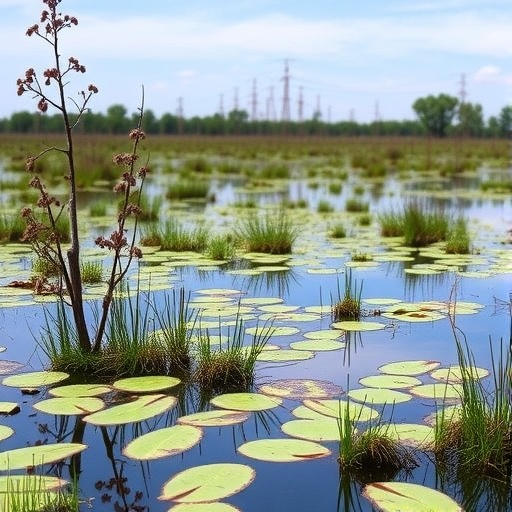
In the complex and ever-evolving narrative of climate change, methane stands as one of the most potent greenhouse gases, with a warming potential far exceeding that of carbon dioxide over short timescales. As researchers worldwide strive to accurately quantify the sources and sinks of methane, a groundbreaking study has now shone a spotlight on a surprising and hitherto underappreciated contributor: small wetlands. This new research, leveraging state-of-the-art 30-meter resolution remote sensing data, reveals that these diminutive, often overlooked ecosystems play an outsized role in global methane emissions, upending traditional assumptions and calling for urgent recalibration of global methane budgets.
Wetlands have long been recognized as significant natural sources of methane emissions due to anaerobic decomposition processes in saturated soils. However, until now, most global methane inventories and models have primarily focused on larger wetland systems, overlooking the countless small wetlands scattered across non-forested landscapes. According to the latest findings, there exists an astonishing 160 million small wetlands with sizes ranging from a mere 0.001 to 1 square kilometer across the planet’s surface. This vast network of small wetlands collectively contributes almost a quarter of the total methane emissions attributed to wetlands—a figure that greatly surpasses previous estimates.
This revelation owes much to the deployment of ultra-high-resolution remote sensing technologies, which have enabled unprecedented detection and mapping of wetland units that were previously invisible to coarser-scale satellite imagery. By analyzing data spanning two decades from 2003 to 2022, the research team has not only cataloged these wetlands but also tracked changes in their methane emission patterns over time. These findings indicate a significant upward trend in methane emissions from small wetlands during this period, with the very smallest wetlands—those under 0.1 square kilometers—emerging as the dominant contributors to both the volume and growth rate of methane release.
The implications of these results are profound for climate science and policy. Conventional methane emission models that omit or underestimate small wetlands risk missing an essential piece of the global methane puzzle, potentially leading to inaccuracies in greenhouse gas inventories and climate projections. Since methane has approximately 80 times the global warming potential of CO₂ over a 20-year horizon, even relatively small unaccounted sources can jeopardize efforts to meet international climate targets. The newfound recognition of small wetlands as emission hotspots calls for their integration into Earth system models and international reporting frameworks.
One of the study’s key technical advances lies in the integration of multi-temporal remote sensing datasets with advanced classification algorithms tailored to differentiate small wetlands from other land cover types. Previous methods struggled with detecting these patches due to their small size and fragmented distribution amid heterogeneous landscapes. By utilizing fine-scale spectral resolution and adaptive learning models, researchers have successfully distinguished these wetlands with remarkable accuracy, overcoming the limitations of coarse-resolution datasets that amalgamate small wetlands into broader land categories.
Furthermore, the work elucidates the spatial distribution patterns of small wetlands, which cluster predominantly in non-forested regions globally. These areas, often less studied compared to forested wetlands like peatlands and swamps, feature sizable variability in hydrologic regimes and vegetation types that influence methane production. The interaction of local environmental factors—such as soil moisture, temperature, and microbial community composition—with wetland size determines methane flux intensity. Small wetlands, despite their diminutive footprint, provide microhabitats where anaerobic conditions sustain robust methanogenesis, sometimes amplified by periodic flooding or thawing events.
A particularly intriguing aspect uncovered by the researchers is the dynamic nature of small wetland methane emissions over time. The analysis shows a robust upward trajectory, suggesting that climate change-induced hydrological alterations—such as increased precipitation variability and thawing permafrost—may be expanding or intensifying these wetland sources. This temporal growth underscores the urgency of including these systems in mitigation and adaptation strategies, especially given their feedback potential in accelerating global warming through positive feedback loops.
Moreover, this study raises important questions about the ecological and biogeochemical processes governing methane dynamics at fine spatial scales. Small wetlands represent complex mosaics where shifts in vegetation assemblages, redox conditions, and microbial populations can disproportionately affect methane fluxes. Enhanced remote monitoring combined with targeted field campaigns could refine our mechanistic understanding of these processes, informing predictive models with improved resolution and accuracy.
The findings also challenge policymakers and environmental managers to reconsider land-use planning and conservation priorities. Small wetlands, despite their size, contribute significantly to the global methane budget and might be particularly susceptible to anthropogenic pressures such as drainage, agricultural conversion, and urban expansion. Protecting these wetlands may offer a dual benefit: conserving biodiversity and ecosystems services while potentially moderating methane emissions if suitable management practices are adopted.
In light of this research, a foundational shift in wetland classification and monitoring paradigms is warranted. The traditional dichotomy distinguishing wetlands primarily by size and type should give way to a more nuanced framework that acknowledges the heterogeneity and importance of small wetlands across the globe. High-resolution Earth observation platforms, combined with machine learning and in-situ measurements, can provide the tools necessary to capture these ecosystems’ temporal and spatial dynamics.
The study’s reliance on robust, three-dimensional modeling techniques further strengthens the confidence in its results. By simulating methane emission processes explicitly linked to observed wetland characteristics, the team bridges observational data and predictive capacity, enabling exploration of future scenarios under various climate trajectories. These models emphasize the responsiveness of small wetlands to environmental drivers that are rapidly shifting due to anthropogenic influences.
An equally important contribution comes from the research’s comprehensive global scope. Many localized studies have highlighted wetland methane emissions, but this work unites fragmented knowledge into a planetary perspective. By accounting for millions of small wetlands previously hidden in coarse datasets, the study enriches our understanding of how terrestrial biogeochemical cycles interact with climate forcing agents.
However, uncertainties remain regarding the precise quantification of methane contributions from small wetlands. Factors such as temporal variability driven by seasonal cycles, episodic disturbances, and methodological differences in emission measurements present challenges. Nonetheless, this study advances the frontier significantly by providing a more complete inventory, catalyzing future research aimed at reducing uncertainty margins.
Finally, the scientific community and climate negotiators are urged to reevaluate the global methane budget in light of these new insights. Accurate accounting of all methane sources—including small wetlands—will be critical for developing effective mitigation strategies, forecasting climate impacts, and tracking compliance with international agreements like the Global Methane Pledge. This research marks an important step toward closing gaps in our understanding of greenhouse gas dynamics and underscores the value of cutting-edge remote sensing combined with robust ecological analysis.
In conclusion, the overlooked realm of small wetlands emerges from obscurity as a pivotal player in the climate change discourse. Their unexpectedly large contribution to global methane emissions, rapid recent growth, and sensitivity to environmental change call for intensified scientific attention and policy focus. Future climate resilience will depend on integrating these findings into comprehensive climate models, informing stewardship strategies, and fostering international collaboration to safeguard these critical ecosystems while mitigating their warming impact.
Cite Scienmag News
Sloane Callahan. (April 8, 2026). Small Wetlands’ Big Role in Global Methane. Scienmag. https://scienmag.com/small-wetlands-big-role-in-global-methane/
Sloane Callahan. "Small Wetlands’ Big Role in Global Methane." Scienmag, 8 April 2026, https://scienmag.com/small-wetlands-big-role-in-global-methane/. Accessed 4 September 2026.
Sloane Callahan. "Small Wetlands’ Big Role in Global Methane." Scienmag. April 8, 2026. https://scienmag.com/small-wetlands-big-role-in-global-methane/


