


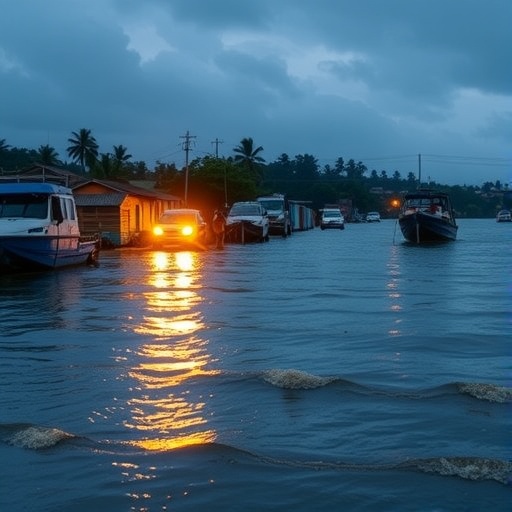
Along Ghana’s eastern coastline, where the Gulf of Guinea presses relentlessly against low-lying sandy shores, the sea is steadily dismantling the foundations of communities that have fished these waters for generations. A new qualitative study published in the Journal of Environmental Studies and Sciences offers a granular, community-level account of how recurrent coastal flooding is eroding not just land and homes, but the very assets—natural, physical, financial, human, and social—on which fisherfolk livelihoods depend. The research, conducted by Senanu Kwasi Kutor, Desmond Ofori Oklikah, and Godwin Arku of the Department of Geography and Environment at the University of Western Ontario, is among the first to trace the dynamics of livelihood assets over time in two Ghanaian coastal communities confronting escalating climate hazard exposure.
The study rests on the sustainable livelihoods framework, a conceptual apparatus developed in the late 1990s that decomposes household well-being into five interlocking capital assets. Human capital encompasses skills, health, and labor; social capital captures networks, trust, and reciprocal obligations; natural capital refers to fisheries, land, and coastal ecosystems; physical capital includes boats, nets, housing, and infrastructure; and financial capital covers savings, credit, and income streams. In livelihoods analysis, poverty is understood not simply as a lack of income but as a depletion or imbalance across this asset portfolio, and climate shocks are understood as exogenous forces that can drain one or more capitals simultaneously. By asking fisherfolk to appraise their own assets retrospectively—before flooding became a defining feature of daily life and after—the researchers were able to reconstruct a longitudinal narrative of loss from within the communities themselves.
Methodologically, the investigation employed twenty-five qualitative in-depth interviews with fisherfolk in the two case study communities, both situated on Ghana’s vulnerable southeastern coast, a stretch of shoreline repeatedly battered by tidal waves and sea encroachment. The interview protocol probed how participants perceived and experienced changes in each of the five livelihood capitals, with thematic analysis used to identify patterns across accounts. Snowball sampling was used to reach participants embedded in close-knit fishing networks, and the researchers attended carefully to positionality, reflexivity, and the ethical sensitivities of working in communities where livelihood insecurity is a lived and often painful reality. This approach trades the statistical breadth of household surveys for interpretive depth, capturing nuances—such as the shifting meaning of kinship obligations during a disaster—that quantitative indices of livelihood vulnerability often miss.
The findings paint a consistent picture of asset deterioration. Before recurrent coastal flooding became a major hazard, participants in both communities appraised their livelihood assets positively, describing functional fishing gear, secure homes, reliable access to fishing grounds, and social arrangements that buffered households against ordinary shocks. With the intensification of flooding in recent years, however, participants reported marked decline across nearly every asset category. Boats and nets are damaged or destroyed by storm surges; homes built decades ago crumble as the sea undermines their foundations; savings are consumed by rebuilding rather than reinvestment; and the physical erosion of landing beaches and coastal land shrinks the natural resource base on which fishing depends. Health and educational investments—core components of human capital—are deferred as households divert resources to immediate survival.
Strikingly, one asset defied this pattern: social capital. While fisherfolk reported erosion of natural, physical, financial, and human capitals, their social networks did not merely persist but, in the researchers’ interpretation, emerged as the residual cushion absorbing repeated shocks. Communal labor, kin-based sharing of catch, and mutual assistance during displacement events continued to bind communities together even as material assets vanished. This resilience of social capital carries a double meaning. It testifies to the strength of communal institutions in Ghanaian fishing societies, but it also signals danger: when social capital becomes the last line of defense, repeated withdrawals from that reserve—neighboring households endlessly absorbing one another’s losses—risk exhausting the very networks that hold communities together. Previous research on coastal Bangladesh and elsewhere has warned that the collapse of livelihoods under environmental stress can push people toward desperate coping strategies, including illegal activities, underscoring how fragile this final buffer can be.
Ghana’s coastline provides an ideal—and alarming—laboratory for this inquiry. The country’s roughly 550-kilometer shore is among the most rapidly eroding in West Africa, with some stretches retreating several meters per year. Low-lying communities in the Ketu South Municipality and the Keta area of the Volta Region have suffered repeated tidal wave disasters in recent years, with seawater surging hundreds of meters inland, destroying homes, salt-mining operations, and fishing infrastructure. Earlier scholarship has mapped the geophysical vulnerability of Ghana’s coast to sea-level rise, documented the sociodemographic determinants of household exposure in the Volta Delta, and catalogued the multiple environmental and socioeconomic stressors bearing down on small-scale fisheries. What this new study adds is the temporal dimension: an explicit before-and-after accounting of asset trajectories as perceived by the people whose livelihoods are at stake.
The mechanism linking flooding to asset depletion operates through several reinforcing channels. Directly, floodwaters and wave action destroy physical capital and degrade natural capital through saltwater intrusion and shoreline retreat. Indirectly, each flood event triggers a cascade: households liquidate savings or take on debt to repair damage, which drains financial capital; children may be withdrawn from school and adults from productive work to assist with recovery, eroding human capital; and declining catches—compounded by climate-driven changes in fish stocks—reduce the income stream needed to replenish any of these reserves. Because livelihood assets are fungible and interdependent, a shock to one capital propagates through the portfolio, producing a spiral in which each successive flood inflicts disproportionate damage on an already weakened household economy. This dynamic helps explain why communities that once recovered from occasional marine incursions now experience each event as a step down an irreversible gradient of impoverishment.
The authors argue that the policy response must match the multidimensional character of the problem. Seawalls, the conventional engineering answer that Ghana has pursued in vulnerable towns such as Keta, have drawn criticism for their cost, their tendency to displace erosion down-drift, and their failure to address the livelihood dimensions of coastal risk. Instead, the researchers recommend nature-based solutions, most prominently mangrove restoration. Mangroves attenuate wave energy, trap sediment, stabilize shorelines, and sequester carbon at rates that rival tropical forests, while simultaneously providing nursery habitat for fish and material resources for coastal households—an intervention that rebuilds natural capital even as it shields physical and financial assets. International evidence from the Caribbean and the Pacific supports the role of sustainably managed mangrove systems in reducing community vulnerability to coastal hazards.
Complementing ecosystem restoration, the study calls for welfare insurance schemes tailored to fishing communities. Index-based or subsidized micro-insurance could prevent households from having to liquidate productive assets after each flood, breaking the depletion spiral at its financial link. The authors frame this as a form of social protection analogous to the safety-net programs pioneered in Indian fisheries decades ago, updated for an era of accelerating climate hazards. Other policy options they gesture toward include investments in early-warning systems, climate-resilient housing, and livelihood diversification that reduces dependence on a single, increasingly hazardous resource. The underlying principle is that adaptation policy should target the asset portfolio as a whole rather than any single capital in isolation.
The study also identifies critical gaps in what is known. Qualitative work of this kind, while rich in interpretive detail, is limited to two communities and twenty-five voices; the authors frame their contribution as mapping what we know, what we do not know, and what we need to know about flooding and livelihood asset dynamics. Outstanding questions include the quantitative magnitudes of asset loss across hazard events, the thresholds at which social capital begins to fray under repeated strain, the differential experiences of women and other subgroups within fishing communities, and the long-term effectiveness of mangrove restoration under projected rates of sea-level rise along the Ghanaian coast. Answering these questions will require combining the kind of participatory, longitudinal qualitative research exemplified here with remote sensing of shoreline change and panel surveys of household asset holdings.
For now, the message from Ghana’s eroding coast is unambiguous. Climate hazards are not merely damaging infrastructure; they are systematically dismantling the asset base of coastal livelihoods, leaving social bonds as the final, straining safety net. Whether the communities of the Volta coastline retain a viable future may depend on how quickly policy can rebuild natural buffers and financial protections before that last reserve is spent.
Cite Scienmag News
Sloane Callahan. (September 4, 2026). Flood impacts on livelihood assets in Ghanaian coastal communities: current knowledge and gaps. Scienmag. https://scienmag.com/flood-impacts-on-livelihood-assets-in-ghanaian-coastal-communities-current-knowledge-and-gaps/
Sloane Callahan. "Flood impacts on livelihood assets in Ghanaian coastal communities: current knowledge and gaps." Scienmag, 4 September 2026, https://scienmag.com/flood-impacts-on-livelihood-assets-in-ghanaian-coastal-communities-current-knowledge-and-gaps/. Accessed 4 September 2026.
Sloane Callahan. "Flood impacts on livelihood assets in Ghanaian coastal communities: current knowledge and gaps." Scienmag. September 4, 2026. https://scienmag.com/flood-impacts-on-livelihood-assets-in-ghanaian-coastal-communities-current-knowledge-and-gaps/


