


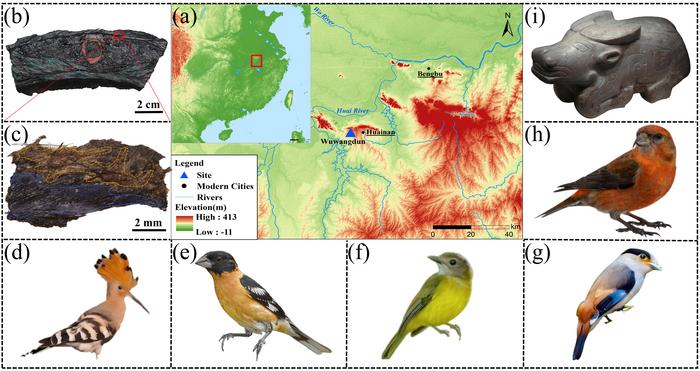
In a groundbreaking study that bridges archaeology, proteomics, and ancient cultural heritage, researchers have unlocked the biological secrets behind feather decorations discovered in one of China’s most significant royal mausoleums. The Wuwangdun site, located in Huainan, Anhui Province, houses Tomb No. 1, a royal burial site dating back to the late Warring States period (late 3rd century BCE). Within this tomb, multifaceted feather decorations have been unearthed, shedding new light on ancient Chinese rituals, social hierarchy, and craftsmanship, while also providing unprecedented insights into the spiritual world of the Chu elite.
Feathers have long been recognized as potent symbols in numerous ancient civilizations, but physical evidence of their use in burial contexts has been exceedingly scarce. The organic composition of feathers, primarily keratin, makes them prone to rapid degradation in burial environments. This vulnerability has left significant gaps in the archaeological record concerning the species origins of feathers and the methods employed in their preservation and attachment. This study overcomes such challenges by deploying advanced proteomic techniques to decode the very makeup of the feathers and adhesives used in the decoration unearthed from Tomb No. 1.
By applying matrix-assisted laser desorption/ionization time-of-flight mass spectrometry (MALDI-TOF-MS) and liquid chromatography-tandem mass spectrometry (LC-MS/MS), the international research team identified the β-keratin proteins characteristic of feathers, correlating these profiles with those of specific bird species. Their results demonstrated that the feathers composing the decorative piece originated from a diverse avian assemblage, imprinting a rich tapestry of ecological and symbolic significance. The five bird species identified include the hoopoe, black-headed grosbeak, yellow-bellied whistler, silver-breasted broadbill, and common crossbill.
Among these, the presence of the hoopoe is especially remarkable. Across ancient texts and historical records in China, the hoopoe is heralded as an emblem of good fortune and a spiritual guide for souls navigating passage to the afterlife. This bird’s symbolic connotations are not confined to East Asia; civilizations spanning ancient Egypt and Persia also revered the hoopoe for its mystical associations. The inclusion of hoopoe feathers in the tomb’s decoration suggests a cross-cultural dimension to the Chu elite’s spiritual beliefs, hinting at a sophisticated worldview that integrated symbolic fauna into ritual attire and objects.
Beyond the feathers themselves, the study also addressed an integral question: the nature and provenance of the adhesive particle binding the feathers in place. Through meticulous proteomic analyses, the researchers isolated and identified collagen peptides indicative of animal glue. Intriguingly, through comparative proteomic studies conducted on a well-documented type specimen—a short-horned water buffalo skeleton from the Yinxu site dating to approximately 1300–1046 BCE—they were able to assign the adhesive’s animal origin precisely to the short-horned water buffalo (Bubalus antiquus).
This precise taxonomic identification was enabled by detecting amino acid sequence variants across different water buffalo species, including river buffalo, swamp buffalo, and the extinct short-horned water buffalo. The ability to differentiate species-specific peptides in ancient collagen paints a new methodological frontier in identifying animal-derived archaeological adhesives, advancing capabilities far beyond morphological assessments. This state-of-the-art proteomic approach establishes solid criteria for tracing species origins with high confidence, thereby also opening new avenues for investigating the domestication, trade, and extinction dynamics of water buffalo populations in ancient China.
The combination of feather β-keratin identification and glue proteomics marks an interdisciplinary milestone in archaeology and molecular biology. It directly addresses an enduring question: How were such delicate, organic materials preserved and utilized in ancient ceremonial contexts? The findings uncover that these elaborate feathered decorations were not crafted from a single bird species but from a carefully curated set of avifauna, each laden with symbolic meaning and cultural resonance. By reassembling the biological makeup of these objects, the research reconstructs aspects of ancient craftsmen’s selection criteria for materials based on both aesthetic and spiritual functions.
The discovery also enriches our understanding of the ritual functions of feather decorations in Chu society. Ancient Chinese records document that feathers were employed as ritual markers, symbols of identity, and visuals denoting aristocratic status. Furthermore, folklore and textual traditions expressed beliefs in “ascension to immortality as feathered beings,” portraying feathers as conduits between the human and spiritual realms. The intricate use of feathers in burial artifacts underlines their crucial role in shamanistic practices and the broader spectrum of spiritual life among the Chu ruling class.
From the perspective of material culture studies, the identification of animal glue derived specifically from the short-horned water buffalo underscores an advanced knowledge of adhesive technologies in antiquity. Water buffaloes were vital livestock, contributing not only to agriculture but evidently to elite craft production. The short-horned water buffalo, now extinct, played a unique role in this historical ecosystem. The techniques developed by this research team to differentiate buffalo species through proteomic criteria carry important implications for paleozoology, domestication studies, and understanding regional biodiversity changes.
Another compelling dimension revealed by this investigation is the lifespan and trade networks surrounding these exotic feathers and animal-based adhesives. The presence of birds such as the silver-breasted broadbill and yellow-bellied whistler suggests an extensive ecological range or complex procurement channels that spanned different habitats. Analysis of the adhesive further hints at selective sourcing of animal proteins widely valued for their binding properties. Together, these findings indicate that the creation of these decorations was a meticulous, knowledge-intensive process interconnected with rulership and status display.
This work simultaneously enhances archaeological methodology and deepens the historical narrative. By employing cutting-edge proteomic techniques, researchers have provided a molecular window into materials typically lost to time. Such an approach offers a replicable model for future investigations into fragile archaeological artifacts composed of organic materials, regularly overlooked due to preservation constraints. The pinpointing of species origins enables a richer reconstruction of cultural practices and economic exchanges in ancient societies.
The multidisciplinary collaboration exemplified in this study, combining archaeology, proteomics, zoology, and historical contextualization, vividly illustrates the potential for modern science to illuminate ancient human behaviors. Unlocking the molecular data embedded within feather remnants and animal adhesives is more than a technical feat—it is a resurrection of long-silenced narratives concerning identity, spirituality, and technological innovation among the elites of the Chu state.
In conclusion, the proteomic identification of multi-species feather decorations combined with the precise determination of water buffalo-derived animal adhesive crafts a new chapter in our understanding of ancient Chinese burial customs. It opens paths to empirically investigate spiritual iconography through biomolecular remains, reconstruct ritual economies, and clarify the role of now-extinct fauna within the human cultural milieu. This research not only fills a longstanding gap in archaeological science but also highlights the intricate relationships between humans, animals, and symbolic expression across millennia.
Through the lens of this study, we witness a remarkable intersection of life sciences and humanities, where the microscopic traces of proteins deliver macroscopic insights into royal mortuary traditions, ecological diversity, and technological prowess of ancient civilizations. As analytical technologies continue evolving, their application promises to uncover even deeper strata of human history encoded within the delicate materials that past generations fashioned with intention and reverence.
News Publication Date: (Information not provided)
Web References: https://www.eurekalert.org/multimedia/1130068
References: Science Bulletin, DOI: 10.1016/j.scib.2026.04.036
Cite Scienmag News
Courtney Benton. (May 11, 2026). Ancient Water Buffalo and Birds Linked Through Feather Proteins: Insights from Paleoproteomics. Scienmag. https://scienmag.com/ancient-water-buffalo-and-birds-linked-through-feather-proteins-insights-from-paleoproteomics/
Courtney Benton. "Ancient Water Buffalo and Birds Linked Through Feather Proteins: Insights from Paleoproteomics." Scienmag, 11 May 2026, https://scienmag.com/ancient-water-buffalo-and-birds-linked-through-feather-proteins-insights-from-paleoproteomics/. Accessed 3 September 2026.
Courtney Benton. "Ancient Water Buffalo and Birds Linked Through Feather Proteins: Insights from Paleoproteomics." Scienmag. May 11, 2026. https://scienmag.com/ancient-water-buffalo-and-birds-linked-through-feather-proteins-insights-from-paleoproteomics/


