


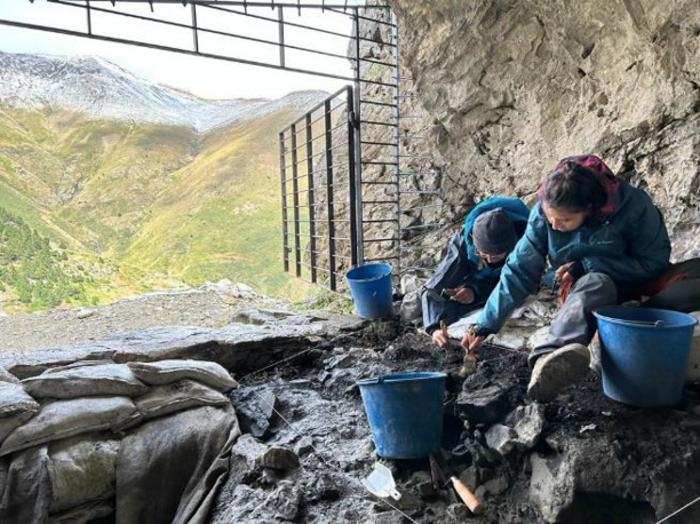
At an extraordinary altitude of 2,235 meters above sea level in the Núria Valley of the Pyrenees, archaeologists have uncovered Cova 338, a prehistoric cave whose archaeological findings are reshaping our understanding of human activity in high-mountain environments. This site, distinguished as the highest-altitude prehistoric cave in the Pyrenees exhibiting evidence of intense human occupation, challenges longstanding perceptions that such elevated terrains were merely marginal zones occupied sporadically by prehistoric communities. The extensive artifacts and stratified deposits unearthed here reveal a complex and recurrent pattern of human use dating from the 5th millennium BCE through the end of the 1st millennium BCE.
This monumental discovery is the outcome of a collaborative international research effort spearheaded by the Universitat Autònoma de Barcelona (UAB) and the Institut Català de Paleoecologia Humana i Evolució Social (IPHES-CERCA), alongside contributions from multiple European institutions. Employing sophisticated archaeological methodologies such as 3D spatial recording, systematic sediment sampling, and flotation techniques, the team meticulously documented and analyzed every material fragment, thereby reconstructing a high-resolution narrative of prehistoric life at these altitudes. The site’s deposits showcase not only anthropogenic combustion structures and faunal remains but also a significant assemblage of green copper-rich minerals, likely malachite, indicative of systematic mineral exploitation.
These findings decisively overturn the traditional paradigm that viewed high-altitude mountainous regions as negligible or marginal in prehistoric subsistence and settlement strategies. Instead, Cova 338 reveals a logistical node embedded within a well-structured seasonal mobility framework. Human groups recurrently returned to this cave, engaging in organized activities involving both resource extraction and symbolic behavior. The presence of personal ornaments—specifically two pendants crafted from a marine shell of the genus Glycimeris and a brown bear tooth—emphasizes the cultural and possibly ritualistic dimensions of occupancy, underscoring the symbolic significance attributed to this remote alpine locale.
The mineralogical evidence points to an early and sustained engagement with copper-rich ores, positioning Cova 338 as one of the earliest documented sites of high-mountain metallurgical resource exploitation in Western Europe. The deliberate transportation of malachite fragments into the cave followed by onsite processing gestures towards an intricate knowledge of mineral resources and metallurgical practices during the Late Neolithic and Bronze Age. This challenges preexisting notions that such advanced resource exploitation occurred predominantly in lowland areas, broadening our comprehension of prehistoric technological adaptations to alpine ecologies.
From a spatial perspective, the cave’s internal organization reveals differentiated zones that may correspond to specific functional areas: hearths for controlled combustion, loci for ornament creation, and mineral processing spots. This spatial differentiation underscores a degree of social complexity and forward planning in site usage, illustrating a sophisticated integration of environmental knowledge with subsistence and cultural practices. Excavations highlighted a pattern of intermittent yet intensive occupation phases, implying that these mountain landscapes were not barriers but integral components of broader prehistoric territorial networks.
Conducting archaeological work under such extreme environmental conditions presented formidable logistical challenges. Cova 338 is accessible solely on foot, with strict prohibitions on motorized transport, necessitating manual handling of all excavation equipment, sediments, and recovered materials. The commitment to scientific rigor under these constraints required innovative field methodologies ensuring maximal data recovery while preserving the fragile high-altitude context. This approach enhances the reliability and resolution of paleoenvironmental and anthropological inferences attainable from the site.
The implications of this research resonate beyond regional archaeology, prompting a reevaluation of prehistoric mobility and resource utilization strategies across high mountain zones in Europe. The evidence from Cova 338 expands the archaeological narrative to encompass alpine settings as dynamic spaces of human innovation and cultural complexity rather than marginal frontiers. It opens avenues for interdisciplinary studies integrating geoarchaeology, mineralogy, and symbolic anthropology to decipher the multifaceted roles these environments played in sustaining prehistoric populations.
The meticulous excavation and subsequent analyses were undertaken within the framework of the ARRELS project, a comprehensive initiative funded by the Catalan government dedicated to exploring prehistoric transhumance and mobility in the Upper Ripollès area. The collaboration between academic institutions and local governmental bodies, including the Queralbs Town Council and the Ter and Freser Headwaters Natural Park, facilitated fieldwork and ensured that this sensitive archaeological heritage is conserved for ongoing and future scientific scrutiny.
Furthermore, this research underscores how the use of advanced scientific protocols, coupled with a cooperative institutional model, can push the boundaries of what is achievable in high-mountain archaeology, traditionally hampered by accessibility and preservation challenges. By integrating sedimentological analyses with artifact spatial mapping and organic residue examinations, the project unravels the complexity of prehistoric lifeways in environments that test human endurance and ingenuity.
The discovery of Cova 338 enriches our understanding of human adaptability and resilience, highlighting how early communities developed not only survival strategies but also intricate socio-economic systems in seemingly inhospitable settings. This site stands as a testament to humanity’s capacity to integrate ecological niches previously underestimated, redefining high mountain landscapes as active theaters of prehistoric cultural evolution and technological advancement.
Looking forward, the findings at Cova 338 serve as a catalyst for renewed archaeological interest in alpine regions globally. They encourage refined investigative techniques and multidisciplinary approaches aimed at uncovering similarly overlooked prehistoric highland occupations. Such endeavors promise to enhance our grasp of the spatial distribution of early metallurgical activities and their socio-economic contexts, illuminating pathways of human interaction with extreme environments.
In summary, Cova 338 exemplifies a paradigm shift in understanding prehistoric human activity in the Pyrenees, revealing a landscape of dynamic occupation, mineral exploitation, and symbolic expression at altitudes once considered too forbidding for sustained human engagement. This revelation not only reconstructs aspects of regional prehistory with unprecedented clarity but also enriches the broader discourse on human-environment interactions in challenging terrains during prehistory.
Web References:
https://www.eurekalert.org/multimedia/1128623
https://mediasvc.eurekalert.org/Api/v1/Multimedia/79ef87b8-1f4c-46e6-b17c-cf76ce0cfb04/Rendition/low-res/Content/Public
Cite Scienmag News
Courtney Benton. (May 5, 2026). Cova 338 Sheds New Light on Pyrenean Prehistory at Altitudes Above 2,000 Meters. Scienmag. https://scienmag.com/cova-338-sheds-new-light-on-pyrenean-prehistory-at-altitudes-above-2000-meters/
Courtney Benton. "Cova 338 Sheds New Light on Pyrenean Prehistory at Altitudes Above 2,000 Meters." Scienmag, 5 May 2026, https://scienmag.com/cova-338-sheds-new-light-on-pyrenean-prehistory-at-altitudes-above-2000-meters/. Accessed 3 September 2026.
Courtney Benton. "Cova 338 Sheds New Light on Pyrenean Prehistory at Altitudes Above 2,000 Meters." Scienmag. May 5, 2026. https://scienmag.com/cova-338-sheds-new-light-on-pyrenean-prehistory-at-altitudes-above-2000-meters/


