


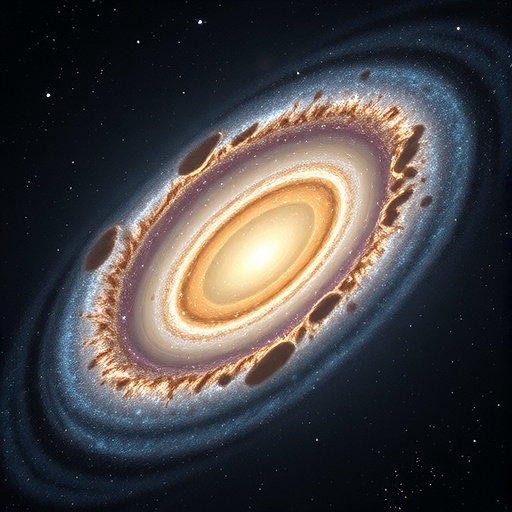
In the vast landscape of our contemporary Universe, galaxies predominantly showcase a dynamic interplay of ordered rotational motion, elegantly swirling around their centers. This rotational support is a signature feature of many galaxies, especially those that actively form new stars. Yet, within this cosmic ballet, there exists a distinct class of galaxies that defy this norm — massive, quiescent systems dominated not by rotation but by random, chaotic motions of their stars. These peculiar cosmic entities, known as slow rotators, have long intrigued astronomers due to their enigmatic origins and dramatic departure from the expected galactic dynamics.
Slow rotators are typically found among the heaviest galaxies, often characterized by their lack of new star formation and an absence of disk-like structures. The prevailing understanding posits that these galaxies undergo transformative processes that strip away angular momentum, effectively quenching their star-forming activity and morphing them into spheroidal or elliptical shapes governed by random stellar motions. The critical question that has lingered in the astronomical community is when in the cosmic timeline this transformation begins and the mechanisms that drive it. Traditional models suggest slow rotators should be exceptionally rare in the early Universe, primarily because young galaxies then were actively rotating and forming stars.
Recent advancements in observational astronomy, particularly through the James Webb Space Telescope (JWST), have opened unprecedented windows into the distant past, allowing scientists to peer back over 12 billion years to witness galaxies as they appeared when the Universe was in its infancy. Utilizing JWST’s near-infrared integral-field spectroscopy capabilities, a team of astronomers recently unveiled a groundbreaking discovery: the massive, quiescent galaxy XMM-VID1-2075, residing at a redshift of 3.449. This places the galaxy at a mere 1.8 billion years after the Big Bang, a period long considered too early for slow-rotating galaxies to exist.
The detailed spectroscopic observations of XMM-VID1-2075 revealed intriguing properties that challenge previous assumptions. The galaxy exhibits disturbed, low-surface-brightness features — subtle, extended structures indicative of past interactions or mergers, hinting at an active and tumultuous formation history. Most strikingly, the kinematic analysis shows a low stellar spin parameter, denoted as λ_Re = 0.123 with asymmetric uncertainties, a quantifiable measure that firmly places this galaxy in the category of slow rotators. Unlike its rotationally supported counterparts, XMM-VID1-2075’s stellar motions are dominated by dispersion, or random velocities, suggesting a dynamically hot system with little coherent rotation.
This finding is monumental because it provides concrete evidence that the processes leading to the formation of slow-rotating, massive galaxies were already underway in the early Universe, well before the commonly accepted epochs. It implies that these galaxies achieved both their substantial mass and their dynamical state — dominated by random stellar motion rather than rotation — in less than two billion years after cosmic dawn. Such rapid maturation challenges existing models of galaxy evolution, which typically rely on protracted, quiescent phases or multiple merger events distributed over longer timescales to explain the rise of slow rotators.
The genesis of slow rotators has often been associated with major dry mergers, where two similarly massive galaxies collide without significant gas content, effectively randomizing stellar orbits and destroying rotational disks. However, the complexity observed in XMM-VID1-2075’s morphology and kinematics suggests that alternative or additional mechanisms might be involved. One possibility is that early, intense environmental interactions or rapid accretion episodes could strip galaxies of their angular momentum and trigger the swift cessation of star formation, producing dispersion-dominated stellar systems at surprisingly high redshifts.
Moreover, this discovery has profound implications for understanding the interplay between galaxy dynamics and their surrounding dark matter halos. Slow rotators tend to inhabit dense environments where gravitational interactions are frequent, contributing to their chaotic stellar motions. The identification of such a galaxy at z=3.449 demands a reevaluation of how dark matter structures assembled and influenced the baryonic component to produce massive, quiescent galaxies so swiftly in the infancy of cosmic time.
The methodological breakthrough enabling this discovery lies predominantly in JWST’s unmatched sensitivity in the near-infrared regime, coupled with integral-field unit (IFU) spectroscopy. This technique provides a three-dimensional view of galaxies, capturing spectra across spatially resolved regions, thereby enabling detailed maps of stellar velocities and dispersions. Without JWST’s capabilities, probing the internal kinematics of such distant, faint galaxies would remain infeasible, underscoring the telescope’s transformative role in extragalactic astronomy.
From a cosmological perspective, observing slow rotators at these early epochs also enriches our understanding of star formation quenching — the process by which galaxies cease creating new stars. The quiescent nature of XMM-VID1-2075 asserts that efficient quenching mechanisms were rapidly operational, potentially involving powerful feedback from active galactic nuclei or environmental effects that halted star formation and preserved the galaxy in its evolved state.
Importantly, this discovery sets a new benchmark for theoretical models of galaxy evolution, which must now accommodate the existence of massive, dispersion-supported galaxies at z > 3. Computational simulations will need to incorporate processes capable of expeditious buildup and dynamical transformation of galaxies within just a few hundred million years. This recalibration could lead to deeper insights into the physics governing angular momentum loss, feedback processes, and merger histories in the young Universe.
The ramifications extend beyond galaxy dynamics to the broader narrative of cosmic structure formation. Given that slow rotators often dominate the cores of galaxy clusters in the local Universe, tracing their progenitors to such high redshifts informs the timeline of cluster assembly and the environmental evolution of galaxies. It suggests that the seeds of today’s massive elliptical galaxies were sown at remarkably early times, evolving through an intricate interplay of cosmological and astrophysical forces.
Intriguingly, the disturbed features observed hint at a violent past that may have included multiple minor mergers or gravitational interactions, which can cumulatively disrupt disk-like structures and drive the system into a slow-rotating state. This complex assembly history, revealed in a single snapshot through JWST’s lens, opens avenues for statistically assessing how common such early slow rotators might be and what specific pathways dominate their formation.
As JWST continues to survey the distant Universe with unprecedented depth and detail, more examples like XMM-VID1-2075 are expected to emerge, potentially revolutionizing our grasp of galactic morphologies, dynamics, and histories in a formative cosmic epoch. These observations invite a rethinking of the conventional wisdom around galaxy evolution, emphasizing that the diversity of galaxy types observed today had already begun shaping just a few billion years after the Big Bang.
Furthermore, the discovery underlines the essential synergy between cutting-edge observational platforms and theoretical efforts in astrophysics. It exemplifies how pushing technological boundaries fosters paradigm-shifting science, transforming abstract models into concrete empirical realities. The characterization of XMM-VID1-2075 not only fills a critical gap in our cosmic timeline but also lays foundational knowledge for unraveling the complex tapestry of galaxy formation and evolution.
In conclusion, the unveiling of a massive, evolved slow-rotating galaxy at such a high redshift marks a pivotal moment in astrophysics. It challenges existing frameworks, fuels new hypotheses, and expands the frontier of cosmic exploration. As we continue to probe deeper into the Universe’s past, findings like these will illuminate the pathways through which the grandest cosmic structures emerged from the primordial darkness, shaping the Universe as we perceive it today.
Cite Scienmag News
Grant Pearson. (May 4, 2026). Massive Slow-Rotating Galaxy Discovered in Early Universe. Scienmag. https://scienmag.com/massive-slow-rotating-galaxy-discovered-in-early-universe/
Grant Pearson. "Massive Slow-Rotating Galaxy Discovered in Early Universe." Scienmag, 4 May 2026, https://scienmag.com/massive-slow-rotating-galaxy-discovered-in-early-universe/. Accessed 5 September 2026.
Grant Pearson. "Massive Slow-Rotating Galaxy Discovered in Early Universe." Scienmag. May 4, 2026. https://scienmag.com/massive-slow-rotating-galaxy-discovered-in-early-universe/


