


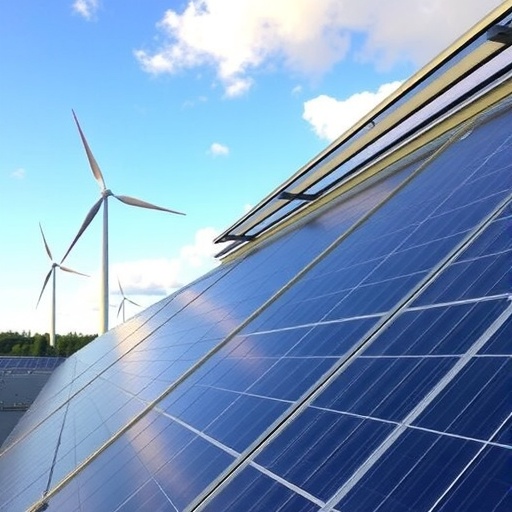
A groundbreaking peer-reviewed study published in Communications Sustainability on May 4, 2026, delivers a critical reassessment of direct air capture (DAC) technology by contrasting its effectiveness against renewable energy investments such as solar and wind power. The comprehensive analysis reveals that under nearly all conditions across the United States and projected through 2050, the climate and public health benefits derived from investing an equivalent amount of money in wind or solar energy substantially surpass those yielded by direct air capture, even when catalytic technological advances in DAC are assumed.
This investigation diverges sharply from prior studies that traditionally evaluated DAC based on whether the technology could remove more carbon dioxide from the atmosphere than it produces during operation or if its cost per metric ton of CO₂ mitigates emissions at or below the social cost of carbon. These older benchmarks offered an implicit comparison solely with inaction, thereby granting DAC a relatively lenient standard. The current study, conducted by PSE Healthy Energy in collaboration with Boston University School of Public Health and Harvard T.H. Chan School of Public Health, elevates the comparison bar by pitting DAC head-to-head with renewable energy deployment possibilities achievable with the same capital expenditure. This reframing offers a more stringent and policy-relevant criterion to guide future investments in emission reduction technologies.
At the core of the analysis lies a sophisticated computational simulation that models the health and climate impacts of deploying cost-equivalent DAC facilities, utility-scale solar arrays, and onshore wind farms across 22 distinct U.S. electricity grid regions from 2020 to 2050. The researchers examined four distinct DAC performance scenarios: today’s current commercial baseline, characterized by an energy intensity of approximately 5,500 kilowatt-hours and a capture cost near $1,000 per ton of CO₂; an optimistic “ambitious progress” projection where energy consumption dips below 1,500 kilowatt-hours and costs are halved to $500 per ton; a visionary “breakthrough” scenario envisioning revolutionary improvements with only 800 kilowatt-hours per ton captured at $100 cost; and intermediate scenarios. These hypothetical progressions encapsulate the range of plausible technological development in DAC efficacy and economics.
Strikingly, even under the ambitious progress case, the model shows that investing in wind and solar consistently delivers multiples of the combined climate and public health gains per dollar compared to DAC on a national scale. Only within the most transformative breakthrough scenario does DAC surpass renewables in overall benefit. Yet, even here, wind and solar continue to outperform DAC across large swaths of the country, particularly in many states across the Upper Midwest. Alarmingly, under current commercial metrics, DAC facilities connected to existing grids would paradoxically emit more greenhouse gases and air pollutants by 2050 than the amount they successfully remove, indicating a net negative environmental impact.
This paradox arises because DAC’s energy-intensive processes, if powered by fossil-fuel-dependent electricity grids, amplify emissions of sulfur dioxide (SO₂), nitrogen oxides (NOₓ), and fine particulate matter (PM2.5). These pollutants disproportionately burden communities situated near electricity generation plants, exacerbating local health risks. Renewable energy deployments, in contrast, consistently reduce both greenhouse gases and harmful air pollutants regionally and nationally across all modeled scenarios. Thus, the analysis interweaves carbon accounting with rigorous evaluation of public health outcomes, painting a holistic picture that transcends conventional greenhouse gas metrics.
Lead author and Air Quality Scientist Dr. Yannai Kashtan emphasizes that carbon negativity alone is not sufficient rationale for deploying DAC technology as a climate mitigation strategy. The study urges policymakers and investors to employ opportunity cost assessments weighing DAC against renewable investments to maximize both climate and health returns. “If your sink is overflowing, turn off the tap before you begin mopping the floor,” Kashtan analogizes, underscoring the primacy of aggressively reducing emissions before deploying costly carbon removal technologies that carry ancillary environmental costs.
Boston University’s senior environmental health researcher and co-author, Dr. Jonathan J. Buonocore, highlights the broader implications this work has for climate finance and mitigation planning. He asserts that adopting cost-effectiveness analysis rooted in combined climate and health benefits ensures funding prioritization achieves the greatest “bang for the buck” while minimizing unintended pollution side effects. As jurisdictions worldwide commit to ambitious decarbonization targets, this fresh evidence calls for recalibrating strategic emphasis toward readily scalable, low-impact renewable infrastructure.
While the study does not dismiss the future utility of DAC, particularly for addressing residual legacy CO₂ concentrations once direct emissions are curtailed, it cautions that premature or overly optimistic deployment risks significant capital misallocation and detrimental public health externalities. As such, the authors urge that DAC deployment thresholds be established based on opportunity-cost considerations, which imposes a far more rigorous test than prior carbon-neutrality or cost-parity evaluations.
Funded by the ClimateWorks Foundation, the research offers a timely and nuanced reevaluation of DAC’s role within U.S. climate policy frameworks. It integrates advanced environmental modeling with public health impact metrics to provide policymakers with actionable intelligence amid an evolving landscape of decarbonization technologies. The results also spotlight the importance of electricity grid decarbonization as a prerequisite for maximizing the environmental benefits of emerging negative-emission technologies.
This paradigm-shifting work informs ongoing debates around optimal pathways to net-zero emissions, spotlighting the comparative advantages of direct renewable energy deployment over nascent carbon removal schemes. The study’s emphasis on the intertwined nature of climate mitigation and public health outcomes sets a new standard for assessing technological interventions addressing global climate challenges.
By rigorously incorporating regional energy mix nuances and projecting cost trajectories under multiple future scenarios, the analysis embraces the complexity of U.S. energy systems and temporal dynamics, rendering its conclusions particularly robust for strategic long-term planning. As governments and investors weigh the merits of competing climate solutions, this evidence positions renewables—not DAC—as the frontrunner for cost-effective, near-term climate and health gains.
Ultimately, this research challenges prevailing optimism around DAC’s economic viability and environmental favorability, calling for a recalibration of expectations and incentives. It underscores the imperative of aligning climate investments with technologies that not only reduce greenhouse gas emissions but concurrently enhance public health by lowering co-pollutants—a criterion where renewables demonstrably excel.
News Publication Date: May 4, 2026
Web References: http://dx.doi.org/10.1038/s44458-026-00068-0
References: Kashtan, Y., Michanowicz, D. R., Shonkoff, S. B. C., Pendleton, J., Sousa, B., Willis, M. D., & Buonocore, J. J. (2026). Direct air capture has substantial health and climate opportunity costs. Communications Sustainability. https://doi.org/10.1038/s44458-026-00068-0
Cite Scienmag News
Faith Mcneil. (May 4, 2026). New Study Finds Renewable Energy More Cost-Effective Than Direct Air Capture for Carbon Reduction. Scienmag. https://scienmag.com/new-study-finds-renewable-energy-more-cost-effective-than-direct-air-capture-for-carbon-reduction/
Faith Mcneil. "New Study Finds Renewable Energy More Cost-Effective Than Direct Air Capture for Carbon Reduction." Scienmag, 4 May 2026, https://scienmag.com/new-study-finds-renewable-energy-more-cost-effective-than-direct-air-capture-for-carbon-reduction/. Accessed 3 September 2026.
Faith Mcneil. "New Study Finds Renewable Energy More Cost-Effective Than Direct Air Capture for Carbon Reduction." Scienmag. May 4, 2026. https://scienmag.com/new-study-finds-renewable-energy-more-cost-effective-than-direct-air-capture-for-carbon-reduction/


