


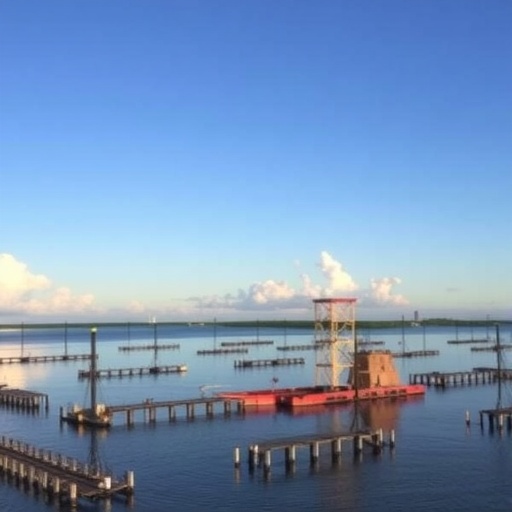
A team of interdisciplinary researchers led by Tulane University has presented a compelling analysis on the climate-driven land loss and demographic shifts occurring in coastal Louisiana, positioning the state as a potential incubator for pioneering climate adaptation strategies globally. Their study, recently published in the distinguished journal Nature Sustainability, sheds light on the accelerated retreat of Louisiana’s coastlines due to climate change, and the resulting population decline, framing these challenges as an opportunity for innovation in climate resilience planning.
This research integrates geological, archaeological, demographic, and policy perspectives to develop a comprehensive understanding of how coastal communities can adapt to the relentless pressures of rising sea levels and intensifying storm surges. Louisiana, with one of the most exposed coastal zones in the world as identified by the Intergovernmental Panel on Climate Change, embodies a critical case study for future climate adaptation. The region experiences some of the highest wetland losses globally, signaling profound environmental transformations.
Unlike global coastal areas that continue to witness population growth despite climate risks, Louisiana illustrates an inverse trend marked by significant depopulation since the year 2000. This decline, accentuated by repeated hurricane impacts, is emblematic of ongoing climate-driven migration patterns. The researchers assert that such demographic shifts are harbingers of what other vulnerable coastal zones might soon encounter, emphasizing the urgency of integrated planning efforts.
A cornerstone of the study’s findings is the identification of an ancient shoreline located about 30 miles north of New Orleans, near Lake Pontchartrain, as uncovered by geoscientist Zhixiong Shen. Dating back roughly 125,000 years—during a period when global temperatures were between 0.5 to 1.5 degrees Celsius above preindustrial levels and sea levels were significantly elevated by 10 to 20 feet—this ancient shoreline helps forecast the potential inland migration of current shorelines under ongoing climate change scenarios.
Lead author Torbjörn Törnqvist underscores the significance of this paleogeographical marker, noting that with global warming nearing 1.5 degrees Celsius above mid-19th century levels and projections quickly approaching or surpassing 2 degrees, the Louisiana coastline is likely already locked into a trajectory of substantial retreat inland. This insight challenges existing perceptions of coastal stability and underscores the immediacy of adaptation needs.
Despite the daunting outlook, the research highlights space for constructive action. State and local governments, along with regional stakeholders including employers and infrastructure developers, are urged to initiate long-term transition planning. Such proactive measures could enable the preservation of economic continuity and facilitate new opportunities in renewable energy, land-building strategies, and innovative housing frameworks tailored to the evolving geography.
The study draws from archaeological records detailing Indigenous populations’ historical resilience, who navigated environmental shifts by relocating within coastal zones. This historical precedent offers a valuable framework for understanding adaptive migration patterns and informs modern strategies for managed relocation, reinforcing the importance of interdisciplinary knowledge in addressing climate challenges.
Co-author Jesse Keenan emphasizes the economic and societal benefits of proactive planning, asserting that Louisiana’s unique geographical and cultural position equips it to become a leader in crafting infrastructure and institutional expertise crucial for future generations facing similar environmental transformations globally. The intersection of climate science, public policy, and social history emerges as a critical nexus for adaptation strategies.
Examining international examples such as Kiruna, Sweden, where a city relocation due to subsurface mining is underway with extensive early planning, the researchers illustrate practical models of managed retreat. This urban renewal initiative, which involves moving approximately 6,000 residents over several decades, serves as a blueprint for Louisiana and other vulnerable regions to emulate in their adaptation planning timelines.
The urgency of reducing global greenhouse gas emissions remains paramount to mitigating future climate impacts. The researchers caution that failing to adhere to the Paris Agreement target of limiting warming to 2 degrees Celsius will exacerbate shoreline retreat and flood risks, threatening low-lying inland areas including southern sections of Baton Rouge. Their assessment underscores the precarious balance between emission trajectories and adaptation efficacy.
Törnqvist points out that current warming trends align more closely with a 3-degree Celsius increase, intensifying both the pace and magnitude of environmental changes in coastal regions. Such projections demand a dual approach that integrates emission reductions with robust, anticipatory adaptation strategies to safeguard vulnerable populations and ecosystems.
The comprehensive nature of the research team—incorporating experts from geology, sociology, archaeology, and environmental sciences—reflects a holistic approach necessary for confronting the complex and multifaceted nature of climate adaptation. This collective expertise is vital for translating scientific insight into actionable policy and resilient community planning, providing a tested pathway forward.
In conclusion, Louisiana’s ongoing environmental transformation offers a sobering yet instructive case study on climate change’s tangible impacts and the critical importance of early, informed adaptation planning. This multidisciplinary investigation not only forecasts challenges but also illuminates pathways for managed retreat, economic reinvention, and sustainable futures in coastal America and beyond.
Cite Scienmag News
Sloane Callahan. (May 4, 2026). Tulane Researchers Highlight Louisiana’s Potential to Lead Global Climate Adaptation Efforts. Scienmag. https://scienmag.com/tulane-researchers-highlight-louisianas-potential-to-lead-global-climate-adaptation-efforts/
Sloane Callahan. "Tulane Researchers Highlight Louisiana’s Potential to Lead Global Climate Adaptation Efforts." Scienmag, 4 May 2026, https://scienmag.com/tulane-researchers-highlight-louisianas-potential-to-lead-global-climate-adaptation-efforts/. Accessed 3 September 2026.
Sloane Callahan. "Tulane Researchers Highlight Louisiana’s Potential to Lead Global Climate Adaptation Efforts." Scienmag. May 4, 2026. https://scienmag.com/tulane-researchers-highlight-louisianas-potential-to-lead-global-climate-adaptation-efforts/


